

Photo by Luca Nardone from Pexels
MARSEILLE, France — Older adults often experience a decline in hearing and vision. Fortunately, that does not apply to the sense of touch. A new study published in Frontiers in Aging Neuroscience has recently found that humans only experience a decline in touch sensitivity in hairless skin. In other words, a person’s hairier regions remain as sensitive to touch as they were decades ago.
“Touch gets worse on the hands with age, but not on our hairy arms and cheeks, of which the cheek is especially sensitive to touch,” says Dr. Jean-Marc Aimonetti, a researcher at the Research Center in Psychology and Neurosciences and one of the report’s corresponding authors, in a media release.
The resilience to a loss of touch sensitivity as someone ages is not all that surprising if you consider human evolution. Humans are wired to be social creatures, making touch an important sense to continue navigating the world and fostering deeper relationships with others.
It’s such an important sensation that researchers note that touch-starved people can start to feel physically ill. When people engage in physical contact, like hugging a relative, the brain releases natural opioids, brain chemicals involved in mood, and the “bonding hormone” oxytocin.
Methodology
Ninety-six left-handed women between 20 and 75 years-old were tested for their touch sensitivity in three areas: the hairless tip of the right index finger, the right forearm, and the right cheek. Both the forearm and cheek are usually covered with a fuzzy layer of hair. Each woman sat in a quiet room with their eyes closed and wearing noise-canceling headphones to minimize distractions.
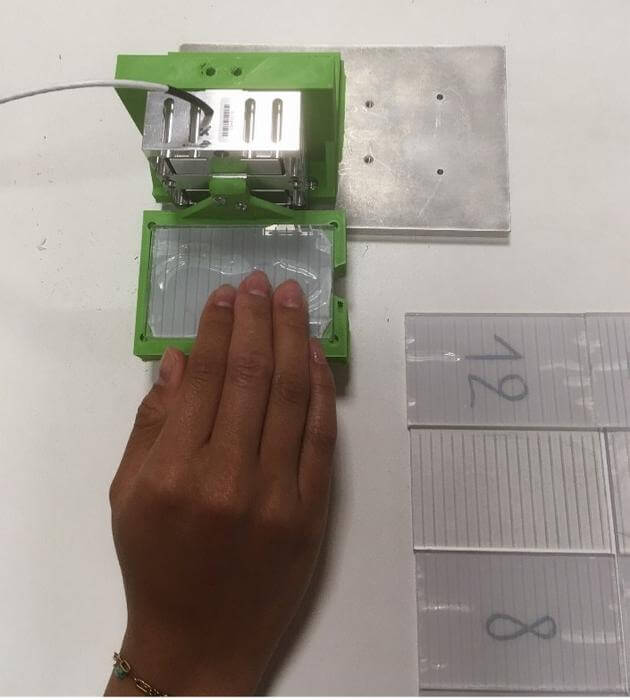
The first experiment involved women blindly moving the tip of their right index finger over 11 plates with differently spaced grooves between 3.6 mm and 6 mm wide. Researchers instructed the women to say whether they felt the grooves were wider or narrower than the reference plate, which was 4.8 mm wide. Each person was tested 132 times, and the team calculated a score for correct attempts.
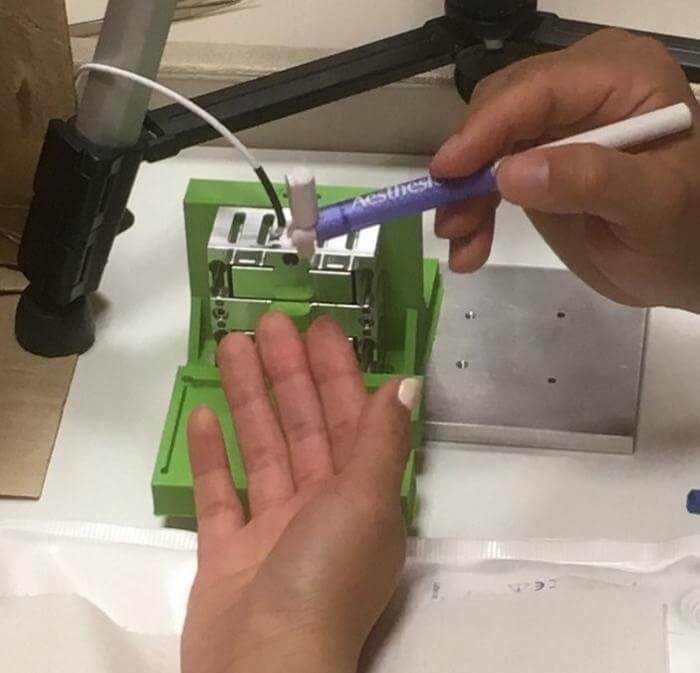
A second experiment involved placing 13 classes of monofilaments on each woman’s skin in a randomized, dose-deescalating pattern. The monofilaments had a calibrated force between 0.08 and 75 millinewtons. Women spoke up when they sensed a touch and the experiment would continue until a person made two errors in a row — a sign the person could no longer detect the stimulus. The test is verified as a way to measure touch sensitivity and is used among people with neuropathy from diabetes.
Key Results
The research team found that older women’s index fingers were less sensitive to touch when grazing their fingers on the differently grooved plate. However, the results showed no loss of touch sensitivity with age when tested on the cheek and forearms.
The 10 youngest women could detect 5.6 millinewtons of monofilaments on the forearm, which was comparable to the touch sensitivity of the 10 oldest women. However, this result was not statistically significant.
The 10 youngest women felt as much as 0.9 millinewtons of monofilament on the cheek, compared to the touch sensitivity of 1.1 millinewtons for the 10 oldest participants.
Discussion & Takeaways
Hairy skin, like the cheeks and forearms, remains sensitive to touch even as one gets older. According to the authors, this finding was surprising as hairless skin contains a lot more mechanoreceptors — specialized neurons that detect pressure and touch — than hairy skin.
One explanation for hairy skin’s continued sensitivity is that it serves an important purpose in human anatomy. In addition to protecting the skin, hair also acts as an antenna to detect when stimuli are nearby.
“Hair is our friend. It protects us from bacteria and tell us which way the wind is blowing. It’s not for nothing that we have hair in the most sensitive areas,” explains Dr. Aimonetti.
You can also increase the level of sensitivity on your skin, even if there is no hair. According to Rochelle Ackerley, the second corresponding author of the study, people need to avoid extreme temperatures and air pollution. Additionally, excessive alcohol consumption, smoking, and sunbathing can damage the skin.


