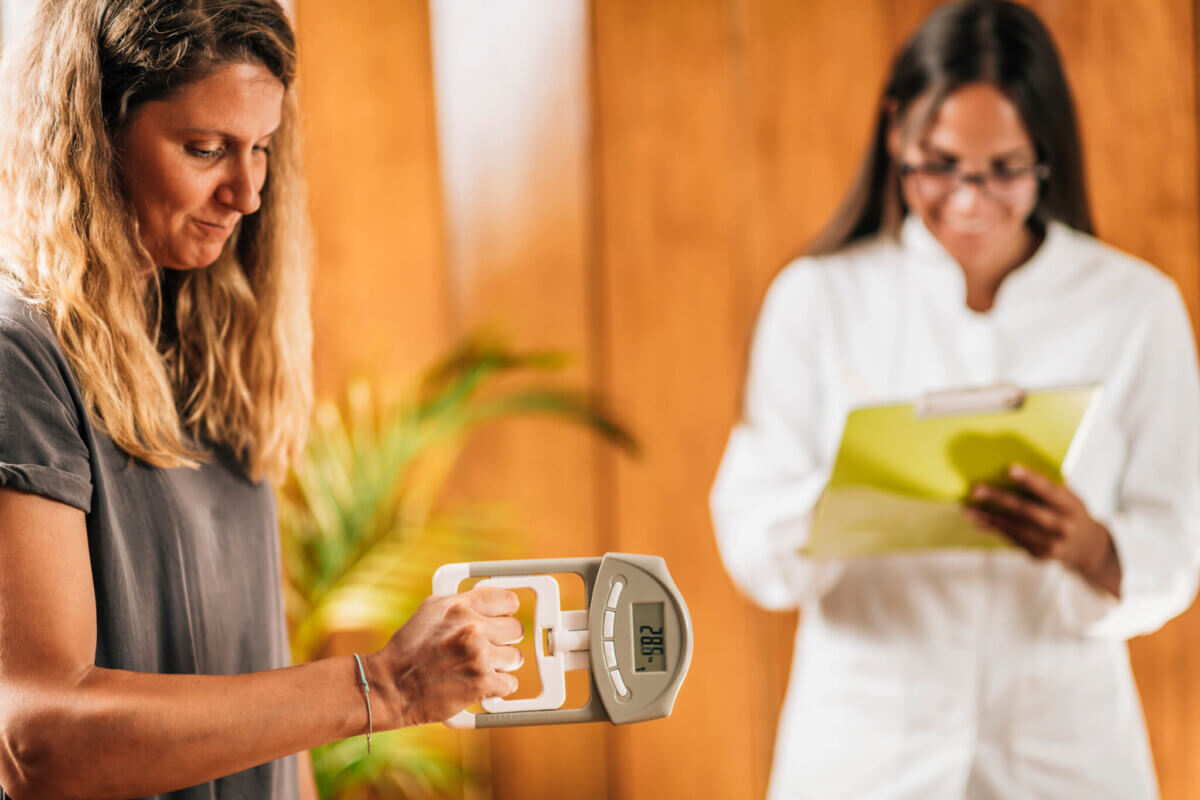
Handgrip strength test with digital hand dynamometer. (© Microgen - stock.adobe.com)
In A Nutshell
- In 93,275 UK adults, stronger midlife grip predicted slower disease progression and lower mortality over 13 years.
- Each 11.6 kg increase in grip is linked to a 14% lower risk of a first health problem and a 13% lower risk of death.
- Approximate protective thresholds appeared near 32 kg, 39 kg, and 47 kg at successive stages.
- Muscle strength tracks with lower inflammation and better metabolic markers long before symptoms.
BATON ROUGE, La. — How hard can you squeeze? That simple measure of strength might forecast whether you’ll stay healthy or face serious health problems as you age.
Researchers tracked 93,275 adults for over 13 years. They found people in their 40s through 60s with stronger handgrips were far less likely to develop obesity-related diseases or die early. This held true even when participants carried excess body fat. The protective effect played out over years. Participants with weak grips at the start faced a cascade of health problems as they aged. Those with stronger hands stayed healthier longer.
Scientists at the Pennington Biomedical Research Center in Louisiana analyzed data from UK Biobank participants who had what researchers call “preclinical obesity.” This means they had elevated body measurements like BMI, waist circumference, and body fat percentage but hadn’t yet developed any of the 18 health problems linked to obesity. These ranged from sleep apnea and high blood pressure to chronic joint pain and diabetes.
Over an average of 13.4 years, the research team tracked who developed these health problems and who died. Each standard increase in grip strength (roughly 11.6 kilograms of squeezing force) lowered the risk of developing a first health problem by 14%. Moving from one problem to multiple issues dropped by 8%. Progressing from multiple problems to death fell by 13%.

Why Grip Strength Is More Than Just Muscle Power
Grip strength has emerged as a powerful health indicator in recent years. Unlike BMI, which simply divides weight by height squared, grip strength offers a window into overall muscle function and metabolic health. Previous studies have linked weak grip to higher rates of diabetes, heart disease, and early death. Most focused on people who already had health problems.
This study examined people at an earlier stage: those carrying excess weight but still functioning normally in middle age. Researchers used body measurements to identify participants. A BMI of 30 or higher for non-Asian participants (28 or higher for Asian participants) plus at least one elevated metric among waist circumference, waist-to-hip ratio, waist-to-height ratio, or body fat percentage. Then they excluded anyone who already had diagnoses like heart failure, diabetes, liver disease, or mobility limitations.
What remained was a snapshot of preclinical obesity, a newly recognized health status defined in January 2025 by a Lancet commission as having excess fat without overt health dysfunction yet. Grip strength was measured using a simple handheld device that participants squeezed with both hands.
Participants ranged from age 40 to 69 at the start of the study, with most in their mid-50s. Most carried extra weight but functioned normally in daily life. Some would stay that way. Others would develop diabetes, heart problems, or joint disease. A portion would die before the study ended.
Grip strength at that starting point turned out to be remarkably telling. When researchers divided participants into three groups by grip strength, the differences became stark over the following decade-plus. Men in the strongest group could squeeze harder than 44 kilograms. The weakest group managed 36.5 kilograms or less. For women, the ranges were 26 kilograms or more versus 20.5 kilograms or less.
Compared to the weakest group, those in the strongest category had a 20% lower risk of developing initial health problems, a 12% lower risk of progressing to multiple issues, and a 23% lower risk of dying after developing multiple conditions.
For someone in middle age, these numbers translate to real differences in health outcomes over the following decade or more. People with stronger grip strength were much more likely to avoid the chronic conditions that eventually limit independence and mobility.
How a Simple Squeeze Test Can Predict Future Health
Rather than simply comparing people who stayed healthy to those who didn’t, the research team created three different tracking methods to see how disease unfolds. The first followed people from baseline health to developing one problem, then multiple problems, then death. The second tracked people who developed one problem but didn’t progress further before dying, while the third captured people who died without ever developing any documented health problems.
In the first tracking method, which included 50,216 people who developed at least one health issue, stronger grip at the start predicted better outcomes at every step. Among the 8,163 deaths recorded during the study period, 3,946 occurred in people who had progressed to having multiple obesity-related problems.
The pattern held even after researchers accounted for age, sex, race, cholesterol levels, blood pressure, diabetes markers, physical activity, smoking, alcohol use, and medication use.
Different grip strength levels offered protection at different stages of disease progression. Moving from baseline to first health problem showed benefits starting around 32 kilograms of grip force. Avoiding the transition from first to multiple problems required 39.2 kilograms. Preventing death after multiple problems called for 46.8 kilograms or more.
These thresholds suggest that as disease advances over time, greater muscle strength is needed to stay healthy. People who maintain high grip strength throughout midlife may never reach the more advanced stages of obesity-related decline as they age.
Men and women both benefited from stronger grip, though in slightly different ways. Among men, grip strength showed protective effects across all disease stages, with a 14% reduced risk of death after multiple problems per 11.6-kilogram increase. For women, the strongest benefit came at the earliest stage, with a 19% reduced risk of developing that first health problem per 11.6-kilogram increase in grip strength.
When Grip Strength Starts to Protect Your Health
Several biological factors might explain why grip strength in midlife matters for long-term health outcomes. Grip strength serves as a stand-in for total muscle mass and quality throughout the body. People with more muscle tend to have less body fat, even at the same weight. Fat tissue is what drives most obesity-related health problems.
The study found that participants with stronger grips had lower levels of C-reactive protein, a blood marker of inflammation. Chronic inflammation links obesity to conditions like heart disease, diabetes, and fatty liver disease. Expanded fat tissue attracts immune cells that pump out inflammatory molecules, creating a cascade of metabolic problems. More muscle mass appears to counteract this process over time.
Muscle tissue also acts as an endocrine organ, secreting beneficial molecules called myokines, which are hormone-like signals that help regulate blood sugar, insulin sensitivity, and energy metabolism. When muscle mass or strength declines as people age, this protective signaling may weaken.
People with stronger grips also tended to have better blood sugar control, lower triglycerides, and smaller waist circumferences. They were also more likely to exercise regularly and less likely to smoke.
The study included additional analyses using MRI scans of thigh muscle and full-body scans measuring total lean mass in subsets of participants. Both measures showed similar protective patterns, confirming that grip strength reflects overall muscle health.

What These Findings Mean for Staying Healthy as You Age
Traditional approaches to obesity focus almost entirely on fat accumulation, using BMI as the primary screening tool despite its well-known limitations. BMI doesn’t distinguish between fat and muscle, can misclassify athletes as obese, and may miss high body fat in people with low muscle mass.
Grip strength offers a functional measure that captures metabolic health more directly. It’s cheap, quick, and requires only a simple device. The question is whether adding grip testing to routine medical exams could identify at-risk individuals earlier and guide interventions.
Some caveats apply. The UK Biobank population skews toward White, relatively healthy, middle-aged to older adults who volunteered for research. Results might differ in other populations. The study couldn’t prove that improving grip strength in midlife would prevent disease, only that people with stronger grips fared better years later.
The 18 health problems included in the obesity definition have multiple causes beyond excess weight. Not every case necessarily resulted from obesity itself. Grip strength naturally declines with age and tends to be lower in people with sedentary lifestyles, poor nutrition, or chronic illnesses.
For people in their 40s, 50s, and 60s who carry excess weight without symptoms, muscle strength might be a modifiable factor that determines whether they progress to disease or maintain health as they age. Resistance training, adequate protein intake, and staying physically active all preserve muscle mass and function. What you do to maintain strength in midlife could shape your health in the decades ahead.
Disclaimer for readers: This article summarizes scientific research for general informational purposes. It is not medical advice and should not replace consultation with your healthcare provider about your individual health concerns.
Paper Summary
Methodology
Researchers analyzed data from 93,275 UK Biobank participants aged 40 to 69 who met criteria for preclinical obesity at baseline (2006-2010). Preclinical obesity was defined as having a BMI of 30 or higher (28 or higher for Asian participants) plus at least one elevated measure among waist circumference, waist-to-hip ratio, waist-to-height ratio, or body fat percentage, without any of 18 obesity-related health problems. Problems included conditions like sleep apnea, heart failure, high blood pressure, diabetes, fatty liver disease, kidney disease, arthritis, and mobility limitations. Grip strength was measured using a hydraulic hand dynamometer, averaging both hands. The study used multistate models to track three different progression trajectories over a mean follow-up of 13.4 years: baseline to first problem to multiple problems to death (Model 1); baseline to first problem to death without further progression (Model 2); and baseline to death without any documented problems (Model 3). Analyses adjusted for demographics, lifestyle factors, medications, and metabolic biomarkers.
Results
During follow-up, 8,163 deaths occurred. Each standard deviation increase in grip strength (11.6 kg) was associated with reduced risk at every transition stage. In Model 1, hazard ratios were 0.86 for baseline to first problem, 0.92 for first to multiple problems, and 0.87 for multiple problems to death. Participants in the highest grip strength tertile compared to the lowest showed 20% lower risk of developing initial problems, 12% lower risk of progressing to multiple issues, and 23% lower risk of dying after developing multiple conditions. Restricted cubic spline analysis revealed protective grip strength thresholds at 32.0 kg for avoiding first health problem, 39.2 kg for avoiding progression to multiple problems, and 46.8 kg for reducing mortality risk. Sensitivity analyses using MRI-measured muscle volume and DXA-measured lean mass in subsets of participants confirmed similar protective associations. The relationship held across sex, age, race, and lifestyle subgroups.
Limitations
The study has limitations. Participants were primarily white, middle-aged to older adults from the UK who volunteered for research, which may limit generalizability to other populations. The observational design cannot establish causation or determine whether interventions to improve grip strength would prevent disease progression. The 18 obesity-related health problems included have multifactorial causes and may not be solely attributable to obesity. The study excluded people with BMI under 30 who had central obesity, a group that also faces health risks. No longitudinal body composition data were available to assess whether changes in obesity status influenced trajectories. The study could not investigate biological mechanisms at the genomic or proteomic level.
Funding and Disclosures
Y.S. received funding from the Collaboration in Action Program 2024 supported by Our Lady of the Lake Health and Louisiana State University. G.H. was partially supported by the National Institute of General Medical Sciences (U54GM104940). L.L. received funding from the National Natural Science Foundation of China (81770813 and 82070866). The authors reported no conflicts of interest. The funders had no role in study design, data collection, analysis, interpretation, or manuscript preparation.
Publication Information
Xu M, Li M, Zhang Y, Li L, Shen Y, Hu G. “Handgrip Strength and Trajectories of Preclinical Obesity Progression: A Multistate Model Analysis Using the UK Biobank,” published October 15, 2025 in The Journal of Clinical Endocrinology & Metabolism, doi:10.1210/clinem/dgaf521


