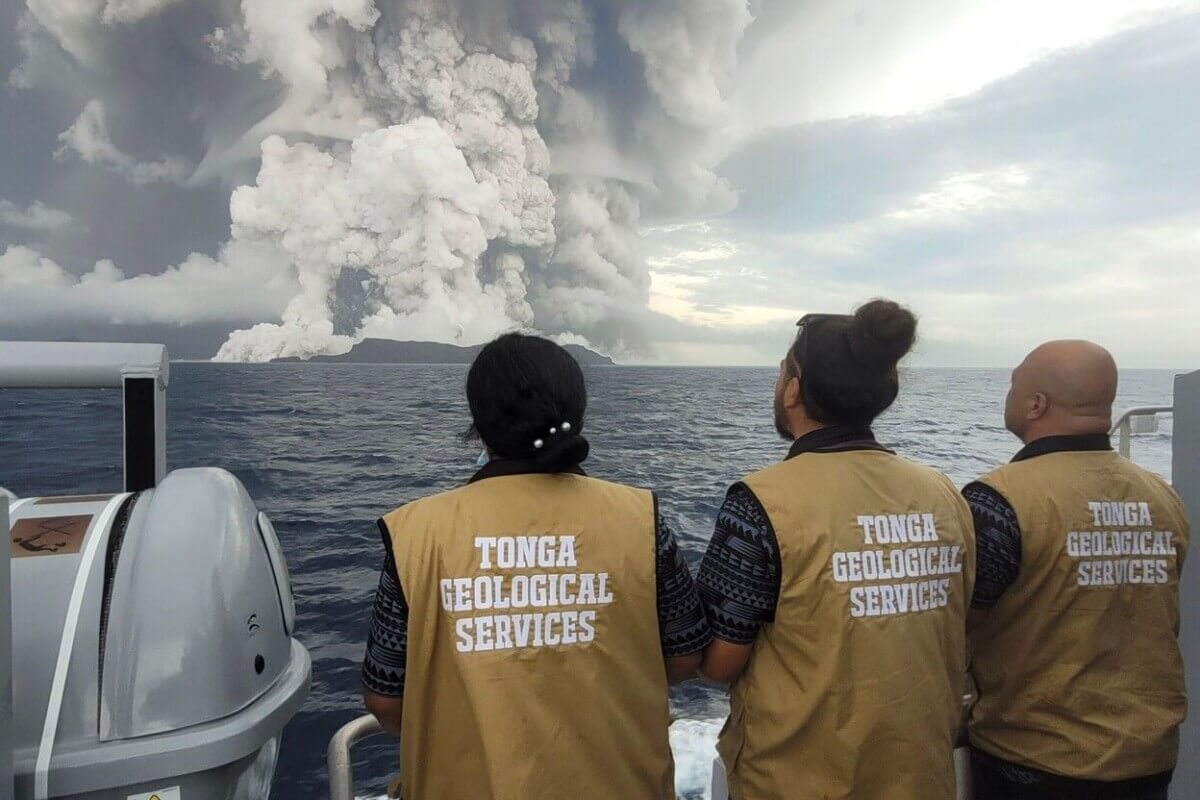
Tonga Geological Services staff making observations of the Hunga Tonga–Hunga Ha‘apai volcano. (Credit: Tonga Geological Services/ZUMA/Alamy)
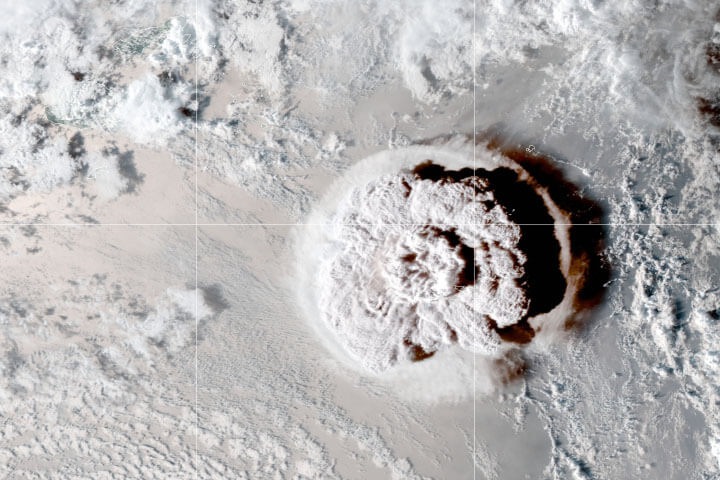
WASHINGTON — On Jan. 15, 2022, the Hunga Tonga-Hunga Ha’apai volcano unleashed one of the most powerful eruptions in recent history. Satellites captured a monstrous plume soaring over 35 miles into the sky, generating unprecedented atmospheric waves and lightning activity. While it may have seemed like a relatively unpredictable event, a new study has discovered a mysterious signal within the Earth moments before the cataclysm.
Researchers publishing their work in the journal Geophysical Research Letters believe this almost imperceptible signal could revolutionize our understanding of volcanic eruptions. It may even provide people in high-risk areas with an early-warning system in the future.
A team from the University of Tokyo uncovered this strange seismic precursor — a geological “whisper” — which occurred approximately 15 minutes before the volcano’s catastrophic explosion. This finding comes from an innovative study analyzing seismic data from stations hundreds of kilometers away in Fiji and Futuna.
“Early warnings are very important for disaster mitigation,” says Mie Ichihara, a volcanologist at the University of Tokyo and one of the study’s co-authors, in a media release. “Island volcanoes can generate tsunamis, which are a significant hazard.”
The research team used sophisticated signal processing techniques to extract and analyze Rayleigh waves, which are seismic waves that travel along the Earth’s surface. These waves, typically undetectable to human perception, revealed a critical moment in the volcano’s buildup to eruption.
“Many eruptions are preceded by seismic activity,” says Takuro Horiuchi, a volcanology graduate student at the University of Tokyo and the lead author of the study. “However, such seismic signals are subtle and only detected within several kilometers of the volcano.”
When it comes to the Hunga Tonga eruption, that seismic signal traveled a great distance, sounding the alarm on a huge seismic event.
“We believe unusually large movements started at the time of the precursor,” Horiuchi notes.
What makes this discovery extraordinary is its potential to transform how we monitor and predict volcanic events, especially for remote and underwater volcanoes that are challenging to study directly. The seismic signal was remarkably similar in power to a magnitude 4.9 earthquake, yet it occurred with no visible surface activity — a true geological enigma.
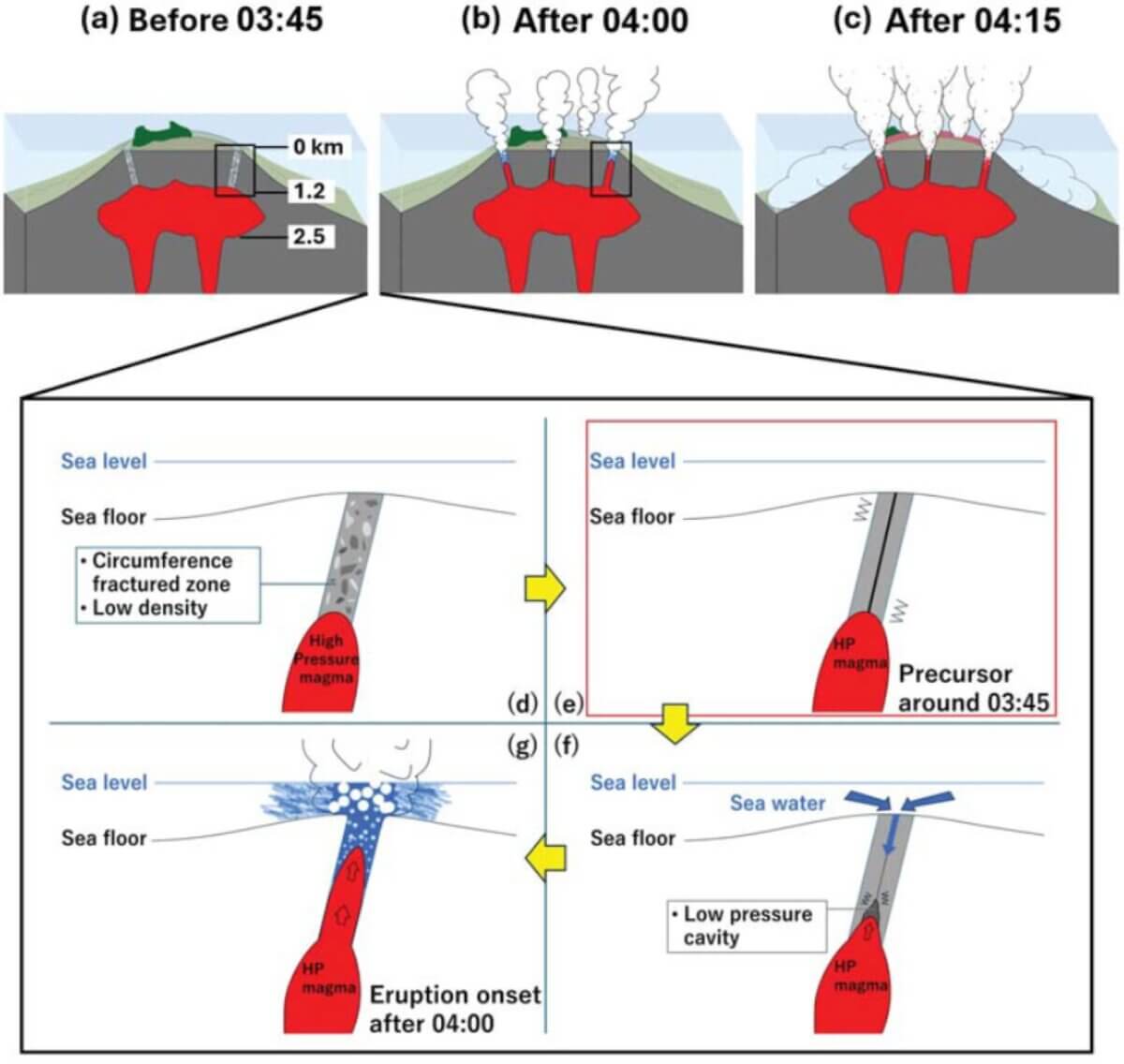
The scientists propose a fascinating scenario for what might have happened beneath the ocean’s surface. They believe the seismic waves were generated by a tensile failure in a circular, low-density rock structure near the volcano’s caldera rim. This initial crack allowed magma, volcanic gases, and seawater to interact, ultimately triggering the massive eruption.
“There are very few observed caldera-forming eruptions, and there are even fewer witnessed caldera-forming eruptions in the ocean,” Ichihara explains. “This gives one scenario about the processes leading to caldera formation, but I wouldn’t say that this is the only scenario.”
The Hunga Tonga-Hunga Ha’apai eruption was no ordinary volcanic event. It generated atmospheric waves that circled the globe, created the highest concentration of lightning ever recorded, and produced a tsunami that impacted regions thousands of miles away. The plume expanded beyond 250 miles within just one hour, making it a truly exceptional geological phenomenon.
By capturing this 15-minute warning signal, researchers have opened a potential window into understanding the initial stages of catastrophic volcanic eruptions. Their methods demonstrate that even a few distant seismic stations can provide crucial insights into volcanic activity — and perhaps even save lives.
Paper Summary
Methodology
The research team used two broadband seismometers located over 750 kilometers from the volcano. They applied advanced signal processing techniques to extract and analyze Rayleigh waves, focusing on a specific frequency range between 0.03 and 0.1 Hz. By examining cross-correlation coefficients and spectral densities, they could identify and characterize the precursor seismic signal.
Key Results
The study identified a significant seismic wave originating from the volcano’s direction around 03:45 UTC, approximately 15 minutes before the main eruption. This wave had characteristics similar to those of an earthquake with a magnitude of 4.9 but occurred without any visible surface activity, as confirmed by satellite imagery.
Study Limitations
The researchers acknowledged several limitations, including the lack of direct observation equipment near the volcano and the inability to definitively confirm the precise source mechanism of the precursor signal. The study relies on indirect evidence and theoretical modeling.
Discussion & Takeaways
The research suggests that subtle seismic signals could potentially provide early warnings for catastrophic volcanic events. By demonstrating that distant seismic stations can capture critical precursor information, the study offers a promising approach to monitoring challenging volcanic systems.
Funding & Disclosures
This research was supported by the Science and Technology Research Partnership for Sustainable Development (SATREPS), funded jointly by the Japan International Cooperation Agency (JICA) and Japan Science and Technology Agency (JST).


