
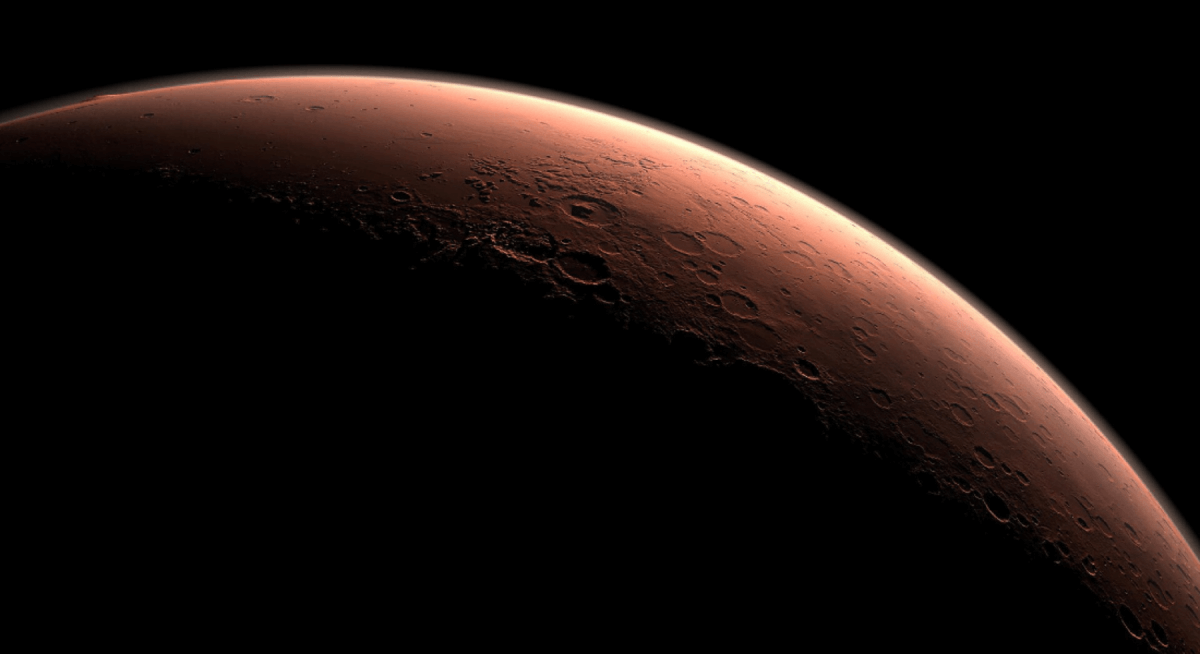
Daybreak at the Gale Crater on Mars where organic material was found Photo: NASA/JPL-Caltech/MSSS
PERTH, Australia — Was Mars just like Earth billions of years ago? A new study is making a very compelling case that our Martian neighbor may have been teeming with life in the distant past. Scientists in Australia have just discovered ancient evidence that the Red Planet once hosted hot water systems capable of supporting primitive life forms.
The groundbreaking study analyzed a tiny grain of zircon from a Martian meteorite that’s older than most continents on Earth. This microscopic time capsule, just a fraction of a millimeter in size, tells a remarkable story about Mars’ ancient past.
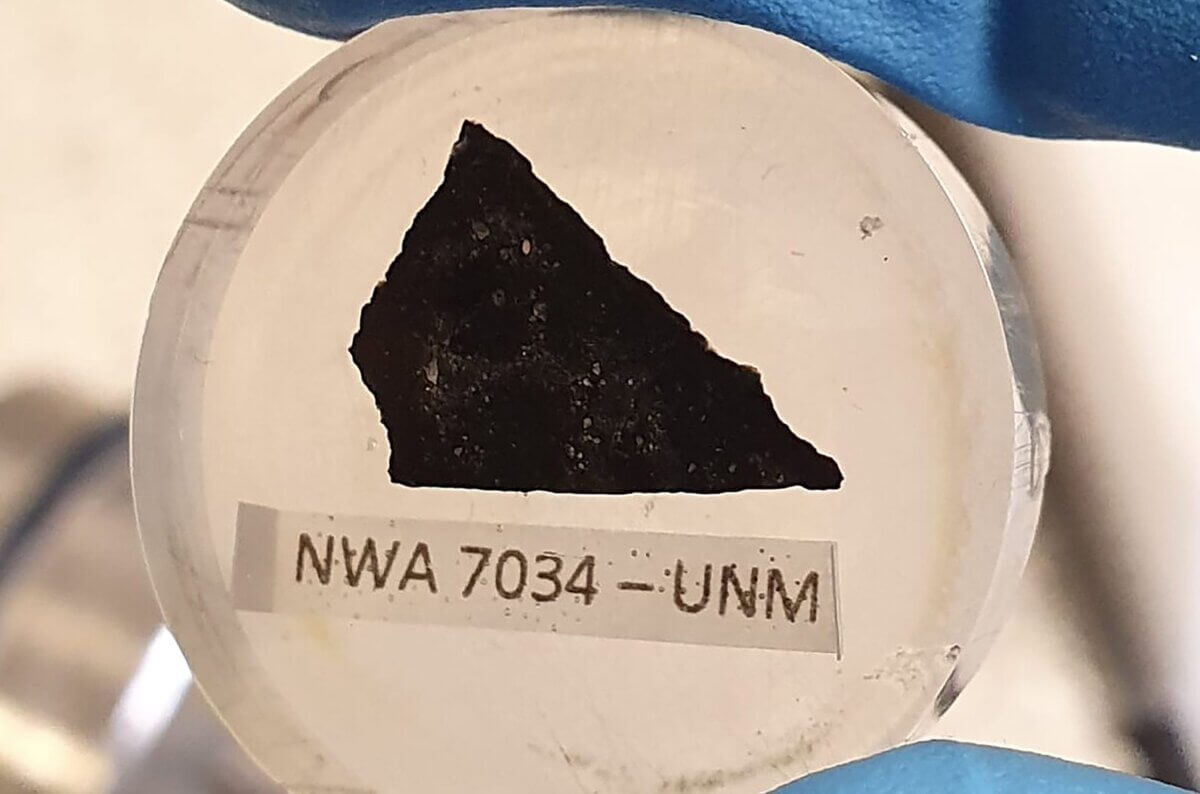
The zircon grain, part of a meteorite nicknamed “Black Beauty,” is 4.45 billion years old — dating back to the earliest days of Mars’ geological history. Using advanced nano-scale imaging techniques, scientists detected chemical signatures that suggest hot water was actively circulating during the planet’s formative years.
“Hydrothermal systems were essential for the development of life on Earth and our findings suggest Mars also had water, a key ingredient for habitable environments, during the earliest history of crust formation,” says Dr. Aaron Cavosie, a planetary scientist from Curtin University, in a media release.
The research team identified specific elements like iron, aluminum, yttrium, and sodium within the zircon. These chemical fingerprints indicate the presence of water-rich fluids during Mars’ volcanic periods, even after the planet endured massive meteorite impacts that dramatically reshaped its surface.
What makes this discovery particularly exciting is that it challenges previous assumptions about Mars’ early environment. The evidence suggests that despite the planet’s harsh exterior, underground water systems might have created pockets of potential habitability billions of years ago.
Understanding Mars’ ancient water systems could provide crucial insights into the conditions that might support life beyond Earth. While the study doesn’t definitively prove life existed, it dramatically increases the likelihood that Mars once had environments where primitive life could have emerged.
The research published in Science Advances was a collaborative effort involving scientists from Curtin University, the University of Lausanne, and the University of Adelaide. It represents another tantalizing step in humanity’s quest to understand our planetary neighbor and the potential for life in the universe.
“This new study takes us a step further in understanding early Mars, by way of identifying tell-tale signs of water-rich fluids from when the grain formed, providing geochemical markers of water in the oldest known Martian crust,” Dr. Cavosie concludes.
Paper Summary
Methodology
The researchers employed a combination of advanced micro- and nanoscale techniques to study a zircon grain from the Martian meteorite NWA7034, dated to 4.45 billion years old. Scanning Electron Microscopy (SEM) and Transmission Electron Microscopy (TEM) were used to visualize fine structures and detect the presence of nanoscale chemical inclusions.
Time-of-Flight Secondary Ion Mass Spectrometry (ToF-SIMS) allowed for high-resolution chemical mapping of the elements within the zircon, while Atom Probe Tomography (APT) provided atomic-scale detail about the distribution of trace elements such as iron, aluminum, and yttrium. These techniques enabled the researchers to reconstruct the history of the zircon’s formation and its later modification through hydrothermal and impact-related processes.
Key Results
The study revealed several key findings about the zircon grain. Chemical zoning, characterized by alternating bands of iron, aluminum, and sodium, indicated that the grain crystallized in a hot, water-rich environment on Mars. The presence of magnetite inclusions, tiny particles of a magnetic mineral, further suggested that oxidizing conditions prevailed during its formation.
Additionally, deformation features and clusters of trace elements provided evidence that the zircon had undergone a significant meteorite impact event long after it originally crystallized. Collectively, these findings confirm the existence of hydrothermal systems on Mars over four billion years ago, highlighting the potential for early habitability.
Study Limitations
The analysis focused on a single zircon grain, which may not fully represent the environmental conditions of early Mars. There was also some uncertainty regarding the exact timeline of hydrothermal activity and impact events due to the limitations of the radiometric data obtained from the zircon. Moreover, the grain’s journey from Mars to Earth introduces the possibility that some features may have been altered during its ejection from the Martian surface or its transit through space. Additional studies on similar samples are necessary to verify and expand upon these findings.
Discussion & Takeaways
The study sheds light on Mars’s ancient environment, offering critical insights into its geological history. The chemical composition of the zircon supports the idea that water-rich hydrothermal systems existed on the planet’s surface, potentially creating conditions favorable for the emergence of life.
The discovery of magnetite inclusions indicates the presence of a strong magnetic field on early Mars, which could have played a protective role against solar radiation, making the surface more hospitable. These findings also contribute to our understanding of planetary evolution, providing further evidence that Mars had an active crust and hydrosphere during its earliest history.
Funding & Disclosures
The research was funded by the Swiss National Science Foundation under grant PZ00P2_216313, along with support from the Australian Research Council through Discovery Projects DP190103849 and DP210100336. Additional funding was provided by Curtin University’s Space Science and Technology Centre. The authors declared no competing interests, and all data used in the study are publicly available.


