
Watching election results can be stressful on your brain. (Credit: gpointstudio/Shutterstock)
In A Nutshell
- Your brain remembers who’s ahead during vote counting, and those mental snapshots stick around even after you learn the final result
- When the eventual winner takes a late lead, people are more likely to suspect the election was rigged, no matter which party they support
- In seven studies with nearly 1,500 participants, researchers found this bias persisted even when they explained why vote counts shifted
- If Georgia’s 2020 ballots had been counted in reverse order, fraud suspicions might have targeted Trump instead of Biden
What if Georgia had counted its ballots in reverse order in 2020?
Joe Biden would have led from the start. Donald Trump’s supporters would have watched his numbers climb slowly throughout election night. By the time Trump caught up, Biden voters might have been the ones crying fraud. New research suggests that simple change in counting order could have flipped which party suspected the election was rigged.
The culprit? A cognitive bias that makes early leaders in any competition seem more legitimate than late surgers, even when the final score is identical. Psychologists call it the cumulative redundancy bias, and it may have helped fuel one of the biggest political crises in American history.
On November 3, 2020, Donald Trump was ahead in Georgia. For hours, as Americans watched numbers update on their screens, he maintained that lead. Then Joe Biden started catching up. By the time nearly all votes were tallied, Biden had won. Trump’s response was immediate. He tweeted “STOP THE COUNT!” and claimed officials were somehow “finding” ballots to change the outcome.
Researchers from Ruhr University Bochum in Germany and the University of Lisbon in Portugal discovered something striking. It wasn’t just partisan loyalty driving those fraud allegations. It was a cognitive quirk that affects Democrats and Republicans alike. Their findings, published in Psychological Science, show that people are more likely to suspect election fraud when the eventual winner takes a late lead, regardless of political affiliation or the actual legitimacy of the results.
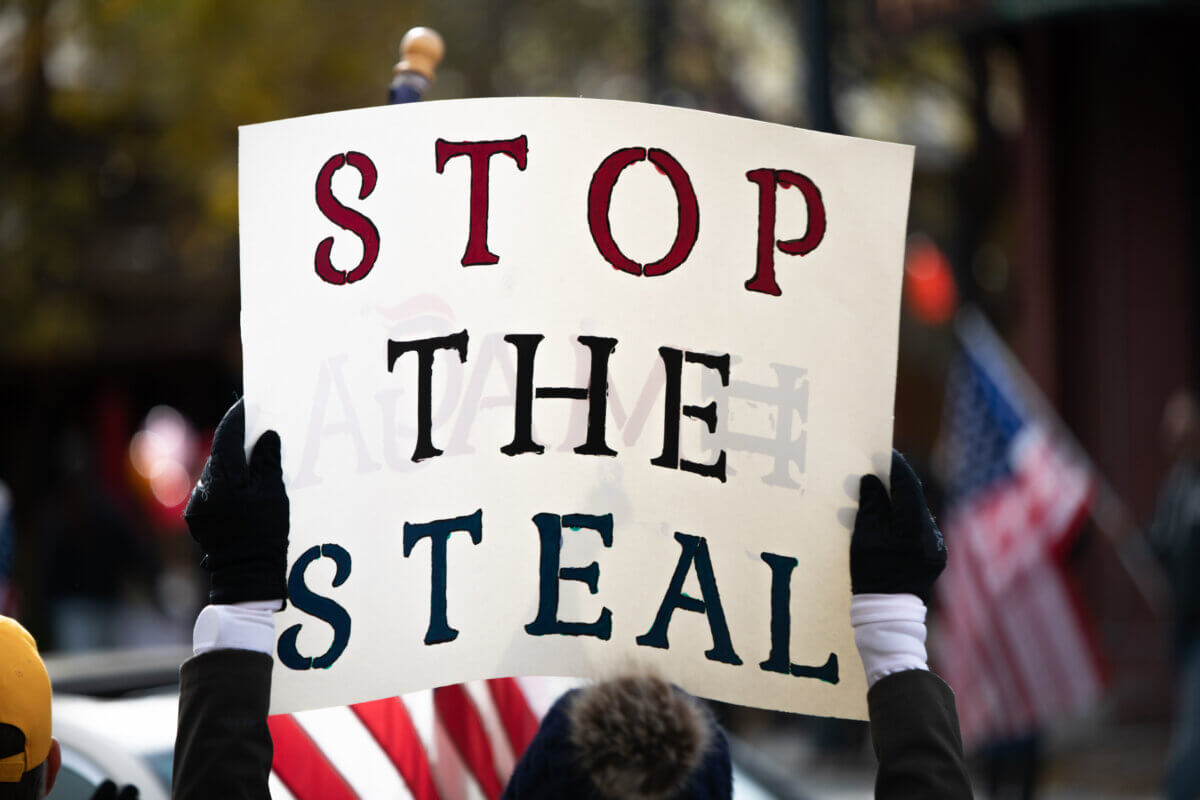
Watching Early Election Leaders Changes What You Believe
The research involved seven studies with hundreds of American and British adults. Across all experiments, the pattern held. Watching someone lead early creates a lasting impression. That impression persists even after you learn the final result.
Research shows that in competitions between sports teams, stocks, or algorithms, competitors who lead early receive more favorable evaluations later, even after the final outcome is known. It’s like watching a team dominate for three quarters. Even if they lose in the final minutes, they still seem like the “better” team.
In a press conference on election night, Trump called it “a corrupt system.” He claimed election officials wanted to determine how many votes they needed and then find them.
The researchers tested whether this psychological phenomenon extends beyond general impressions to actual beliefs about election legitimacy. In one experiment, participants watched a simulated school election between two candidates named Peter and Robert. Both received votes from 12 different classes, counted one at a time. Peter won in both scenarios by the same margin, but the order of counting differed. In one version, Peter led from the start. In another, he trailed throughout and only pulled ahead at the very end.
After seeing the final results, participants who watched Peter lead from the beginning rated him as the better candidate. They predicted he’d succeed in future elections. Participants who watched Peter come from behind actually rated Robert (the loser) more favorably than Peter, the winner. The early lead was powerful enough to overshadow the actual election outcome.
The studies involved final samples ranging from 166 to 327 participants per experiment, all recruited through Prolific, an online research platform. Researchers randomly assigned people to different conditions to control for pre-existing biases.
Then the researchers introduced rumors of election fraud. Participants who watched the winner take a late lead found it much more likely that votes had been manipulated and that the wrong candidate had won. The effect held whether researchers showed absolute vote totals or percentages, the format typically used by news organizations.
Testing the Bias With Real Election Data
Next, the team used actual vote-counting data from Georgia’s 2020 presidential election. To avoid triggering partisan reactions, they told participants it was from a recent election in Eastern Europe, with candidates named “Miroslav K.” and “Lukas P.” When the winning candidate took a late lead (as Biden did in the real Georgia count), participants were more suspicious of fraud. When researchers reversed the order so the winner led from the start, those suspicions dropped.
One experiment tested whether these doubts arise during vote counting, not just after it’s finished. Researchers showed participants updates every three hours, mimicking how results trickled in on election night 2020. They stopped before reaching 100% counted. Even at that point, participants already suspected manipulation favoring whichever candidate was currently ahead. In the late-lead scenario matching what actually happened in Georgia, people found fraud favoring the current leader more plausible.
Could explanations fix the problem? The researchers told some participants that the losing candidate was more popular in rural areas counted first, while the winning candidate was popular in urban areas counted last. This pattern mirrors what actually happened in 2020, when Biden voters disproportionately used mail-in ballots often counted later. The explanation helped slightly but didn’t eliminate the bias.
Why Both Parties Fall Into the Same Trap
Finally, the researchers tested the big question: does political affiliation override this bias? They showed American participants the real 2020 election data, explicitly identifying the candidates as Joe Biden and Donald Trump. Republicans thought fraud favoring Biden was more likely. Democrats thought fraud favoring Trump was more likely. But the vote-counting order still mattered for both groups. Republicans became even more suspicious of Biden when they saw him take a late lead. Democrats became more suspicious of potential Trump-favoring fraud when researchers reversed the order so Trump appeared to come from behind.
Both groups fell into the same psychological trap. The only difference was which candidate’s late surge triggered their suspicion.
The order in which votes get counted is shaped by procedures and logistics. In 2020, Biden supporters were more likely to vote by mail, partly due to COVID-19 concerns. Many counties counted mail-in ballots last. Urban counties, which lean Democratic, took longer to process and report results compared to rural counties. None of this indicated fraud, but the resulting pattern of early Trump lead and late Biden surge created perfect conditions for the bias to take hold.
Why Your Brain Takes Snapshots Instead of Waiting for the Final Score
Researchers suggest the cumulative redundancy bias stems from how humans process sequential information. When you observe something happening over time, each observation leaves an impression. Those impressions pile up. The brain struggles to completely discount them later, even when new information arrives. First impressions are hard to shake for the same reason.
The research team notes that their participants came from the United States and United Kingdom and used the Prolific platform, so the findings might not apply universally. But they have no reason to think Americans or Britons are uniquely susceptible. The cumulative redundancy bias appears to be a fundamental feature of human cognition.
False beliefs about election fraud might be partly built into how we communicate election results. Media organizations report partial results in real-time because the public demands it. Nobody wants to wait days in the dark while votes are counted. But that transparency comes with a psychological cost. Every update showing an early leader reinforces the impression that this person should win. When they don’t, brains struggle to let go of those earlier snapshots.
What Can Be Done?
Waiting to publicize results until all votes are counted might backfire, raising different suspicions about delayed information. Better public education about why vote counts unfold the way they do could help. If people understood before election night that certain ballots or regions get counted later, they might be less surprised by shifts in the tallies. Advanced forecasting algorithms that incorporate multiple information sources beyond just live counts might also prevent misleading partial results from being broadcast.
There’s a deeper lesson about truth in democracy. We like to think facts speak for themselves. We assume the final vote count is what matters. Human psychology doesn’t work that way. How information unfolds over time shapes what people believe, sometimes more powerfully than the information itself. In 2020, Trump’s early lead in Georgia was real. Those votes existed. But they weren’t representative of the full electorate, and the cumulative redundancy bias turned that misleading middle chapter into a lasting impression that never fully corrected for millions of Americans.
Your brain isn’t trying to deceive you. It’s doing what brains do: forming impressions based on repeated observations. But in an era of real-time election coverage, that normal cognitive process can have serious consequences for democracy itself.
Disclaimer: This article summarizes scientific research for general informational purposes. It is not intended as political analysis, legal advice, or professional guidance. For questions about election integrity or voting processes, consult official election authorities in your jurisdiction.
Paper Summary
Methodology
The researchers conducted seven experiments with a total of 1,457 participants recruited through Prolific Academic from the United States and United Kingdom. Participants ranged widely in age, with mean ages between 37 and 45 years across studies. Each study used a between-subjects design, randomly assigning participants to either an “early lead” or “late lead” condition. In the early-lead condition, the eventual winner led throughout the vote counting process. In the late-lead condition, the eventual loser led for most of the count, with the winner only taking the lead near the end. Studies 1 through 3 used simulated school elections with fictional candidates. Study 4 used real 2020 Georgia presidential election data but presented it as an Eastern European election with fictional candidate names. Studies 5 through 7 also used Georgia data, with Studies 6 and 7 testing whether explanations and partisan identification could reduce the bias. Study 7 explicitly identified the candidates as Biden and Trump and included both Democratic and Republican participants. Participants viewed sequential updates showing cumulative vote totals or percentages, then answered questions about candidate quality, predicted success, and likelihood of election fraud.
Results
Across all seven studies, participants consistently rated early leaders more favorably and were more likely to suspect fraud when the eventual winner gained a late lead. In Studies 1 and 2, the effect was strong enough that participants in the late-lead condition actually rated the losing candidate more favorably than the winner. Studies 2 through 4 showed that participants in late-lead conditions rated vote manipulation and the wrong candidate winning as significantly more likely. Study 5 demonstrated that fraud suspicions emerged even before vote counting was complete. Study 6 found that providing explanations for why the winner took a late lead reduced but did not eliminate the effect. Study 7 showed that the bias persisted even when participants knew they were viewing the 2020 Trump-Biden race and even accounting for participants’ own political affiliations. Republicans were more suspicious of Biden-favoring fraud, and Democrats more suspicious of Trump-favoring fraud, but the vote-counting order affected both groups similarly.
Limitations
The research was conducted entirely online with participants from English-speaking countries (United States and United Kingdom) who use the Prolific platform. The findings may not generalize to other populations or cultures. The studies used relatively short vote-counting sequences (10 to 20 updates) compressed into a few minutes, which differs from real election nights that unfold over hours. Some studies used fictional candidates or presented real candidates under false pretenses, which may have reduced emotional investment compared to following an actual election in real-time. Exclusion rates varied across studies, with some studies excluding up to 20-30% of participants who failed attention checks, potentially limiting generalizability. The studies measured beliefs and perceptions but did not assess actual behaviors, such as whether people would act on their fraud suspicions.
Funding and Disclosures
The research was funded by Grant No. 538466518 from the Deutsche Forschungsgemeinschaft (DFG, or German Research Foundation) awarded to Hans Alves. All authors declared no conflicts of interest. The study received approval from the Ethics Committee of the Faculty of Psychology of Ruhr University Bochum. Grammarly was used to assist with writing, and ChatGPT-4o was used to assist with generating R code. All hypotheses, methods, sample sizes, exclusion criteria, and analysis plans were preregistered prior to data collection. All study materials, data, and analysis scripts are publicly available at https://doi.org/10.17605/OSF.IO/VCB53.
Citation
Vaz, A., Ingendahl, M., Mata, A., & Alves, H. (2025). “Stop the Count!”—How Reporting Partial Election Results Fuels Beliefs in Election Fraud. Psychological Science, 36(8), 676-688. doi:10.1177/09567976251355594


Simple humor nature prohibits most people from admitting error. Only magnanimous people freely admit error, it seems. So this study, in my mind, simply supports what is generally known about human nature. Nevertheless, it has very good points and is written in a neutral Matter.