(Aleksandrkozak/Shutterstock)
GENEVA, Switzerland — In a breakthrough that reads like alchemy, scientists at the University of Geneva have solved a long-standing mystery about how gold travels through the Earth’s crust to form valuable deposits of this precious metal. Their discovery reveals that a particular form of sulfur acts as nature’s gold courier, challenging previous theories about how precious metal deposits form.
The journey of gold from deep within the Earth to mineable deposits has long puzzled geologists. Now, researchers have identified that bisulphide, a specific form of sulfur, plays a crucial role in transporting gold through superhot fluids released by magma – the molten rock that eventually becomes the volcanic formations we see at the surface.
“Due to the drop in pressure, magmas rising towards the Earth’s surface saturate a water-rich fluid, which is then released as magmatic fluid bubbles, leaving a silicate melt behind,” explains Stefan Farsang, lead author of the study published in Nature Geoscience.
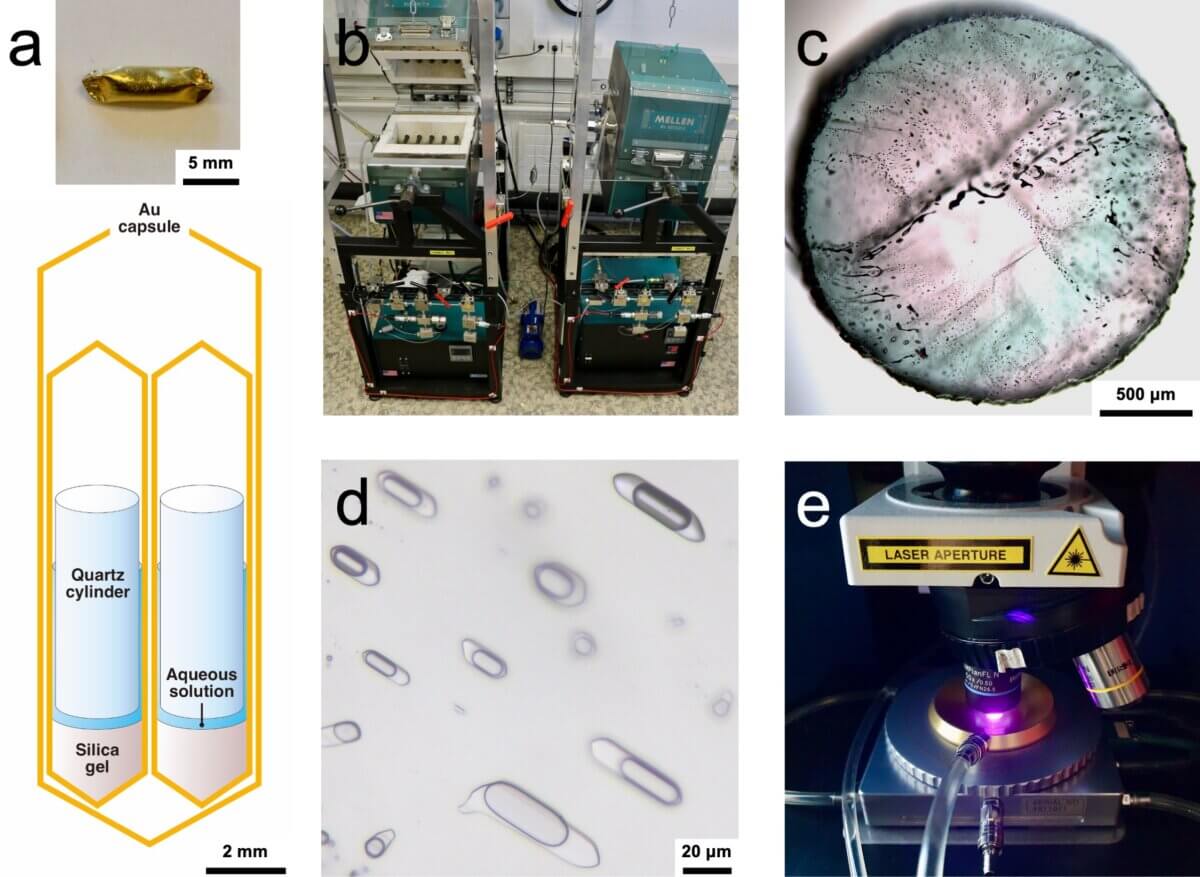
To understand this process, the research team developed an innovative experimental setup that recreates the extreme conditions found deep within the Earth. They sealed a quartz cylinder and a specially composed liquid inside a gold capsule, then subjected it to intense pressure and temperatures reaching 875°C (1,607°F) – conditions similar to those found in natural magmas.
This groundbreaking methodology allowed the scientists to observe something previous researchers couldn’t: the exact chemical form of sulfur present in these magmatic fluids. Using laser analysis techniques, they discovered that bisulphide, along with hydrogen sulfide and sulfur dioxide, are the main forms of sulfur present at these extreme temperatures.
The findings overturn a 2011 study that had suggested different sulfur compounds were responsible for gold transport.
“By carefully choosing our laser wavelengths, we also showed that in previous studies, the amount of sulfur radicals in geologic fluids was severely overestimated and that the results of the 2011 study were in fact based on a measurement artifact,” says Farsang, effectively settling a decade-long debate in the geological community.
Since much of the world’s gold and copper comes from deposits formed by these magma-derived fluids, understanding exactly how they form could also aid in future mineral exploration efforts.
Think of it as understanding nature’s own delivery system: just as a postal service needs specific vehicles and routes to deliver packages, gold needs specific chemical compounds and conditions to move through Earth’s crust. By identifying bisulphide as the primary “delivery vehicle,” scientists have mapped out one of nature’s most valuable transportation networks.
The study emerged from the complex interaction between tectonic plates – the massive sections of Earth’s crust that slowly move against each other. When one plate slides beneath another, it generates magma rich in volatile elements like water, sulphur, and chlorine. As this magma rises toward the surface, it releases fluids that carry dissolved metals with them – a process that ultimately leads to the formation of the gold deposits that humans have prized throughout history.
This new understanding of gold’s journey through the Earth not only helps explain how existing deposits formed but could also guide future exploration efforts, potentially making gold mining more efficient and targeted.
Paper Summary
Methodology
The study employed a prototype pressure vessel combined with Raman spectroscopy to examine sulfur speciation in magmatic fluids. This method allowed researchers to observe the behavior of sulfur under varying pressure, temperature, and redox conditions relevant to upper crustal magma reservoirs. By simulating these environments, the team could identify the main sulfur species in arc magmatic fluids, such as HS−, H2S, and SO2, and measure gold solubilities under different conditions.
Key Results
The results revealed that sulfur exists primarily as HS− and H2S in the fluids, which significantly increases the solubility of gold, far exceeding previous thermodynamic predictions. The study also noted that sulfur species play a crucial role in gold transport within magmatic-hydrothermal systems, with variations in sulfur species greatly influencing the amount of gold these fluids can carry.
Study Limitations
One limitation of the study is the focus on specific redox, pressure, and temperature conditions that may not represent all natural environments where magmatic processes occur. Additionally, the experimental setup might not completely capture the complex interactions and transformations that sulfur undergoes in natural settings, potentially affecting the generalizability of the findings.
Discussion & Takeaways
This research highlights the importance of sulfur speciation in understanding the geochemical processes that control the cycling of sulfur and metals like gold in magmatic systems. The findings challenge existing models by demonstrating the potential for high gold solubilities and suggest that conventional thermodynamic models may underestimate the influence of sulfur species in arc magmatic fluids.
Funding & Disclosures
This research was supported by the European Research Council (ERC) under the European Union’s Horizon 2020 research and innovation program through grant agreement no. 864792. The authors have declared that there are no competing interests related to this study.


