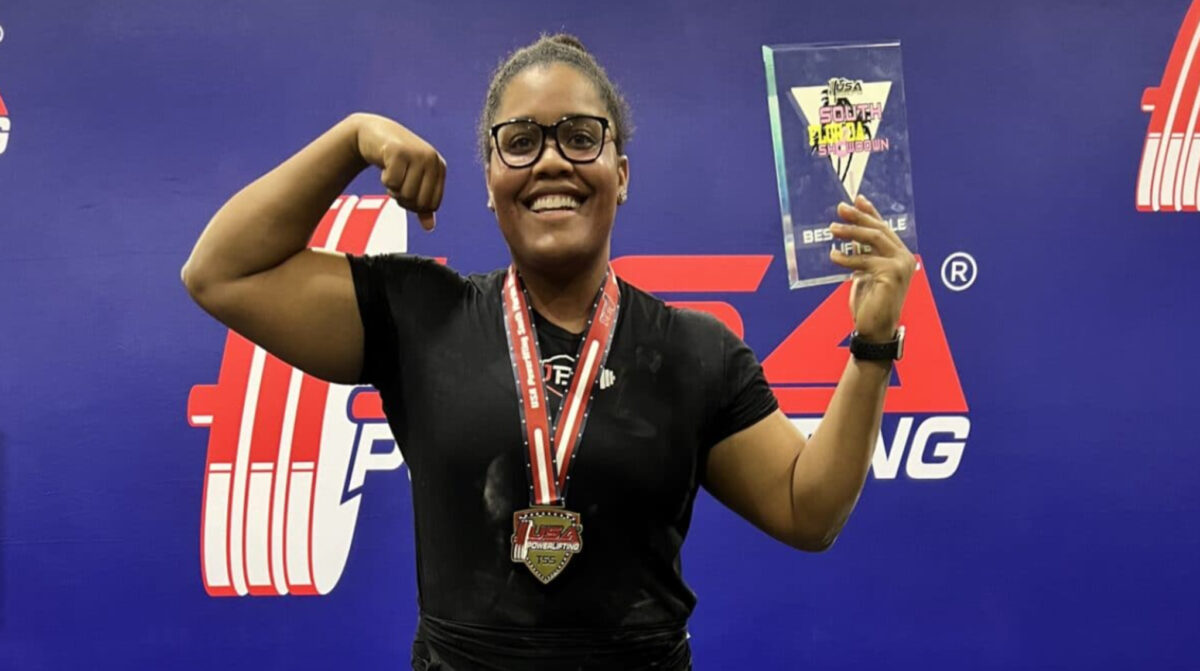
Powerlifter and breast cancer survivor LaShae Rolle. (Credit: Sylvester Comprehensive Cancer Center)
LaShae Rolle tells StudyFinds she never doubted herself, even when symptoms were unbearable. Here’s her extraordinary story.
In a Nutshell
- A 27-year-old powerlifter maintained 87–93% of her strength through breast cancer chemotherapy.
- She used a personalized training plan, delaying heavy lifting 5–7 days after each chemo session.
- Symptoms like fatigue and nausea dropped significantly when exercise timing was optimized.
- The findings don’t apply to most patients, but they offer a model for elite athletes undergoing treatment.
MIAMI — There may be no challenge too tough — or heavy — for LaShae Rolle. The cancer researcher and PhD candidate at the University of Miami Miller School of Medicine, who also happened to be a champion powerlifter, found herself ironically facing the very disease she’d already been studying to prevent.
Despite learning she’d been diagnosed with breast cancer, the world-class athlete defied standard cancer treatment advice, retaining 87-93% of her pre-diagnosis strength while still undergoing chemotherapy. Her experience shows that elite athletes might not need to abandon their sport entirely during treatment – they just need to train smarter.
The Diagnosis That Tried To Change Everything
Before her February 2024 diagnosis with stage 2B estrogen receptor-positive breast cancer at the age of 26, Rolle could squat an astounding 441 pounds, bench press 292 pounds, and deadlift 497 pounds. Knowing that treatment could deplete her of the extraordinary strength and skills she’d worked so hard to build, she decided to take on the challenge of beating cancer while still being able to lift at a high level.
“My training in exercise oncology was actually helpful because it made me aware that exercise during cancer treatment was possible, but I didn’t know to what extent, especially for powerlifting,” she told me. “There are no case studies or examples of powerlifting during cancer treatment. Having a scientific perspective allowed me to apply the scientific method to my own situation, essentially testing what I could do and documenting the results systematically.”
With a clear mind and an idea of the road ahead, Rolle underwent four cycles of chemotherapy that included Taxotere and Cyclophosphamide – drugs notorious for causing severe fatigue, nausea, and muscle weakness. Yet she retained unthinkable strength levels: 408 pounds on squats (93% retention), 254 pounds on bench press (87% retention), and 430 pounds on deadlifts (87% retention).
She also endured a mastectomy and radiation as part of her treatment plan, now documented in a research paper she co-authored with her mentor, Dr. Tracy Crane, director of Lifestyle Medicine, Prevention and Digital Health at the the Sylvester Comprehensive Cancer Center. Their paper is published in the journal Lifestyle Medicine.
Most cancer patients receive standard advice to stick with light walking or gentle yoga during chemotherapy. Yet according to their paper, this case represents “the first documentation to our knowledge of elite-level female powerlifting during active chemotherapy treatment.”

How Waiting One Week After Chemo Changed Everything
Rolle didn’t hesitate to get back in the game after chemotherapy. Just one day after her first cycle, she was back at the gym and ready to give training a try.
Her confidence and ambition wasn’t rewarded. She battled brutal fatigue, nausea, diarrhea, dizziness, loss of taste, and headaches that made training nearly impossible. “Fatigue was by far the hardest symptom to push through,” she said. “All my other side effects didn’t directly interfere with my ability to train, but the fatigue was the main barrier I had to work around.”
So Rolle wisely opted to wait a week after cycles three and four to attempt the typically intense training she was accustomed to doing. The cautious decision proved to be a key breakthrough that lightened her symptoms significantly. Being able to work out again was a mental medicine that she needed.
“Training provided a sense of normalcy because athletics and training have been part of my life since childhood,” she explained. “It helped me feel like myself and gave me mental relief from the reality of treatment. It was something familiar and positive I could focus on.”

How A Psychological Victory Powered Physical Strength
Rolle credits the research team at Sylvester for helping her create a strength training program that would with her chemotherapy cycles and her goals. This included high-intensity days scheduled before chemotherapy infusions, focusing on squats, bench press and deadlifts. Then there were moderate days with mid-cycle sessions featuring accessory movements like rows and shoulder presses, and recovery days with light mobility and therapy work post-infusion.
The team relied on real-time symptom tracking and perceived exertion, creating a feedback loop that prioritized safety and performance.
But beyond her tremendous retention of strength during the training, it’s her psychological perseverance that also stands out.
“I never doubted my ability to continue training, even throughout each stage of treatment,” she recalled. “I worked closely from both clinical and research perspectives with Dr. Carmen Calfa, my breast oncologist here at Sylvester, and with my mentor, Dr. Tracy Crane, to maintain that confidence which has continued even now, post-treatment.”

Today, Rolle admits that she still finds herself in awe when she watches videos of herself handling 400 pounds of iron during her chemo journey like any other powerlifter. Looking back, she believes it was her optimized training plan based on symptom-tracking that led to manageable workouts.
“I didn’t make specific adjustments to preserve strength,” she said. “I think what actually preserved my strength was the consistency of continuing to work out throughout each stage of treatment. The continuity itself was the most important factor.”
Why Exercise And Cancer Should Go Hand-In-Hand
We know how exercise can play a role in preventing cancer, but there’s also strong research showing that physical activity after diagnosis can be therapeutic too. Despite a lack of studies on cancer patients training at the same level as Rolle, there’s plenty to say about how exercise can still help treatment.
A 2022 study from Edith Cowan University examined whether a single vigorous exercise session can trigger anti-cancer effects in men with late-stage prostate cancer. Researchers had nine patients perform 34 minutes of high‑intensity cycling for this trial. Blood samples were taken immediately before, immediately after, and 30 minutes after exercise. The team found that right after exercise, blood showed elevated levels of anti-cancer proteins called myokines. When this post-exercise serum was applied to prostate cancer cells in vitro, tumor cell growth was reduced by about 17%. By 30 minutes post-exercise, myokine levels and the cancer-suppressing effect had returned to baseline.
The study, published in Prostate Cancer and Prostatic Diseases, demonstrates that even a single workout could create a blood “chemical environment” that suppresses cancer cell proliferation. Perhaps more importantly, patients with advanced disease who have already undergone extensive treatment can still experience these benefits.
Interestingly, a separate 2022 study from Edith Cowan researchers confirmed that exercise-induced myokines also slowed tumor growth in cancer patients.
For early-stage breast cancer patients, a 2021 study published in the Journal of Clinical Oncology shows that moderate-to-vigorous exercise before and after chemotherapy was associated with better preservation of cognitive function, and may help prevent or reduce so-called “chemobrain.”
The observational study that included 580 mostly middle-aged women found that patients who did not exercise experienced significant declines in cognitive function during chemotherapy. On the other hand, patients who met activity guidelines before and after chemotherapy maintained a sharp mind.
Cancer Patients Should Still Take Extreme Caution
If you or a loved one is going through cancer treatment and would like to begin an exercise program, it’s imperative you first discuss this with your doctors and care team.
Though very inspiring, Rolle’s story doesn’t mean other cancer patients will be able to exercise at such a high level. It’s important to keep in mind that she was already an accomplished athlete with an intense training regimen before her diagnosis.
She explicitly states in her paper that the findings “apply primarily to elite athletes with established high-intensity training backgrounds and may not generalize to broader populations, even with individualized exercise prescriptions.” Unfortunately, most cancer patients don’t possess the fitness level and experience to handle such a heavy load of training during treatment.
And of course, being in her 20s makes a world of difference.
Still, despite a lack of comparable research, Rolle’s paper and experience will hopefully lead to similar trials for oncologists who have athletes as patients.
“LaShae’s journey is a powerful reminder that survivorship is not just about recovery. It’s about reclaiming strength, identity and purpose,” said her mentor, Crane, who is also an associate professor of medical oncology and public health at the Miller School of Medicine, in a statement. “Her commitment to powerlifting exemplifies how movement can be a form of healing, empowerment and advocacy. Stories like hers are exactly why we continue to champion personalized, evidence-based approaches with lifestyle medicine. Having been through the experience, she has a different perspective and will be able to better design trials and studies.”

“My advice to other athletic cancer patients is to work with their medical team to develop a personalized exercise plan,” added Rolle. “Remember that the day before your diagnosis, you were working out without limitations. Cancer doesn’t immediately change your physical capabilities. Take it day by day, listen to your body, and do what you can within your comfort zone.”
Disclaimer: This article summarizes findings from a single case study and does not constitute medical advice. The results apply to an elite athlete with extensive strength training experience and may not generalize to typical cancer patients. Always consult a medical professional before beginning or modifying any exercise program during cancer treatment.
Full Q&A With LaShae Rolle
Why did you decide to document your own experience in a formal case study, rather than keep it private?
I initially started documenting my experience on social media through my account @StrongAfterCancer (Instagram | Facebook | TikTok). As a powerlifter, I was already tracking all my workouts to monitor form and progress; that’s standard practice whether you’re working with a coach or following your own training plan.
When I was diagnosed @SylvesterCancer, I realized I had been tracking not just my workouts, but also my side effects, so I had all the data needed to create a formal case study. There aren’t examples of powerlifting during cancer treatment documented in the literature, so I felt this could contribute valuable information to the field.
How did it feel to approach your cancer treatment as both a patient and a scientist? Did that dual perspective help or complicate things?
My training in exercise oncology was actually helpful because it made me aware that exercise during cancer treatment was possible, but I didn’t know to what extent, especially for powerlifting. There are no case studies or examples of powerlifting during cancer treatment.
Having a scientific perspective allowed me to apply the scientific method to my own situation, essentially testing what I could do and documenting the results systematically.
Were there moments during chemo when you doubted whether continuing to train was possible or worth it?
I never doubted my ability to continue training, even throughout each stage of treatment. I worked closely from both clinical and research perspectives with Dr. Carmen Calfa, my breast oncologist here at Sylvester Comprehensive Cancer Center, and with my mentor, Dr. Tracy Crane, who directs Sylvester’s Lifestyle Medicine, Prevention and Digital Health program, to maintain that confidence which has continued even now, post-treatment.
What physical symptoms were the hardest to push through—and how did you adapt your training around them?
Fatigue was by far the hardest symptom to push through. All my other side effects didn’t directly interfere with my ability to train, but the fatigue was the main barrier I had to work around.
Can you describe what a “good” day felt like during chemotherapy? How different was it from your pre-diagnosis training days?
A good day meant having enough energy to complete a workout and still function afterward. Pre-diagnosis, I obviously didn’t deal with pain, fatigue, or other treatment side effects, so there was a stark difference in what constituted a “good” training day.
Looking back, what was the most important adjustment you made that helped preserve your strength?
I didn’t make specific adjustments to preserve strength. I think what actually preserved my strength was the consistency of continuing to work out throughout each stage of treatment. The continuity itself was the most important factor.
You wrote that exercise was “central to your identity.” How did training help you psychologically during treatment?
Training provided a sense of normalcy because athletics and training have been part of my life since childhood. It helped me feel like myself and gave me mental relief from the reality of treatment. It was something familiar and positive I could focus on.
What advice would you give to other athletic cancer patients who are scared of losing their physical capabilities?
My advice to other athletic cancer patients is to work with their medical team to develop a personalized exercise plan. Remember that the day before your diagnosis, you were working out without limitations. Cancer doesn’t immediately change your physical capabilities. Take it day by day, listen to your body, and do what you can within your comfort zone.
Paper Summary
Methodology
Researchers documented the training and symptoms of a single 27-year-old competitive powerlifter throughout four cycles of chemotherapy for stage 2B breast cancer. The athlete followed a structured strength training program that was continuously adjusted based on symptom severity and timing relative to chemotherapy infusions. Training intensity was measured using rate of perceived exertion (RPE) scales, while symptoms were tracked daily using a 5-point scale. The program included compound lifts (squats, bench press, deadlifts), accessory movements, and rehabilitation exercises, with timing and intensity modified based on weekly feedback loops.
Results
The athlete retained 87-93% of her pre-treatment strength levels across major lifts by the end of treatment. Squat performance showed the highest retention at 93% (441 to 408 pounds), while bench press and deadlift both retained 87% of baseline strength. Symptom severity decreased significantly when high-intensity training was delayed 5-7 days post-chemotherapy compared to attempting exercise one day after treatment. Rate of perceived exertion gradually increased across cycles, indicating cumulative fatigue, but weight lifted continued to progress throughout treatment.
Limitations
This case study examined only one individual – a young, elite athlete with no family history of breast cancer and negative BRCA testing. Results may not apply to older patients, recreational exercisers, or those with different cancer types or treatment regimens. The study lacks control group comparison and cannot determine whether the high-intensity approach provides superior outcomes compared to standard exercise recommendations. Results are specific to someone with extensive powerlifting experience and may not be safe or effective for patients without established high-intensity training backgrounds.
Funding and Disclosures
The authors received no specific funding for this work and declared no conflicts of interest. The patient provided written consent for the use of her clinical data and exercise logs. The researchers noted that results do not constitute endorsement by the American College of Sports Medicine.
Publication Information
This case study was published in Lifestyle Medicine, volume 6, article e70034, in 2025. The research was conducted by LaShae D. Rolle and Tracy E. Crane from the Department of Public Health Sciences and Division of Medical Oncology at the University of Miami Miller School of Medicine. The paper was received in March 2025, revised in June 2025, and accepted in June 2025.


