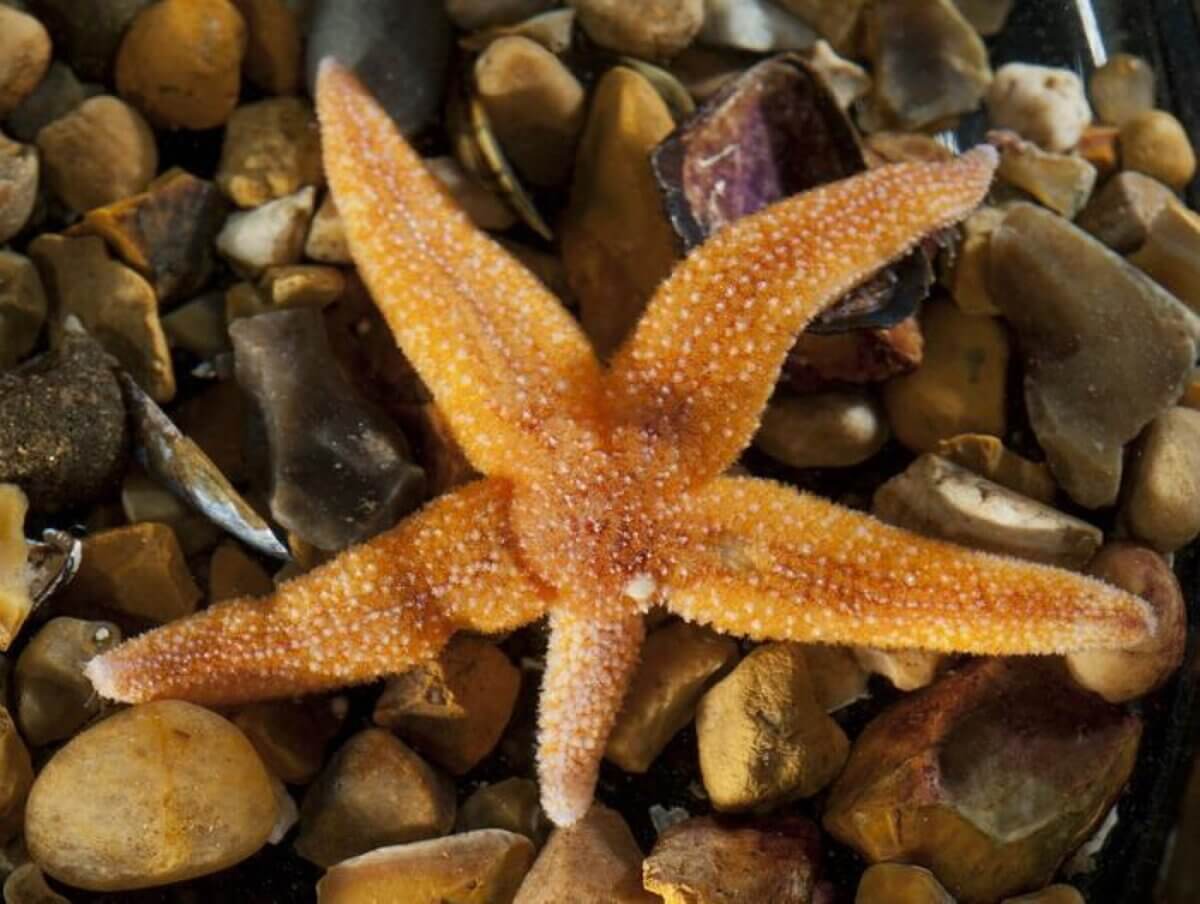
Photograph of a specimen of the common European starfish Asterias rubens with a regenerating arm. Starfish shed arms (autotomy) when attacked by predators and then regenerate a new arm to replace the lost arm. Research by scientists at Queen Mary University of London have uncovered the mechanisms of autotomy by identifying a neurohormone that promotes arm loss in starfish. (Credit: Professor Maurice Elphick / Queen Mary University of London)
LONDON — In the depths of the ocean, a fascinating demonstration of survival unfolds. A predator swoops in, jaws snapping at a seemingly defenseless starfish. However, in a twist that would make Houdini proud, the starfish pulls off the ultimate escape act – it sheds an arm and slips away, leaving its attacker with nothing but a snack-sized appendage.
This remarkable feat of self-amputation, known as autotomy, has long fascinated scientists. Many animals, including lizards, crabs, and starfish, use this remarkable adaptation to escape predators or dangerous situations. Now, researchers at Queen Mary University of London have uncovered a key secret behind this marine magic trick, and it’s all thanks to a tiny molecule with a big job.
In a study published in the journal Current Biology, scientists have identified a neuropeptide that acts as an “autotomy-promoting factor” in starfish. The discovery of this molecule, dubbed ArSK/CCK1, marks the first time a specific molecule has been linked to the regulation of autotomy in animals.
Neuropeptides are small protein-like molecules used by neurons to communicate with each other and with other cells in the body. In this case, ArSK/CCK1 belongs to a family of neuropeptides related to sulfakinin in insects and cholecystokinin in vertebrates, which are known to regulate feeding behavior and stress responses.
The scientists’ curiosity was piqued when they observed that injecting ArSK/CCK1 into starfish sometimes triggered arm autotomy. To explore this phenomenon further, they devised an experiment combining mechanical stimulation with neuropeptide injection. They clamped one arm of each starfish midway along its length and then injected either ArSK/CCK1, a related neuropeptide called ArSK/CCK2, or water as a control.
In starfish injected with ArSK/CCK1, a whopping 85% autotomized the clamped arm. Even more surprisingly, 46% of these animals also shed one or more additional arms. In contrast, starfish injected with ArSK/CCK2 showed a lower rate of autotomy (27%), while those injected with water didn’t autotomize at all.
“Our findings shed light on the complex interplay of neurohormones and tissues involved in starfish autotomy,” says Dr. Ana Tinoco, a member of the research team now working at the University of Cadiz in Spain, in a statement. “While we’ve identified a key player, it’s likely that other factors contribute to this extraordinary ability.”
How exactly does a starfish tell its arm to ‘let go’?
That’s where ArSK/CCK1 comes in. This neuropeptide belongs to a family of molecules related to sulfakinin in insects and cholecystokinin in vertebrates – including humans. In fact, cholecystokinin is known as the “satiety hormone” in humans, helping to regulate our appetite.
To understand the physiological relevance of these findings, the researchers examined the expression of ArSK/CCK1 in the “autotomy plane” – a specialized region at the base of starfish arms where separation occurs. They found nerve fibers containing ArSK/CCK1 in the “tourniquet muscle,” a band of muscle that constricts the arm during and after autotomy.
This suggests that when a starfish is stressed – say, by a hungry seagull – it releases ArSK/CCK1, which triggers the tourniquet muscle to contract. This contraction, combined with other physiological changes, allows the arm to break free cleanly.
Researchers say the discovery provides valuable insights into the neural control of autotomy in starfish and potentially other animals. It suggests that ArSK/CCK1 may work in concert with other signaling molecules to coordinate the complex process of arm detachment, which involves muscle contraction, tissue softening, and breakage.
The story doesn’t end there. Starfish possess incredible regenerative abilities, allowing them to regrow lost limbs over time. This aspect of starfish biology has caught the attention of researchers in fields far beyond marine biology.
“This research not only unveils a fascinating aspect of starfish biology but also opens doors for exploring the regenerative potential of other animals, including humans. By deciphering the secrets of starfish self-amputation, we hope to advance our understanding of tissue regeneration and develop innovative therapies for limb injuries,” says Professor Maurice Elphick, who led the study.
In the social media era, we could say the starfish has mastered the art of the strategic “unfollow” – cutting ties when the situation gets dicey. Unlike our digital dramas, however, this biological disconnection leads to renewal and regeneration. Perhaps there’s a lesson here for us humans: sometimes, letting go is the first step towards growing anew.
Paper Summary
Methodology
The researchers used a combination of behavioral experiments and molecular techniques to investigate autotomy in starfish. They first observed that injecting ArSK/CCK1 sometimes caused arm autotomy. To study this further, they developed a method to induce autotomy reliably by clamping an arm with a clip.
They then combined this mechanical stimulation with injections of ArSK/CCK1, ArSK/CCK2, or water. The team recorded whether autotomy occurred, how long it took, and which arms were affected. To examine the presence of ArSK/CCK1 in starfish tissues, they used a technique called immunohistochemistry, which allows visualization of specific proteins in tissue sections using antibodies.
Key Results
The key findings were that ArSK/CCK1 significantly increased the likelihood of arm autotomy when combined with mechanical stimulation. While only 10% of starfish autotomized when an arm was clamped without injection, this rose to 85% when ArSK/CCK1 was injected. ArSK/CCK2 had a smaller but still noticeable effect, with 27% of injected starfish autotomizing. The researchers also found ArSK/CCK1 in nerve fibers within the tourniquet muscle, supporting its role in the autotomy process.
Study Limitations
The study focused on a single species of starfish, so it’s unclear how generalizable these findings are to other animals that exhibit autotomy. The sample sizes for some experiments were relatively small, which could affect the reliability of the results. Additionally, while the study demonstrates a link between ArSK/CCK1 and autotomy, it doesn’t fully explain the entire mechanism or rule out the involvement of other factors.
Discussion & Takeaways
This research provides the first molecular insight into the neural control of autotomy in animals. It suggests that neuropeptides like ArSK/CCK1 play a crucial role in coordinating this complex defensive behavior. The dual function of ArSK/CCK1 in regulating both feeding and autotomy hints at an integrated stress response in starfish. This study opens up new avenues for research into the evolution and mechanisms of autotomy across different animal groups.
Funding & Disclosures
The study was supported by grants from the Biotechnology and Biological Sciences Research Council and the Leverhulme Trust awarded to Maurice R. Elphick. The authors declared no competing interests.


