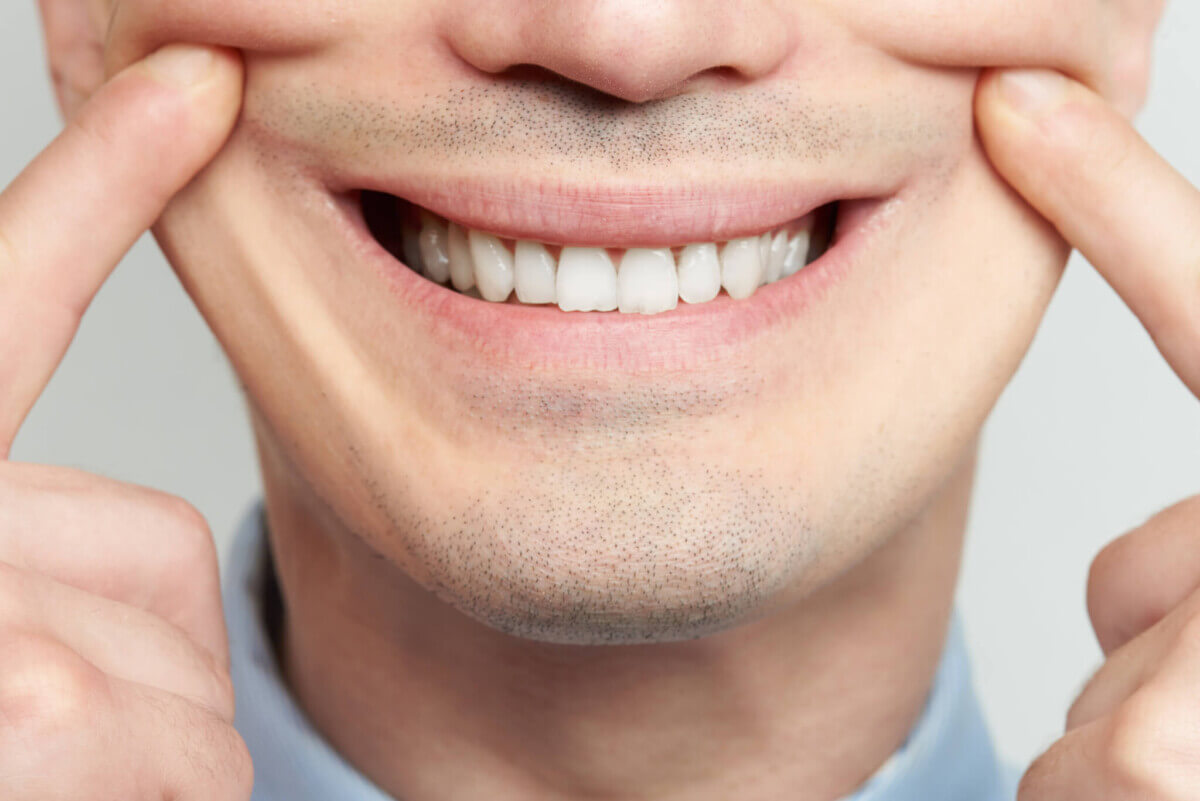
How can you spot a fake smile? (© PixieMe - stock.adobe.com)
You’ve probably heard the claim that it takes more muscles to frown than to smile. It’s usually framed as a feel-good reason to turn your frown upside down – less effort, more joy. But anatomically, the numbers don’t quite add up.
We’ve all seen it – the smile that doesn’t quite reach the eyes. From awkward family photos to strained workplace pleasantries, our brains often detect that something is off long before we consciously realize why.
But what is it about a smile that makes it feel sincere — or fake? The answer lies in a surprising blend of facial anatomy, neurology and emotional authenticity.
Not all smiles are created equal, and anatomically speaking, there are at least two distinct kinds: the Duchenne smile, which reflects genuine happiness, and the non-Duchenne smile, which tends to be more social or strategic.

Named after 19th-century French neurologist Guillaume Duchenne de Boulogne, the Duchenne smile activates two key muscle groups. The first group is associated with the corners of the mouth – where, for example, the risorius (from the Latin to smile) draws the corners outward and the zygomaticus major muscle lifts them.
The second, and most telling, muscle is the orbicularis oculi, which tightens the muscles around the eyes, producing the familiar “crow’s feet” and the gentle narrowing we associate with warmth and delight.
Fake or polite smiles, on the other hand, usually involve only the mouth muscles. The eyes remain wide or indifferent, and the smile appears more mechanical than meaningful – a kind of emotional camouflage.
Both real and fake smiles depend on cranial nerve VII, also known as the facial nerve, which sends signals from the brain to the muscles of facial expression. However, there’s a key neurological difference: Duchenne smiles tend to be generated by the limbic system, the brain’s emotional core – particularly the amygdala, an almond-shaped group of neurons that processes emotional salience.
Non-Duchenne smiles, by contrast, are often under more conscious cortical control, originating in the motor cortex. This divide means that authentic, emotionally driven smiles are involuntary.
You can’t easily will your orbicularis oculi to contract convincingly unless you’re genuinely feeling the emotion behind the expression. Even professional actors must tap into real memories or method techniques to produce them convincingly.
Why Our Brains Notice The Difference
Humans are remarkably good at detecting emotional authenticity. Studies show that even infants as young as ten months can distinguish between real and fake smiles.
Evolutionarily, this ability may have helped us assess trustworthiness, recognize true allies and avoid deception. The fusiform gyrus, a part of the brain involved in facial recognition, works closely with the superior temporal sulcus to decode expressions — helping us gauge intention as much as emotion.
In modern life, our sensitivity to facial nuance continues to matter. Politicians, customer service workers and public figures frequently rely on the social smile to navigate complex interpersonal expectations. But observers – consciously or not – often pick up on these micro-discrepancies.
Fake smiles aren’t necessarily malicious. In fact, they serve important social functions: smoothing awkward interactions, signaling politeness, defusing conflict and showing deference. They are a vital part of what sociologists call “emotional labor” – managing one’s expressions to meet societal or professional expectations.

But this kind of smiling, when sustained for long periods, can be emotionally exhausting. Studies of emotional labor suggest that being required to smile without genuine feeling – especially in service roles – is associated with increased stress, burnout and even cardiovascular strain.
As we move further into the age of AI, synthetic faces – from chatbots to virtual assistants – are being programmed to replicate human expressions. Yet the challenge remains: how do you fake authenticity? Engineers can program a smile, but without the micro-contractions around the eyes, many of these expressions still seem disingenuous. Our own anatomy sets the gold standard.
So next time you’re trying to decode someone’s expression, don’t just look at the mouth. Watch the eyes. The orbicularis oculi rarely lies.
Michelle Spear, Professor of Anatomy, University of Bristol. She does not work for, consult, own shares in or receive funding from any company or organization that would benefit from this article, and has disclosed no relevant affiliations beyond their academic appointment.
This article is republished from The Conversation under a Creative Commons license. Read the original article.


