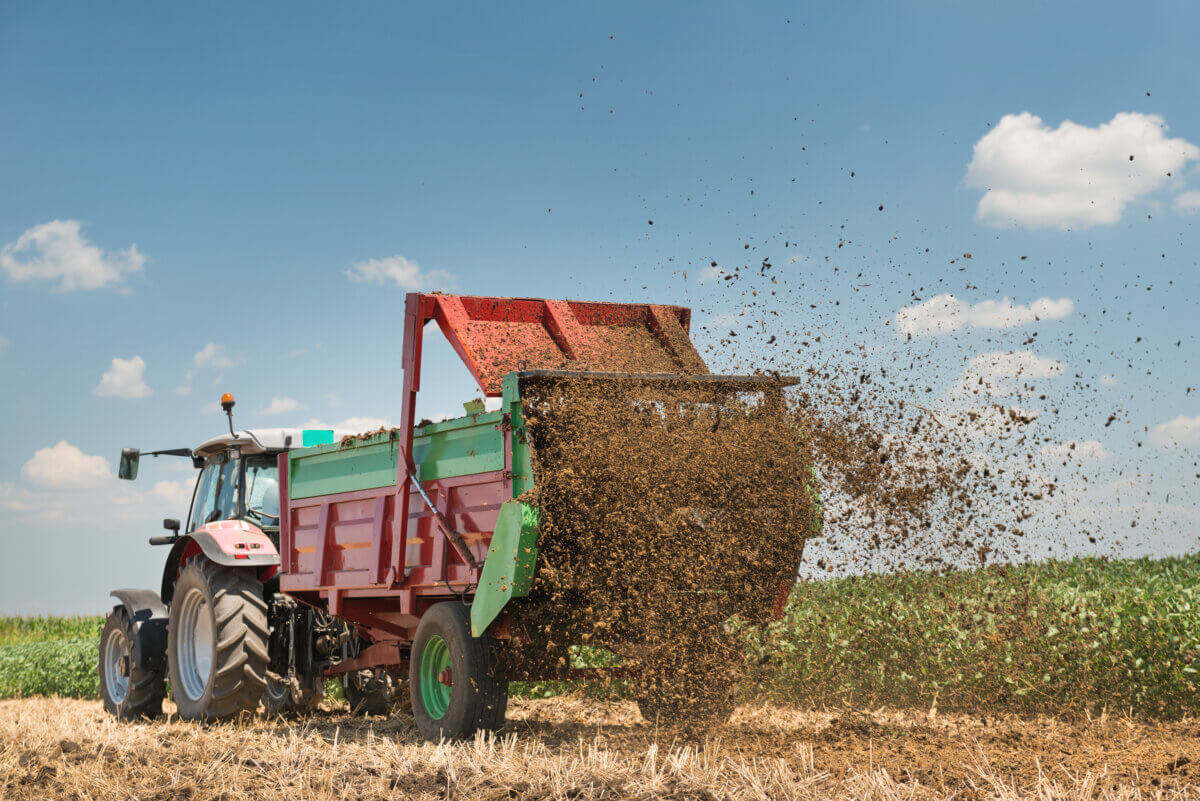
Manure fertilizer being spread in field of harvested wheat. (© Dusan Kostic - stock.adobe.com)
Would you eat potatoes grown in human poo? And how would you feel if the marigolds in your local park sprouted from human manure? In the midst of a climate crisis, human manure offers significant environmental benefits. But can we overcome the “yuck factor” to embrace this sustainable solution?
The climate crisis has us rethinking everything, including how we grow our food and maintain our parks. Traditional fertilizers, both animal-based and synthetic, have hefty environmental costs.
Nitrate pollution from animal manure can have various consequences, from excessive growth of algae to a condition called blue baby syndrome. The manufacture of synthetic fertilizers is so energy-intensive that their production accounts for up to 2% of global energy consumption and about 1.4% of global CO₂ emissions.
These fertilizers are also becoming increasingly expensive, meaning there’s even more incentive to find alternatives.
So, what if there was a way to turn one of our biggest waste products — human excreta — into a sustainable, low-impact fertilizer?
It’s not as outlandish as it sounds. For centuries, societies across the world relied on human waste, often referred to as “nightsoil,” to fertilize their crops. With the advent of modern sanitation systems, that idea has been flushed away.
But now, as urbanization makes waste collection easier and with technology that addresses historic public health concerns, human excretion-based fertilizer (HEBF) might just be making a comeback. The question is, are we ready to embrace it?
To understand public attitudes towards HEBF, my team of computational social science researchers surveyed people in England and Japan – two countries with starkly different histories regarding nightsoil. In Japan, the use of human waste in agriculture was common practice until relatively recently.
In England, however, the “great stink” of 1858, along with cholera outbreaks, drove people to flush toilet waste away through underground sewers. As a result, these two nations have developed very different views on the matter.

Our research reveals some fascinating cultural contrasts. The Japanese, with their more recent history of using nightsoil, are generally more open to the idea of HEBF, especially for food production. English people are more hesitant, particularly when it comes to their food.
However, when it comes to public parks, the English are surprisingly more accepting of human manure than the Japanese. Perhaps it’s easier to stomach the idea of human manure marigolds than human poo potatoes.
Our study also uncovered a significant gender divide. Across both countries, men were generally more accepting of HEBF than women. This could be down to a range of factors, from health concerns to a greater aversion to risk and disgust among women.
It seems that while men are more willing to take a chance on poo-grown produce, women are more skeptical, particularly when it comes to health implications.
Poo is precious
So, why does any of this matter? Tackling the climate crisis requires lots of sustainable innovations – including using our own waste more effectively. HEBF offers a low-impact, resource-efficient alternative to traditional fertilizers, but its success depends on public acceptance.
Understanding the cultural and gender-based nuances in attitudes towards HEBF is crucial for shaping how this technology is introduced and scaled up. It’s clear that a one-size-fits-all approach won’t work. Instead, we need to consider these differences when engaging the public in different countries.
Our waste is a potential resource. Safety aspects – such as the risk of spreading antimicrobial resistant bacteria found in fecal matter – were beyond the scope of this project. But as we face growing environmental challenges, it’s time to reconsider how we deal with human excreta.
While the idea of eating food grown in human manure might seem unappealing at first, it’s worth considering. By understanding and addressing public concerns, scientists can help pave the way for more sustainable, low-impact agricultural practices that are essential for our future.
Steven David Pickering is an assistant professor in the Department of Political Science at the University of Amsterdam.
This article is republished from The Conversation under a Creative Commons license. Read the original article.


Why would we object? Our ‘superiors’ in our great capital have been force feeding it to us in massive quantities for at least the last fifty years.
Poo is one thing, but you are also getting all of the chemicals and even drugs that go down the drain every day. It’s bad enough if they go into the rivers and oceans.