
This image, which combines infrared data from the James Webb Space Telescope with submillimeter observations from the Atacama Large Millimeter/submillimeter Array (ALMA), shows the doughnut-shaped torus and interconnected bubbles of dusty gas that surround the Butterfly Nebula’s central star. The torus is oriented vertically and nearly edge-on from our perspective, and it intersects with bubbles of gas enclosing the star. The bubbles appear bright red in this image, illuminated by the light from helium and neon gas. Outside the bubbles, jets traced by emission from ionized iron shoot off in opposite directions. (Credit: ESA/Webb, NASA & CSA, M. Matsuura, ALMA (ESO/NAOJ/NRAO), N. Hirano, M. Zamani (ESA/Webb)
In A Nutshell
- Webb’s surprise find: Astronomers using the James Webb Space Telescope spotted signs of complex carbon molecules (PAHs) forming inside the chaotic core of the Bug Nebula, 3,300 light-years away.
- Challenging old ideas: These molecules were thought to need calm, sheltered environments, yet they may be forming amid jets, shocks, and fierce radiation.
- A cosmic chemistry lab: The nebula’s layered bubbles and massive dusty ring act like natural laboratories, mixing heat, radiation, and material in unexpected ways.
- Big picture: If dying stars like this routinely forge PAHs, the ingredients of organic chemistry could be far more common across the galaxy than scientists once believed.
CARDIFF, Wales — Astronomers just got a front-row seat to one of the universe’s strangest chemistry experiments, and it’s happening inside the death throes of a star. Using the James Webb Space Telescope (JWST), researchers have found evidence that complex carbon molecules, the same kind that form the scaffolding of organic chemistry, may actually be taking shape in one of the harshest places imaginable: a planetary nebula known as the Bug Nebula (or Butterfly Nebula).
The discovery is surprising because scientists used to think delicate molecules like these could only survive in calm, protected environments. Instead, Webb has revealed that the chaos of a dying star may create the perfect crucible for chemical complexity. “This may be the first identification of a PAH formation site in a [planetary nebula],” the authors cautiously write in their paper, published in Monthly Notices of the Royal Astronomical Society.
What Are PAHs and Why Do They Matter?
The molecules in question are called polycyclic aromatic hydrocarbons (PAHs). If that sounds intimidating, think of them as tiny carbon hexagons, or little honeycomb-shaped structures made of fused rings. On Earth, PAHs show up everywhere from charred food to the soot from a campfire. In space, they’re sprinkled through galaxies, meteorites, and dust clouds, though exactly where they form has remained a mystery.
Scientists care about PAHs because they represent a step toward the complex chemistry that underlies life. They’re not “life molecules” themselves, but they’re a natural bridge between simple carbon atoms and more elaborate organics.
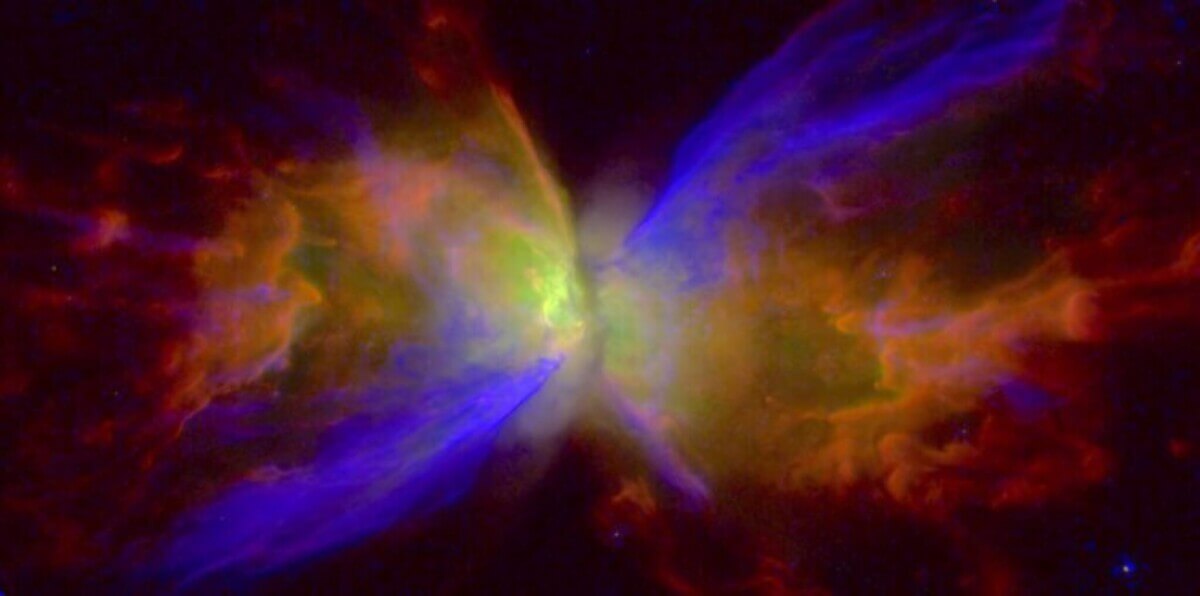
Meet the Bug Nebula
The Bug Nebula, catalogued as NGC 6302, lies roughly 3,300 to 3,400 light-years from Earth. Its central star is blazing hot, about 220,000 degrees Kelvin, nearly 40 times hotter than our Sun’s surface. Viewed through a backyard telescope, the nebula has a winged, butterfly-like shape, which inspired its nickname.
When a star like this one nears the end of its life, it sheds its outer layers into space, creating glowing shells of gas and dust. These planetary nebulae are some of the most colorful and dramatic sights in astronomy. But they’re also violent: fast winds, radiation, and shock waves churn the material into bizarre structures. That makes them seem like unlikely places for delicate molecules to grow.
Bubbles, Layers, and a Chemistry Surprise
Webb’s Mid-Infrared Instrument (MIRI) gave astronomers their sharpest map yet of the Bug Nebula’s heart. What they found was a set of expanding bubbles of gas; not a single smooth outflow, but a series of “impulsive ejections” that shaped the nebula’s structure.
Inside these bubbles, gases are layered like an onion. Closest to the star is intensely ionized hydrogen (atoms stripped of electrons by the star’s fierce radiation). A bit farther out, molecular hydrogen (H₂) re-forms. And, surprisingly, PAHs show up beyond that in a zone where scientists didn’t expect to find them.
In more familiar star-forming regions like the Orion Nebula, PAHs usually lie closer to the source of radiation. The Bug Nebula flips that pattern. This odd layering is a clue that something very different is driving the chemistry here.

Jets, Shocks, and Powerful Radiation
The nebula isn’t quiet. The Webb telescope detected jets of iron and nickel gas blasting outward at up to 115 kilometers per second (about 250,000 miles per hour). These jets carve paths through the surrounding dust and gas, mixing material and helping to sculpt the nebula’s butterfly shape.
The energy environment is extreme. The team measured nearly 200 emission lines from different atoms and molecules, some requiring photon energies up to 205 electron volts to excite. To put that in perspective, visible light carries just 2 or 3 electron volts. These conditions are harsh enough to strip multiple electrons off silicon atoms, yet, paradoxically, they may also create the ultraviolet radiation needed to assemble PAHs.
Surrounding the core is a dense, dusty torus, a ring-shaped structure weighing somewhere between 0.8 and 3 times the mass of our Sun. That’s a staggering amount of material, equivalent to the bulk of an entire star.
This ring contains unusually large dust grains, some up to a few microns across (bigger than typical cosmic dust), along with crystalline silicates. Because the torus is relatively stable, it may act like a natural foundry, allowing slow-burn chemical reactions to proceed for long periods.
How Could PAHs Form Here?
So what’s actually sparking the chemistry? The researchers propose two possibilities.
- Shocks from the hot bubble: As the inner bubble expands, it likely drives a radiative shock into the surrounding gas. That shock generates ultraviolet light, which can split molecules apart and then re-form them in new arrangements, a process that could build PAHs step by step.
- Soft X-rays from the central star: The star is hot enough to emit X-rays, which could also contribute to the chemistry. However, no X-ray emission has yet been detected from the Bug Nebula, so this remains a hypothesis in need of further data.
Either way, it seems that violence and radiation, once thought to be purely destructive, may actually be part of the recipe for molecular complexity.

A New Way of Thinking About Cosmic Chemistry
Traditionally, astronomers thought PAHs formed in gentle outflows or cool clouds, safe from harsh starlight. The Bug Nebula challenges that idea. Instead, dynamic, energetic events might actually be the birthplace of these molecules.
The finding doesn’t mean the nebula is brewing life. But it does hint that the ingredients of organic chemistry may be more widespread, and more resilient, than scientists believed. If PAHs can form in a turbulent stellar graveyard like this, they might be cropping up across the galaxy in all sorts of places once considered inhospitable.
The study focused on one spectacular nebula, so scientists are careful not to overgeneralize. Other dying stars may behave differently. Still, planetary nebulae are common in our galaxy, and if more of them turn out to be chemical factories, the implications are enormous.
Future JWST observations, and perhaps X-ray studies, will test whether the Bug Nebula is an outlier or part of a bigger pattern. Either way, the message is clear: when stars die, they don’t just scatter ashes into space — they may also scatter seeds of chemical complexity.
Paper Summary
Methodology
Researchers used the James Webb Space Telescope’s Mid-Infrared Instrument to create detailed spectroscopic maps of the planetary nebula NGC 6302, covering wavelengths from 5-28 micrometers across an area of approximately 18.5 by 15 arcseconds. The observations were conducted in September 2023 as part of a survey using four different spectroscopic channels. Additional data from the Atacama Large Millimeter/submillimeter Array provided observations of molecular gas. The team analyzed nearly 200 emission lines from various atomic and molecular species.
Results
The study revealed the first potential identification of an active PAH formation site in a planetary nebula, located in the outer regions of expanding stellar bubbles. The observations showed clear stratification of ionized species, with highly ionized atoms concentrated near the central star and PAH emission appearing farther out. The nebula contains a massive dusty torus with 0.8-3 solar masses of material, composed primarily of large, crystalline silicate grains. High-velocity jets were detected moving at speeds up to 115 km/s.
Limitations
The study focuses on a single, extreme example of a planetary nebula, which may not represent typical stellar environments. The spatial resolution limits the ability to distinguish between different physical processes at small scales. The interpretation of PAH formation versus excitation remains uncertain, and the role of X-ray radiation could not be definitively determined due to lack of detected X-ray emission.
Funding and Disclosures
Research was supported by multiple international funding agencies including the UK Science and Technology Facilities Council, European Research Council, Canadian Space Agency, US National Science Foundation, and Spanish research programs. The work is based on observations from the international ESSENcE consortium. No conflicts of interest were reported.
Publication Information
“The JWST/MIRI view of the planetary nebula NGC 6302 – I. A UV-irradiated torus and a hot bubble triggering PAH formation” by Matsuura, M. et al., published in Monthly Notices of the Royal Astronomical Society, Volume 542, pages 1287-1307, 2025. Accepted July 16, 2025.


