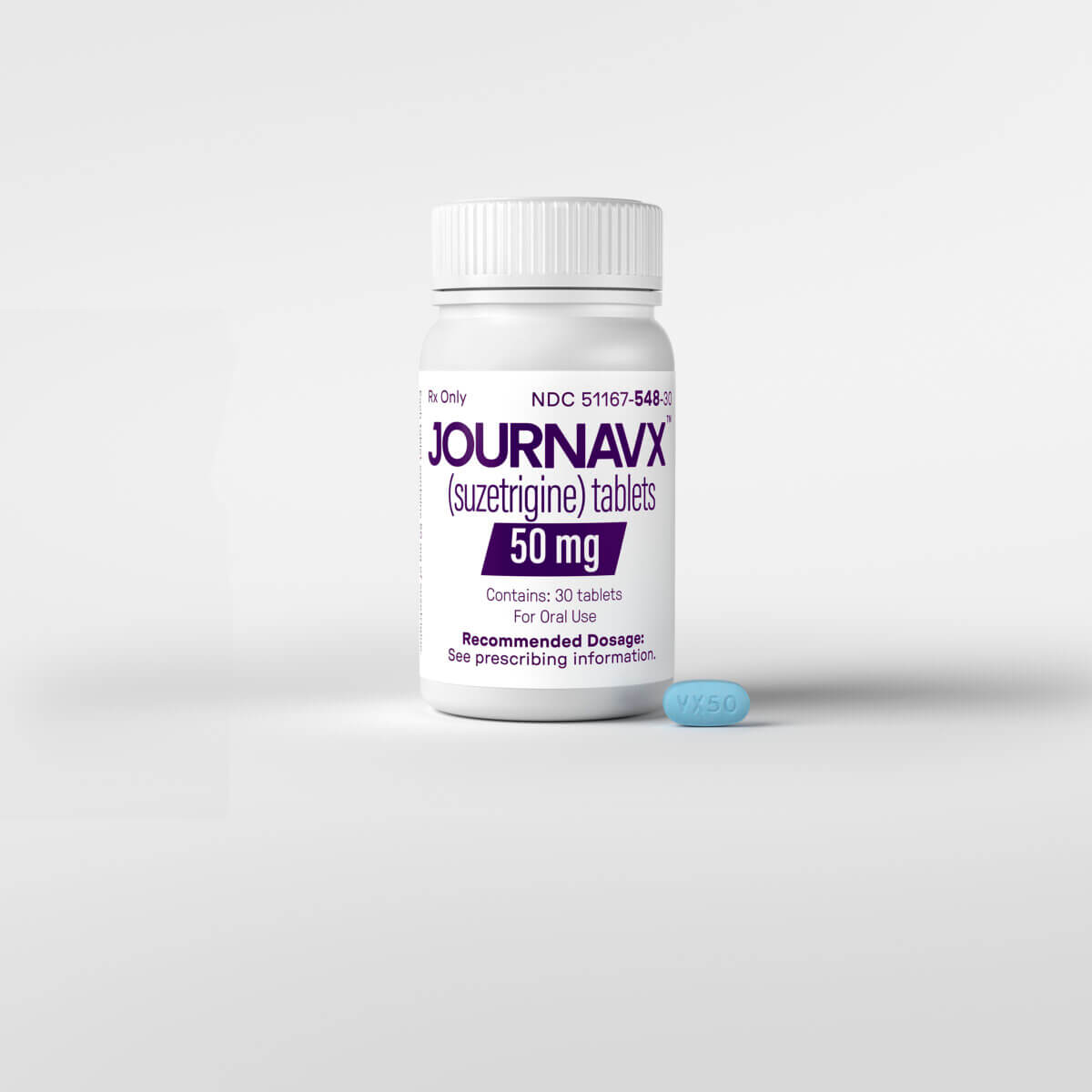
Journavx bottle and tablet. (Photo: Business Wire)
The U.S. Food and Drug Administration (FDA) created a major media stir last week when it announced the approval of suzetrigine (brand name Journavx), a unique new non-opioid, non-addictive drug for the treatment of moderate to severe acute pain. It’s the first pain medication approved in more than 25 years. The FDA granted approval of the drug to Vertex Pharmaceuticals Incorporated.
This is an especially important announcement at a time when opioid misuse, addiction, and deaths continue to be among our country’s most threatening public health problems. Provisional data from the Centers for Disease Control and Prevention (CDC) National Center for Health Statistics indicate that there were an estimated 107,543 drug overdose deaths in the United States during 2023.
“Today’s approval is an important public health milestone in acute pain management,” said Dr. Jacqueline Corrigan-Curay, acting director of the FDA’s Center for Drug Evaluation and Research, in a statement. “A new non-opioid analgesic (pain-relieving drug) therapeutic class for acute pain offers an opportunity to mitigate certain risks associated with using an opioid for pain and provides patients with another treatment option. This action and the agency’s designations to expedite the drug’s development and review underscore the FDA’s commitment to approving safe and effective alternatives to opioids for pain management.”
Journavx is a 50-milligram prescription pill taken every 12 hours after a 100-milligram starter dose. The drug targets a pain-signaling pathway in the peripheral nervous system (outside the brain and spine), before pain signals reach the brain. The mechanism of action is unlike opioid medications, which act within the brain.
Among what makes this new tool for pain management exciting is that it does not create euphoria (a “high”). According to the manufacturer and researchers, that feature of the drug means that there is no potential for it to create addiction or dependence in its users.
There’s an interesting story to the drug’s discovery. Researchers learned of a family of fire walkers in Pakistan who could walk over hot coals without pain. The scientists discovered that they had an absence of a gene that mediated pain signals in response to fire. It took 25 years for the researchers to figure out how to take this genetic defect and use it to develop a drug.
The effectiveness of Journavx was evaluated in two rigorous studies of patients with acute post-surgical pain. The patients had either abdominal surgery or foot surgery. Post-operatively, the patients received either suzetrigine or a placebo for pain relief. All the participants were permitted to use ibuprofen as needed for “rescue” pain management. Both trials showed a statistically significant, greater reduction in pain with the drug compared to placebo.
On a pain-rating scale of zero to 10, with zero being no pain and 10 excruciating, the patients expressed post-operative pain, before treatment with a drug or placebo, as an average of 7. After taking suzetrigine, the pain was reduced by 3.5 points, yielding pain relief of about 50%.
The most common adverse reactions in study participants who received Journavx were itching, muscle spasms, and rash. Patients should avoid food or beverages containing grapefruit.
Cost may be a determining factor in how the drug is used. Vertex said that it has set a wholesale cost of $15.50 per 50-mg pill but that patient assistance programs would be available.


Ginger does the same thing. It is cheaper. And been around for thousands of years.