
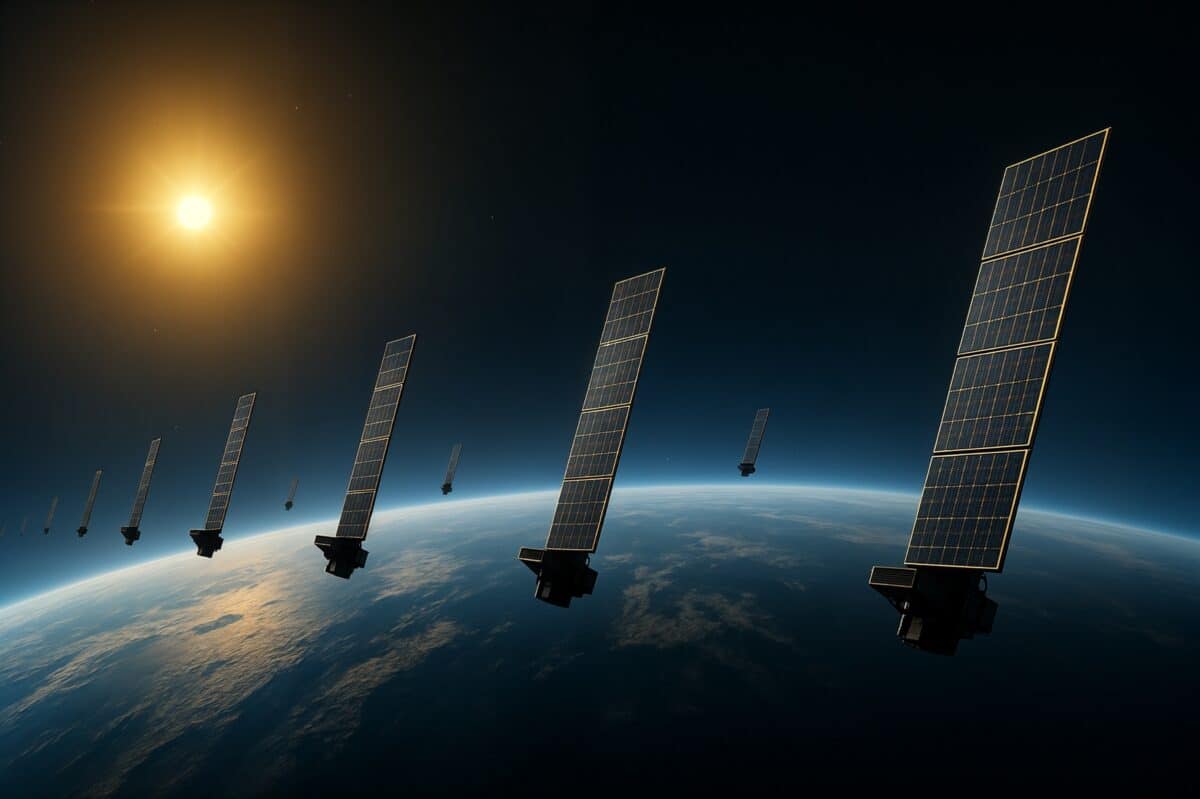
Conceptual image of a Starlink satellite orbiting Earth. (Image by PHOTOCREO Michal Bednarek)
In A Nutshell
- Starlink satellites are emitting unintended radio signals that interfere with sensitive space research.
- In some datasets, nearly 30% of telescope images contained detectable interference from Starlink.
- These emissions are appearing in radio frequencies legally reserved for astronomy, posing a threat to major cosmic studies.
- Scientists warn the interference could hinder efforts to detect signals from the early universe, such as those from the first stars.
PERTH, Australia — Astronomers trying to study the universe face a growing obstacle: unintended radio signals leaking from Elon Musk’s Starlink satellites. According to a sweeping new study, these emissions are now regularly appearing in data from sensitive radio telescopes, potentially drowning out signals from the earliest stars in the universe.
In the worst-affected cases, a detectable Starlink satellite appeared in nearly 30 percent of all telescope images. Researchers warn that without regulatory or engineering solutions, this type of interference could jeopardize efforts to detect extremely faint radio signals from over 13 billion years ago, when the first stars ignited during the cosmic “dark ages.”
The emissions aren’t part of the satellites’ intended communication functions. Instead, they’re likely leaking from onboard electronics. What makes the problem more alarming is that some of this radiation is showing up in radio frequencies reserved exclusively for scientific research.
How Starlink Satellites Create Radio Interference
The study, published in Astronomy & Astrophysics, focuses on Starlink, the largest satellite mega-constellation to date, with more than 7,000 satellites currently orbiting Earth. During the four months covered by the survey, SpaceX launched 477 more, highlighting just how rapidly the network is expanding.
Unlike optical telescopes, which take visible-light images of stars and galaxies, radio telescopes capture faint radio signals produced by cosmic objects. These signals are incredibly weak and can be easily overwhelmed by artificial interference.
The Starlink satellites aren’t aiming transmissions directly at radio telescopes. Instead, they emit unintended electromagnetic radiation, or UEMR, from their internal systems, similar to how an old appliance might cause static on nearby devices. But in this case, the “leakage” is strong enough to interfere with research-grade astronomical observations on Earth.
Scientists Conduct Largest Starlink Interference Study
To measure the scale of the problem, researchers used a radio telescope prototype called the Engineering Development Array 2 (EDA2), located in Western Australia. Over a 29-day period, they collected nearly 76 million images across 24 radio frequencies, including bands important for studying the early universe and those protected by international law.
Using software to compare satellite positions with observed interference, the team identified 112,534 signal detections from 1,806 unique Starlink satellites. They found broadband emissions spread across many frequencies, and narrowband signals that pulsed every 100 seconds.
The newer Starlink satellites were the biggest offenders. About 76 percent of the “v2-mini Ku” models and 71 percent of the “v2-mini direct-to-cell” models currently in orbit were detected. The v2-mini Ku satellites often produced both constant background noise and periodic spikes in interference.
Radio Astronomy Frequencies Under Threat
Some of the interference occurred within frequency bands protected under international radio astronomy regulations. The researchers detected 13 Starlink satellites emitting in the 73.00–74.60 MHz band and 703 satellites in the 150.05–153.00 MHz range — both designated for scientific use only.
The average interference level recorded from Starlink emissions was 93 janskys per beam. That’s roughly 93,000 times stronger than the 1 millijansky level astronomers consider the maximum tolerable threshold for detecting ancient cosmic signals.
The study also found that current international regulations don’t clearly address this type of electronic leakage. The rules mostly cover intentional satellite transmissions, not unintended emissions from internal systems. That leaves a regulatory blind spot that researchers say urgently needs to be addressed.
Other observatories, such as the LOFAR telescope in Europe, have reported similar findings, suggesting this is a global issue, not one limited to a single telescope or hemisphere.
Future of Space Research at Risk
The SKA-Low telescope, now under construction in Western Australia, will be one of the most sensitive radio observatories in the world. Its primary goal is to study the Epoch of Reionization, the period when the first stars and galaxies formed. But that mission could be compromised if Starlink interference continues to worsen.
With other satellite constellations in development, including Amazon’s Kuiper and China’s G60 system, researchers caution that the problem could soon become unmanageable.
SpaceX has previously worked with optical astronomers to reduce the visual brightness of its satellites. The company has also acknowledged the radio interference issue and suggested that emissions may originate from the propulsion or navigation systems. While that offers a starting point, researchers say technical solutions will require substantial collaboration and engineering changes.
To support future efforts, the study team has released its full dataset, enabling regulators and fellow scientists to track how satellite interference evolves over time.
They also underscore what’s at stake: if left unaddressed, the world’s push for global satellite internet could come at the cost of blocking humanity’s view into the oldest parts of the universe.
Disclaimer: This article is based on a peer-reviewed scientific study. While the findings are supported by extensive data, the study focuses solely on Starlink satellites and does not assess potential interference from other satellite systems. The authors note that further research and regulatory discussions are ongoing to address unintended satellite emissions.
Paper Summary
Methodology
Researchers used the Engineering Development Array 2 (EDA2), a radio telescope prototype in Western Australia, to conduct a 29-day survey of Starlink satellite interference. They captured approximately 76 million full-sky images across 24 different radio frequencies, including ranges protected for astronomy and important for cosmic research. The team developed automated software to detect satellite signals by comparing telescope observations with predicted satellite positions, then classified the emissions as either broadband or narrowband interference patterns.
Results
The study detected 112,534 individual instances of radio interference from 1,806 unique Starlink satellites. In the worst cases, nearly 30% of telescope images contained detectable satellite signals. Researchers identified three satellite models with different emission patterns, finding that 76% of newer v2-mini Ku satellites were detectable. Satellites were transmitting in frequencies protected for astronomy: 13 satellites in the 73.00-74.60 MHz band and 703 satellites in the 150.05-153.00 MHz band. The average interference level was approximately 100,000 times higher than limits considered acceptable for detecting signals from the early universe.
Limitations
The study focused specifically on Starlink satellites and didn’t examine interference from other satellite constellations. The research was conducted at a single location in Western Australia, and results may vary at different geographic locations or with different telescope configurations. The automated detection system was designed to minimize false positives, potentially missing some legitimate satellite detections. The study period captured only a snapshot of the rapidly evolving Starlink constellation.
Funding and Disclosures
The research was conducted by scientists from the International Centre for Radio Astronomy Research at Curtin University and DUG Technology. The paper acknowledges traditional land custodians and thanks various software developers. No specific funding sources or conflicts of interest were explicitly disclosed in the available sections of the paper.
Publication Information
The study “The growing impact of unintended Starlink broadband emission on radio astronomy in the SKA-Low frequency range” was published in Astronomy & Astrophysics, volume 699, article A307, in 2025. The research was conducted by D. Grigg, S.J. Tingay, and M. Sokolowski, with the paper received on March 27, 2025, and accepted on June 3, 2025.


