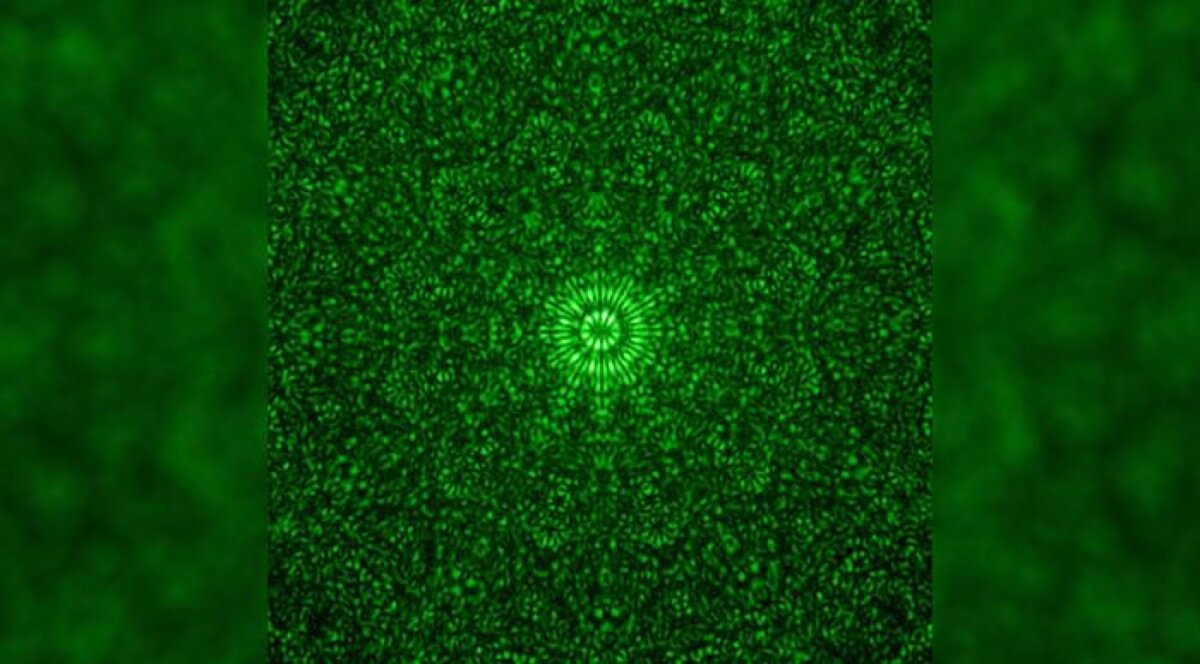
The new quasicrystal design method allows for theoretically any kind of vortex. (Credit: Kristian Arjas/Aalto University)
ESPOO, Finland — Imagine a beam of light that twists like a corkscrew as it travels through space. Now imagine being able to control exactly how many times that beam twists around itself. Scientists at Aalto University in Finland have just achieved a remarkable breakthrough in creating these twisted light beams, achieving more twists than ever thought possible. This achievement could transform how we send data through fiber optic cables and advance emerging technologies like quantum computers.
To understand why this matters, let’s break down what these scientists actually accomplished. In normal light, like what comes from a lightbulb or regular laser pointer, the light waves oscillate (move back and forth) in straight lines. But in these special beams, the light waves rotate around a central point as they travel, similar to how a hurricane moves. Scientists measure how many complete rotations the light makes using something called “topological charge” – essentially a number that tells you how many times the light twists around itself.
Until now, scientists could only create light beams that completed one or two full twists. But this new research has shattered that limit, creating vortices of light that can twist up to 19 times in one direction and 17 times in the other. It’s like the difference between a merry-go-round that only spins once versus one that spins 19 times – a dramatic increase in complexity and potential usefulness.
These light vortices, with their calm central “eye” surrounded by a ring of bright light, can carry staggering amounts of encoded information.
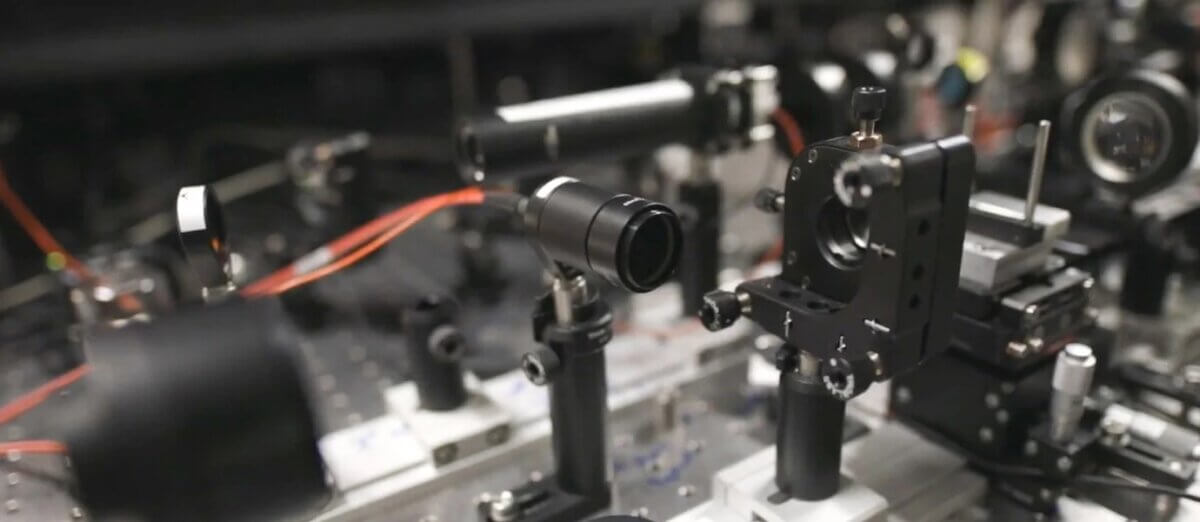
How did they do it? The key lies in a special arrangement of incredibly tiny gold particles placed on glass. These particles were arranged in patterns that never exactly repeat – similar to how the tiles in medieval Islamic art create beautiful, endless patterns. Scientists call these non-repeating patterns “quasicrystals,” and they’re different from regular crystals (like diamonds or table salt) where atoms line up in simple, repeating patterns.
To create their “light hurricanes,” the researchers placed gold particles – each about 400 times thinner than a human hair – in circular patterns about the width of three human hairs. They then covered these patterns with a special light-emitting dye solution. When they shone a powerful laser on this setup, the interaction between the dye molecules and the precisely arranged gold particles produced these unprecedented twisted light beams.
“An electrical field has hotspots of high vibration and spots where it is essentially dead. We introduced particles into the dead spots, which shut down everything else and allowed us to select the field with the most interesting properties for applications,” explains doctoral researcher Jani Taskinen in a media release.
What makes this discovery particularly exciting is how precisely they could control the twisting. By changing the arrangement of the gold particles, they could create beams that twisted exactly three, four, or five times around. But they discovered something unexpected – one of their patterns could also produce beams that twisted many more times, up to 19 complete rotations.
This achievement isn’t just scientifically interesting – it could have real-world applications. Current fiber optic cables transmit data using different properties of light, like its color or the direction it oscillates. Adding this new “twistiness” property could dramatically increase how much information we can send through a single cable. Think of it like adding extra lanes to a highway – suddenly, you can move much more traffic through the same space.
“We could, for example, send these vortices down optic fiber cables and unpack them at the destination. This would allow us to store our information into a much smaller space and transmit much more information at once,” says doctoral researcher Kristian Arjas.
The researchers estimate that this breakthrough could increase data transmission capacity by eight to 16 times compared to current optic fiber technology.
“This research is on the relationship between the symmetry and the rotationality of the vortex, i.e. what kinds of vortices can we generate with what kinds of symmetries. Our quasicrystal design is halfway between order and chaos,” says Professor Päivi Törmä, head of the Quantum Dynamics group at Aalto.
The researchers also discovered that their twisted light beams could shine in almost any direction while maintaining a very precise color – something that’s usually impossible with regular lasers, which typically shine in just one direction. This unique property could lead to new types of lasers with special capabilities.
These twisted light beams might also help advance quantum computing – a new type of computing that harnesses the strange properties of quantum physics to perform calculations that would be impossible for today’s computers. They could also improve tools that use light to manipulate microscopic objects, like individual cells or tiny particles.
The discovery raises fascinating questions about the fundamental nature of light and how it interacts with complex materials. How many times can light be made to twist? How do these highly twisted beams behave differently from regular laser beams? Scientists will likely spend years exploring these questions.
Paper Summary
Methodology
In this study, researchers designed special structures called “quasicrystals,” which aren’t arranged in regular, repeating patterns like most crystals. They used a mix of group theory, which helps understand symmetrical patterns, and a technique involving “lossy” metallic nanoparticles (tiny pieces of metal that absorb light energy).
These particles were placed carefully to amplify specific types of light behavior, especially for generating high topological charges — essentially, swirling patterns of light with unique polarization properties. The nanoparticles acted as dampeners to control energy loss, and the scientists aligned them to create an environment where the light could organize into complex patterns in high charge “modes.”
Key Results
The researchers successfully produced light patterns with very high topological charges, such as -5, +7, -17, and +19. This was a big achievement because previous structures could only reach up to topological charges of 1 or 2. The light emitted had special properties where its polarization rotated in intricate ways. Observing these polarization states provided insight into how the particles influenced light movement.
The quasicrystals produced clear laser light in distinct, intense circles and wide angles, resulting from the unique, dense arrangement of particles. These findings offer a new way to study and potentially use high-charge light beams in practical applications.
Study Limitations
The study’s methods and outcomes also have some constraints. First, the quasicrystal design relies on the very precise placement of nanoparticles, which requires meticulous fabrication techniques and can be challenging to reproduce consistently.
Additionally, while the study achieved high topological charges, the number of charges may still be limited by the structure and material properties. Another limitation is that the experiments were done in controlled laboratory settings, so it’s uncertain if this method would work as effectively in other environments or with larger-scale applications.
Discussion & Takeaways
The study opens up new possibilities for using quasicrystals to produce high-charge laser light. These findings could lead to advances in fields where specific light properties are crucial, like optical communication and sensing technologies. The researchers also discussed how their approach could be adapted to other materials and expanded for different applications, including new kinds of lasers and light-based devices. This work sets a foundation for exploring even higher topological charges and investigating how this light might interact with different materials, potentially enabling groundbreaking technological developments.
Funding & Disclosures
The study was funded by several organizations: the Academy of Finland, the Vilho, Yrjö and Kalle Väisälä Foundation, the Magnus Ehrnrooth Foundation, and the European Union’s Horizon 2020 research program. The research was also part of Finland’s Photonics Research and Innovation Flagship Program. The researchers have declared no competing interests, ensuring objectivity in their findings.


