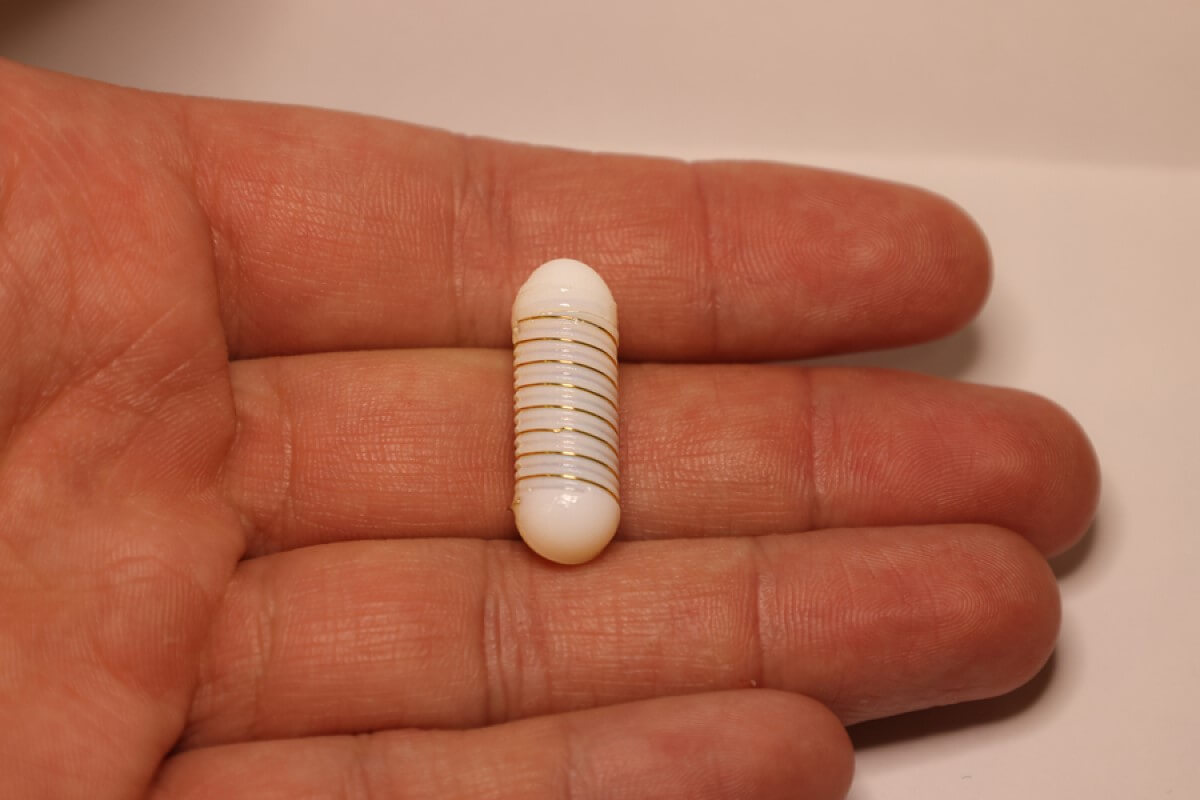
An ingestible capsule that delivers an electrical current can stimulate the release of the hormone ghrelin. Developed at MIT, the capsule could prove useful for treating diseases that involve nausea or loss of appetite, such as anorexia or cachexia. Image: Courtesy of MIT
BOSTON — A strange-looking lizard may have cracked the code for regulating hunger. Inspired by the creature’s skin, researchers from MIT and Brigham and Women’s Hospital have developed a non-invasive ingestible capsule, called the FLASH system. This new pill uses electricity to alter ghrelin, a hormone that rises when hungry. The team believes their work could possibly help patients with gastrointestinal, neuropsychiatric, and metabolic disorders.
“Our lab strives to develop systems that will make it easier and more accessible for patients to receive therapies,” says corresponding author Giovanni Traverso, MB, BChir, PhD, a gastroenterologist in the Brigham’s Division of Gastroenterology, Hepatology, and Endoscopy, in a media release. “This is an exciting proof-of-concept study and a feat of fundamental research and engineering demonstrating the potential of ingestible electroceuticals.”
“An ingestible pill that contains electronics instead of chemicals or drugs is very promising,” adds co-first author Khalil Ramadi, PhD, an assistant professor at New York University and a research affiliate at Brigham and Women’s Hospital. “It provides a way to deliver targeted electrical pulses to specific cells in the gut in a way that can regulate levels of neural hormones in the body.”
Electroceuticals, as the name might imply, use electric signals to treat different conditions. The problem with using them in the stomach is that the fluid in there can interfere with the system, so this team looked to nature to find ways around the problem and allow the system to work well with stomach tissue. That’s where the “thorny devil,” an Australian lizard, came to the rescue. Its skin is able to wick away fluid, which allows it to better absorb water. The researchers used this concept to create a surface-treated hydrophilic capsule with grooves that promote fluid wicking, while still being able to hold an electrode.
They used pig stomachs to test things out by endoscopically stimulating the organ’s inner surface for 20 minutes. They found that ghrelin increased in those with intact vagus nerves, which are nerves that stimulate ghrelin release. The FLASH system was also able to raise ghrelin levels in pigs.
In the future, the team is looking to translate their research to humans and explore the potential for using this approach in other parts of the body. They’re looking ahead to exploring FLASH and other similar technologies for eating disorders and metabolic conditions.
“This development provides many new avenues for research into the complex interconnections between the brain and gut and for furthering the use of electroceuticals as a clinical intervention,” says co-first author James McRae, a PhD Candidate at the Massachusetts Institute of Technology’s Department of Mechanical Engineering.
“It’s a relatively simple device, so we believe it’s something that we can get into humans on a relatively quick time scale,” Traverso adds in a university release.
The findings are published in the journal Science Robotics.


