
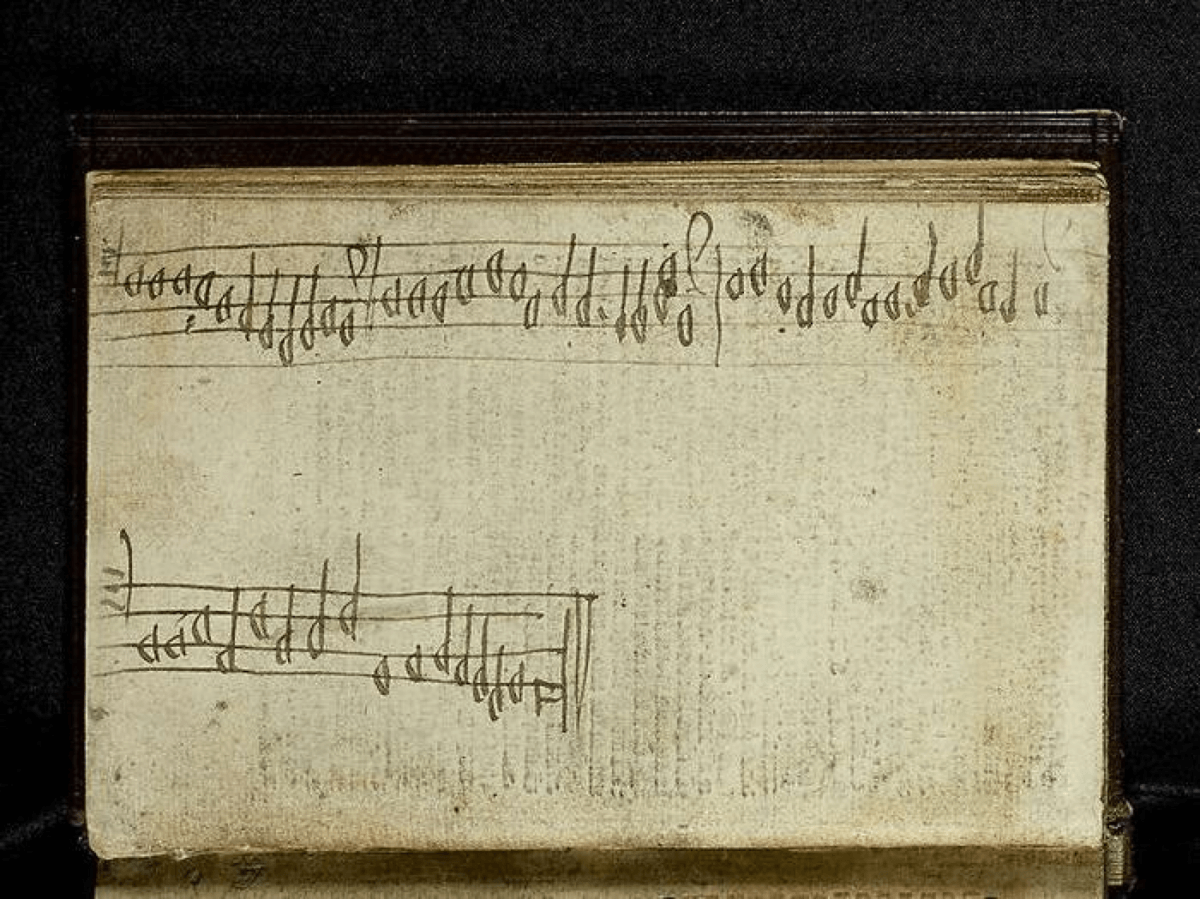
Fragment of music from the Aberdeen Breviary : Volume 1 or 'Pars Hiemalis'. Image courtesy of the National Library of Scotland Credit Images are courtesy of: National Library of Scotland and may be used under the Creative Commons Attribution 4.0 International License.
EDINBURGH, Scotland — What did the world of music sound like 500 years ago? We may finally have a clear answer. Researchers have stumbled upon a mysterious musical score hidden within Scotland’s first printed book. The fragment, containing just 55 notes scrawled on a blank page, has allowed scholars to resurrect a piece of sacred music that hasn’t been heard for nearly five centuries.
The ancient tune was found in The Aberdeen Breviary of 1510, a collection of religious texts commissioned by King James IV that now resides in Scotland’s National Library. While examining the book’s margins for handwritten notes, researchers from Edinburgh College of Art and KU Leuven in Belgium made an unexpected discovery: two lines of musical notation, with the second line roughly half the length of the first.
What makes this find particularly intriguing is that it wasn’t part of the original printed book. Instead, someone deliberately wrote it on a page that was bound into the book’s structure, suggesting they wanted to preserve this piece of music alongside the religious texts.
After careful investigation, the researchers identified the fragment as part of a hymn called “Cultor Dei,” traditionally sung during Lent. The piece uses a musical technique called polyphony, where multiple independent melodies are performed simultaneously – think of it as an early form of harmony.
“Identifying a piece of music is a real ‘Eureka’ moment for musicologists,” says David Coney of Edinburgh College of Art, who solved the musical mystery, in a media release. “Better still, the fact that our tenor part is a harmony to a well-known melody means we can reconstruct the other missing parts. As a result, from just one line of music scrawled on a blank page, we can hear a hymn that had lain silent for nearly five centuries.”
The discovery challenges long-held assumptions about Scotland’s musical past.
“For a long time, it was thought that pre-Reformation Scotland was a barren wasteland when it comes to sacred music,” explains Dr. James Cook from Edinburgh College of Art. “Our work demonstrates that, despite the upheavals of the Reformation which destroyed much of the more obvious evidence of it, there was a strong tradition of high-quality music-making in Scotland’s cathedrals, churches and chapels, just as anywhere else in Europe.”
The book itself has a fascinating history. It once served as the private prayer book of an illegitimate son of a high-ranking Aberdeen Cathedral chaplain, who later became a rural priest. Eventually, it became a family heirloom of a Scottish Catholic whose travels took him across Europe to the Habsburg and Ottoman Empires. This discovery might just be the beginning.
“It may well be that further discoveries, musical or otherwise, still lie in wait in the blank pages and margins of other sixteenth century printed books held in Scotland’s libraries and archives,” says lead author Dr. Paul Newton-Jackson of KU Leuven, noting that similar treasures could be hiding in plain sight.
The research has been published in the journal Music and Letters, offering a rare glimpse into the sophisticated musical traditions of pre-Reformation Scotland and proving that sometimes the most remarkable discoveries can be found in the margins of history.
Paper Summary
Methodology
The researchers employed a combination of historical document analysis, musical transcription, and paleographic techniques. They meticulously examined multiple Scottish music sources from the sixteenth century, such as the Carver Choirbook and the Dunkeld Partbooks, alongside newly discovered fragments like the Aberdeen Breviary Fragment. Special attention was given to the identification of music notation types, the relationship between notated music and its potential liturgical functions, and the broader historical and cultural context of these musical sources.
Key Results
The study revealed significant insights into the polyphonic traditions of sixteenth-century Scotland, particularly highlighting the rarity and value of the Aberdeen Breviary Fragment. This fragment, discovered within a printed liturgical book (the Aberdeen Breviary), contained polyphonic music that was linked to specific liturgical practices and showcased the survival of polyphonic music in Scotland post-Reformation. The fragment was identified as part of a faburden, a specific type of polyphony, which enriched the understanding of Scottish musical practices.
Study Limitations
The primary source, the Aberdeen Breviary Fragment, is a single piece of a potentially larger polyphonic setting, making comprehensive conclusions about its use and origin challenging. There are also significant gaps in the historical record regarding the use and prevalence of such musical forms in Scotland, which limits the ability to generalize findings. Finally, some of the interpretations of the music’s function and context rely on educated guesses rather than solid evidence, particularly concerning the exact usage of the fragment in liturgical settings.
Discussion & Takeaways
This research underscores the complexity of musical life in sixteenth-century Scotland and highlights the interplay between liturgical practices, musical composition, and cultural preservation. The study suggests that despite the Reformation’s impact, there was a continuous, albeit diminished, tradition of complex musical practice in Scotland. It also points to the need for further research into other surviving sources that could provide additional context and insights into Scottish polyphony.
Funding & Disclosures
The research did not specify any particular funding sources or conflicts of interest.


