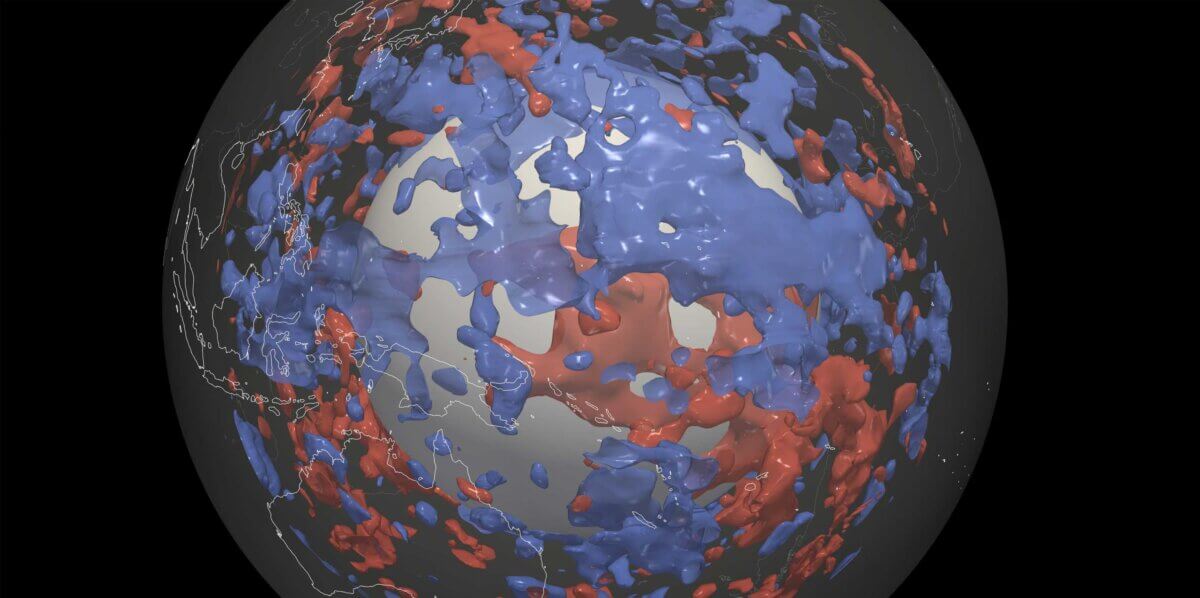
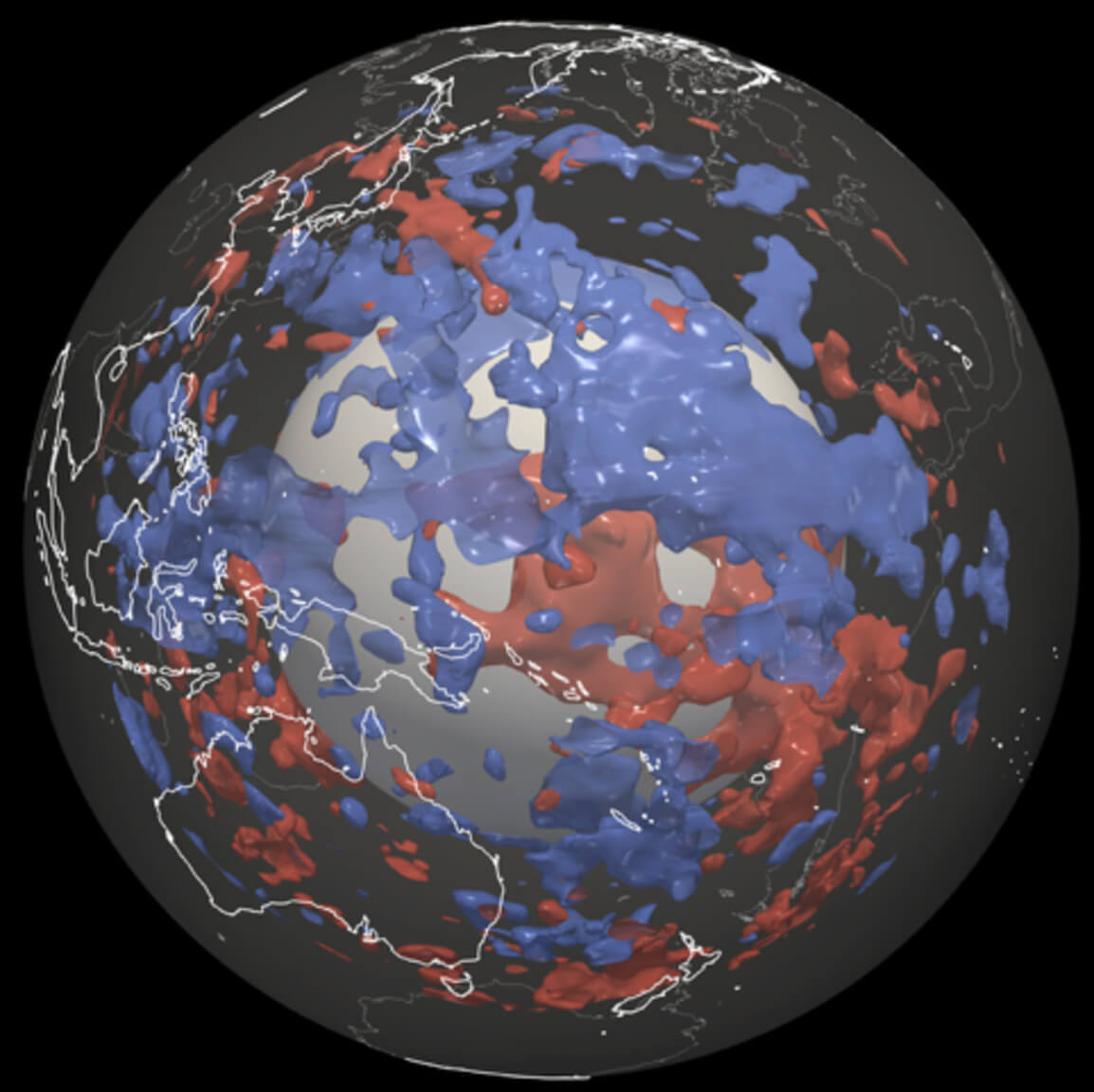
A new computer model visualizes material in the lower mantle that cannot come from subducted plates. (Credit: Sebastian Noe / ETH Zurich)
Supercomputer unveils unexpected anomalies lurking in Earth’s lower mantle
ZURICH, Switzerland — Miles beneath the Pacific Ocean, in a region of Earth’s mantle where conventional wisdom says nothing unusual should exist, scientists have discovered something extraordinary. Using innovative technology to analyze seismic waves, researchers have identified massive structures that challenge fundamental theories about how our planet formed and evolved. It’s as if we’ve discovered a new geological continent – not on Earth’s surface, but deep within it.
Just as doctors use ultrasound waves to peer inside the human body without surgery, geophysicists employ seismic waves from earthquakes to study Earth’s deep interior. When earthquakes occur, they send waves in all directions through the planet. These waves travel at different speeds depending on the materials they encounter, getting bent, bounced, and scattered along the way. By recording these waves at seismic stations worldwide, scientists can create images of structures deep within Earth, much like creating a medical scan of our planet.
For decades, this technique revealed fast-moving wave patterns primarily beneath areas where tectonic plates collide and one plate dives beneath another – a process called subduction. These patterns were thought to be the remains of ancient tectonic plates that had sunk into Earth’s mantle, the layer between the crust and core. However, the earth-shattering new study, published in Scientific Reports, has uncovered something unexpected.
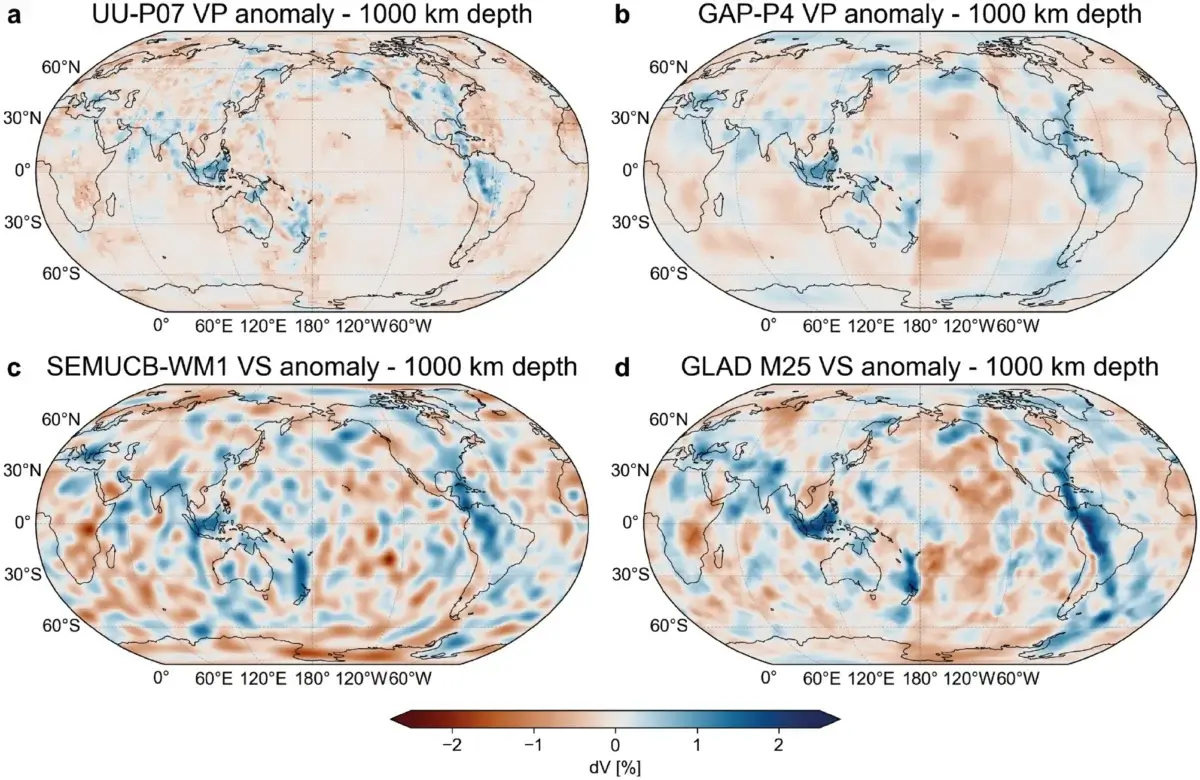
Using one of the world’s most powerful supercomputers, the Piz Daint at CSCS in Lugano, researchers from ETH Zurich and the California Institute of Technology have discovered similar wave patterns in places where they shouldn’t exist – beneath vast oceans and continental interiors, far from any known plate boundaries. “Apparently, such zones in the Earth’s mantle are much more widespread than previously thought,” says Thomas Schouten, the study’s lead author and doctoral student at ETH Zurich’s Geological Institute, in a statement.
The key to this discovery lies in a sophisticated technique called full-waveform inversion (FWI). Unlike traditional methods that analyze only specific types of seismic waves, FWI examines entire seismograms, capturing a more complete picture of Earth’s interior. This comprehensive approach requires enormous computational power but provides unprecedented detail.
The most striking finding emerged beneath the western Pacific Ocean, where researchers identified a massive anomaly between 900 and 1,200 kilometers depth. According to current plate tectonic theories, this material couldn’t have come from subducted plates because the region has no recent history of subduction zones.
ETH professor Andreas Fichtner, who developed the computer model, draws a medical parallel: “It’s like a doctor who has been examining blood circulation with ultrasound for decades and finds arteries exactly where he expects them. Then if you give him a new, better examination tool, he suddenly sees an artery in the buttock that doesn’t really belong there. That’s exactly how we feel about the new findings.”
The discovery suggests these deep Earth structures might have diverse origins, Schouten explains. They could be ancient silica-rich material that has survived since the mantle’s formation about 4 billion years ago, despite continuous churning movements. Alternatively, they might be zones where iron-rich rocks have accumulated over billions of years due to these mantle movements.
The research team emphasizes that current models only show wave speed patterns, which alone cannot fully explain Earth’s complex interior. Future research will need to delve deeper into the material properties creating these patterns, requiring even more sophisticated models and computational power.
Paper Summary
Methodology
The research approach represents a significant advance in how scientists study Earth’s interior. Traditional seismic tomography only analyzes specific earthquake waves, primarily focusing on direct waves that travel along predicted paths. The new full-waveform inversion method, however, examines entire seismograms – including reflected, refracted, and scattered waves that traditional methods ignore. This is comparable to upgrading from a basic X-ray to a full CT scan, providing a much more complete picture.
The team used data from seismic stations worldwide, with particular attention to waves traveling through previously understudied regions like ocean basins and continental interiors. The massive computational requirements of processing this data necessitated the use of the Piz Daint supercomputer, one of the world’s most powerful computing systems.
Results
The study revealed several groundbreaking findings. First, it identified numerous high-velocity anomalies throughout Earth’s mantle that previous studies had missed. The most significant discovery was the large anomaly beneath the western Pacific Ocean, located at depths between 900-1200 kilometers. Unlike previously detected anomalies, which typically correlate with known subduction zones, many of these newly discovered features appear in regions with no geological record of plate subduction.
Statistical analysis showed no significant correlation between these anomalies and past subduction zones, challenging the long-held assumption that such features primarily represent remnants of subducted tectonic plates. This suggests that Earth’s mantle may be more heterogeneous – or varied in composition – than previously thought.
Limitations
While the new methodology represents a significant advance, it still faces certain constraints. The resolution of seismic imaging continues to depend on the global distribution of earthquakes and seismic stations, which remains uneven. Additionally, while FWI provides more comprehensive data, it requires enormous computational resources and makes certain assumptions about wave propagation through Earth’s interior.
The researchers acknowledge that their current models only show wave speed patterns without directly revealing the exact composition or nature of the materials causing these patterns. As Schouten notes, this represents just one property of Earth’s complex interior structure.
Takeaways and Discussion
This research fundamentally challenges our understanding of Earth’s internal structure and dynamics. It suggests that processes beyond plate tectonics may play significant roles in shaping Earth’s interior, potentially including ancient materials preserved from Earth’s early history or accumulations of iron-rich rocks formed through mantle convection.
The findings have important implications for how scientists reconstruct past plate movements and understand Earth’s thermal and chemical evolution. They also open new avenues for research into mantle composition and dynamics, suggesting that Earth’s interior may be more complex and diverse than current models indicate.
Funding and Disclosures
The research received support from multiple sources, including the European Union’s Horizon 2020 research program through the Marie Skłodowska-Curie grant, the Swiss National Science Foundation, and the Seismological Laboratory at the California Institute of Technology. The authors declared no competing interests.
Publication Information
The study, “Full-waveform inversion reveals diverse origins of lower mantle positive wave speed anomalies,” was published in Scientific Reports (2024), DOI: https://doi.org/10.1038/s41598-024-77399-2. The research represents a collaboration between ETH Zurich and the California Institute of Technology, with additional support from the Jet Propulsion Laboratory.


A “structure” is constructed! An “anomaly” is something out of the ordinary. Attention to detail. Use the right words! If the anomalies shown are actually structures, how about a supporting explanation?
We know what is in the earth….. Mt 12:40 “For as Jonas was three days and three nights in the whale’s belly; so shall the Son of man be three days and three nights in the heart of the earth.:
Hab 3:12 “Thou didst march through the land in indignation, thou didst thresh the heathen in anger.” Hell is in the heart of the earth and Jesus beat ’em up for 3 days and nights.
Hydroplate Theory by Walt Brown who has a doctorate in mechanical engineering from MIT.
Look up his book: In The Beginning.
Sounds exactly what you would expect to find from a global flood.
and all of this matters, because… ??
Information is Power . Go back to sleep and let ignorance and apathy rule yer excuse fer a life .
Information in the hands of those like you arrogant overeducated self inflated ego neanderthals, just proves how ignorant, childish & foolish you are!
They need more research money.
The publication is talking about anomalies found within the earth’s mantle, not the earth’s crust. Google search for an image of a cross section of the earth and you will understand.
I think the massive structures are remnants from when the Earth was struck by another heavenly body which created the Moon.
I think the massive structures are remnants from when the Earth was struck by another heavenly body which created the Moon.
Keep messing around in the oceans depth like this and we end up Cthulhu.
It a secret UFO base.
lol. unfortunately, this exciting hypothesis is problematic since the anomalies found deep inside the mantle would’ve had to been built by something that can withstand astronomical temperatures and pressures.
The mantle is so hot and under such immense pressures that even the behavior of mantle rocks act much more ductile (like plastic) rather than being brittle like rocks closer to the surface.
Kind of. It’s Agartha.
It could be structures built by aliens from the tic-tac Videos taken off the west coast of california by the US navy using flir radar technology
I think you meant 900 to 1,200 meters deep, not kilometers. The deepest point in the ocean is the Marianas trench which is 10,984 meters (a little under 11 kilometers). You need a better editor.
This figure is the correct figure supported by the journal paper. ????️????
This is beneath the ocean, in the mantle (“Miles beneath the Pacific Ocean, in a region of Earth’s mantle…”).
Mike, upon re-reading the article and also looking at the source, they’re right that the article is correct. They’re talking about formations inside the mantle beneath ocean, so I guess that means there are layers of other rocks/deposits on top of the irregularities they’ve found. So we’re talking DEEP. As in, the irregularities don’t even touch water, they’re multiple layers beneath the water.
Beneath the ocean, not beneath the surface of the ocean.
No, the structures are inside the mantle which is below the lithosphere/asthenosphere. So the structures are indeed way beneath the surface of the ocean floor.
I think yer a Knowie who dont .
I read where human footprints were found in the Sahara desert that dated back 150,000 years ago.
Who can say what was going on all that time.
Nice picture, what do the colors represent?
Ummmm… Hydroplate Theory anyone?