
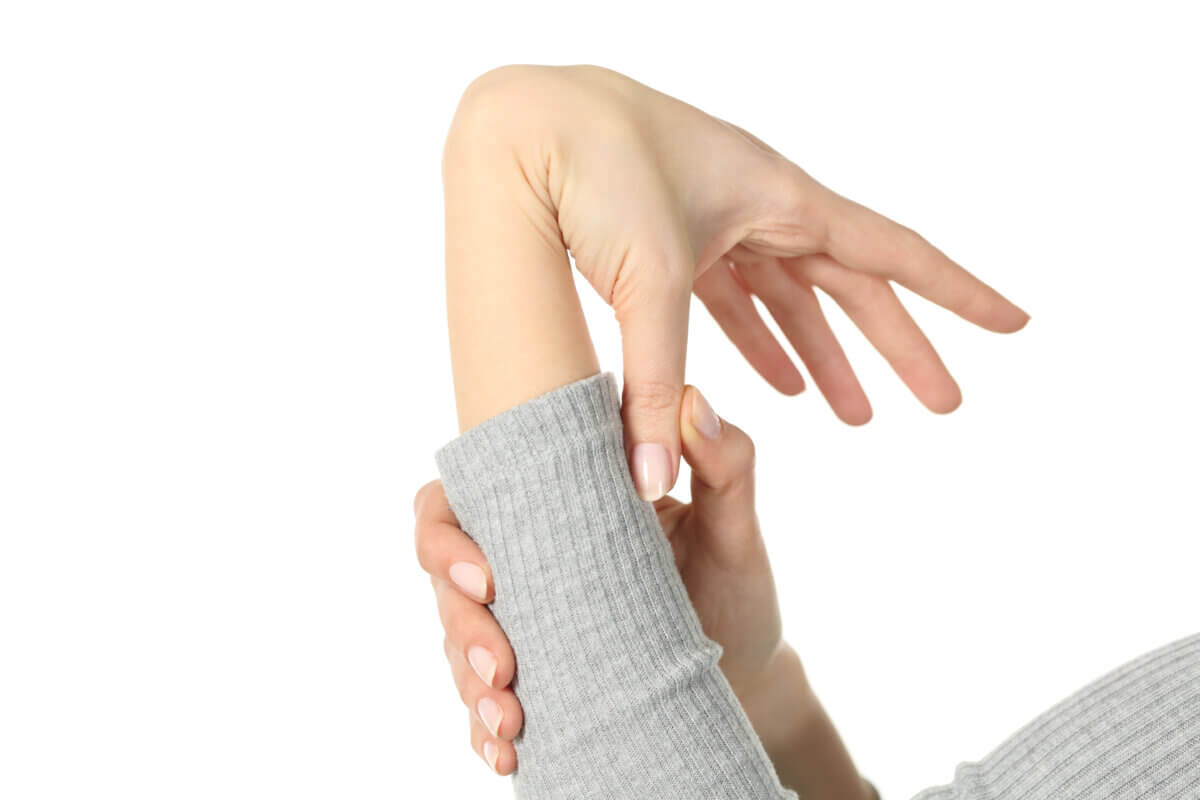
A wrist can be bent much further than we imagine. (Credit: RUB, Kramer)
BOCHUM, Germany — You’re more flexible than you think, suggests a new study on human mobility. Researchers in Germany find people can actually bend their wrists much further than their own brain believes.
“The brain obviously doesn’t have an accurate image of the body movement limits,” says Dr. Artur Pilacinski, a neuroscientist from Ruhr University Bochum and co-author of the study, in a media release.
The brain areas involved in motor planning and motor imagery are used to create a representation of their limbs, and previous studies have shown that people have a distorted perception of their bodies. For example, they typically underestimate the weight or size of their hands.
The study authors, who published their work in the journal Communications Psychology, wanted to see if there is a similar bias for body movements. A total of 84 people were enrolled in two studies and were first asked to estimate how far they moved their hands in four different directions.
Some people were asked to visualize the hand movements mentally and used an angular ruler to show how far they expected their wrists to move. Other participants were shown several positions on an angular ruler and asked to guess whether or not they could reach that spot when they bent their wrists. After making these estimations, the study authors measured their actual wrist mobility as they bent their hand inwards and outwards towards their forearm. They also tilted their wrist toward their thumb or little finger.
In three of the four hand movement rotations, the research study showed a significant difference in the mobility people assumed they had and their actual wrist mobility. On average, people underestimated their wrist mobility by at least 10 degrees. The only exception was their thumb, which the study authors explained is because the wrist is typically the least flexible in this direction.
Overall, the researchers determined that most underestimate their wrist flexibility, which may be a protective measure.
“The most likely explanation is that this bias protects us from injury because it prevents us from overshooting. This way, we may have to make small corrections during our movements, but that protects our muscles, tendons and ligaments,” says Pilacinski.
According to the authors, the new findings are helpful for sports or rehabilitation, where people are often encouraged to go beyond their usual mobility. Knowing that their actual mobility is greater than they assumed could help people better imagine themselves surpassing their limits.
Paper Summary
Methodology
The researchers conducted two different experiments to test how well people could estimate their wrist movements. In the first experiment, they worked with 59 participants who were mostly right-handed and around 21 years-old. These participants sat at a table with their hands placed in specific positions. They first watched short videos showing different wrist movements, then had to guess how far they could move their wrist in four directions: up, down, and side-to-side. After making their guesses, they performed the actual movements so researchers could measure their real range of motion. This process was repeated for both right and left hands.
For the second experiment, 25 different participants placed their hands on a special measuring tool. They had to imagine and point to where they thought their finger would reach when moving their wrist side-to-side. Like the first experiment, they then performed the actual movements to compare their estimates with reality.
Key Results
The study revealed that most people underestimated how far they could move their wrists in almost every direction. The only movement they didn’t consistently underestimate was moving the wrist inward (called adduction). Participants were less accurate at guessing movements with their non-dominant hand, which was usually their left hand. They had the most trouble estimating up-and-down movements (flexion and extension). The researchers also noticed an interesting pattern: the bigger the possible movement range, the more people tended to underestimate it.
Study Limitations
Not everyone showed the same pattern – while most people underestimated their movement range, some actually overestimated it. The study only looked at wrist movements, not other joints in the body. Most participants were young adults around 21 years-old, so the results might not apply to other age groups. The researchers didn’t investigate how factors like exercise, job type, or regular activities might affect people’s estimates. Additionally, they only tested simple movements, not complex ones involving multiple joints.
Discussion & Takeaways
The research suggests our brains naturally underestimate how far we can move our wrists. Interestingly, this might actually be helpful – it’s safer to underestimate than overestimate and risk injury. The researchers think this happens because movements aren’t always precise due to factors like fatigue or stress. Being more careful with movement estimates might help prevent strains and injuries. The study also found that people were better at estimating movements with their dominant hand, probably because they use it more often for daily tasks.
Funding & Disclosures
The study received funding from two main sources: the Université catholique de Louvain (a university in Belgium) and the Bial Foundation through grant number 260/22. The researchers declared they had no conflicts of interest, meaning their personal or financial interests didn’t influence the research. The funders didn’t have any role in how the study was designed, conducted, or reported. To maintain transparency, the researchers made their study data and computer code available for other scientists to review at osf.io/gzrj7.


