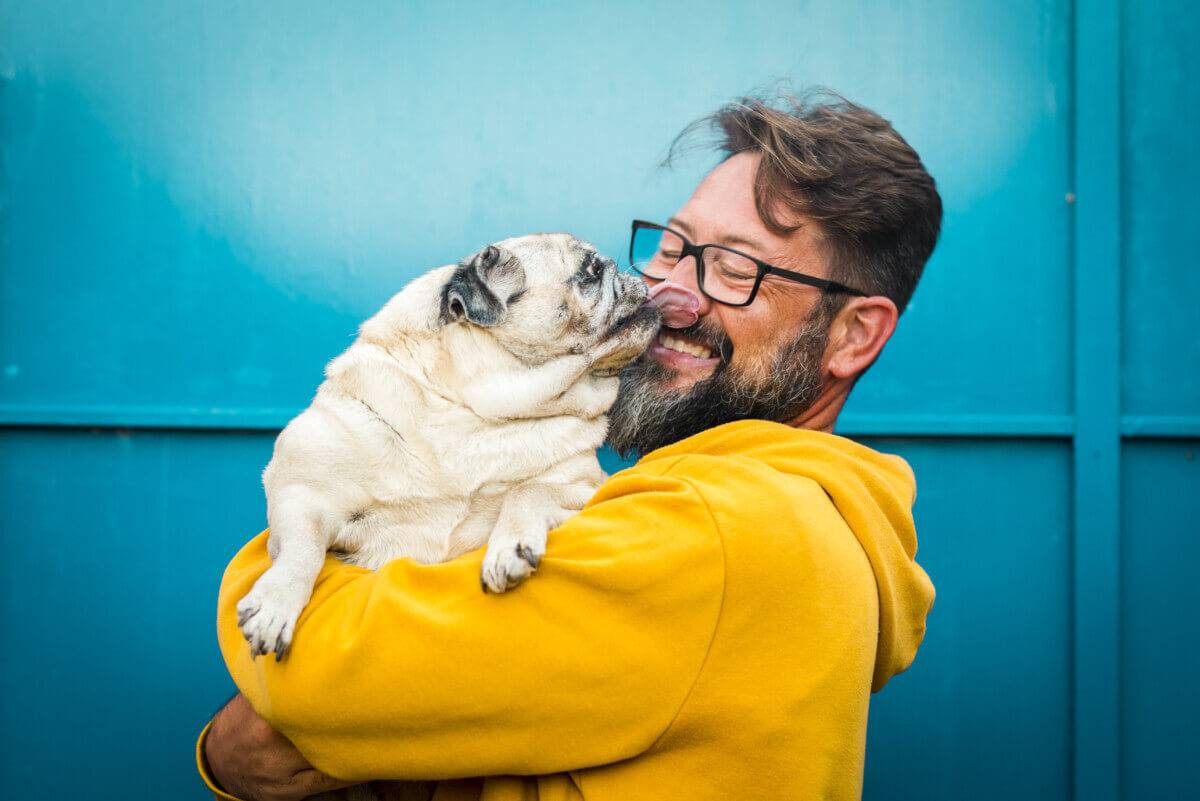
Is it fate or just puppy love? (© simona - stock.adobe.com)
4 In 5 Think Fate Brought Them and Their Dog Together
In A Nutshell
- In a survey of 2,000 dog owners, 81% said it felt like fate that they ended up with their dog.
- Three in four owners said their dog’s personality resembles their own, especially in energy, social habits, and emotional sensitivity.
- Introverts were more likely to have calm, shy dogs, while extroverts were more likely to describe their pups as outgoing, friendly, and energetic.
- Many owners see their dog as an “emotional twin” or even a soulmate, but the survey can’t say whether people choose similar dogs or grow alike over time.
Most dog owners will tell anyone who listens that their furry companion is special, that much isn’t a surprise. Still, a survey of pup parents suggests many dogs and their human caretakers may have been brought together by more than mere coincidence.
Eighty-one percent of dog owners genuinely believe it was fate that matched them with their pet, according to a Talker Research survey of 2,000 dog owners conducted in September 2025. The data backs up this feeling. Three out of four pet parents say their dog’s personality mirrors their own, particularly when it comes to energy levels, how they interact socially, and emotional sensitivity.
The connection between owner and dog personalities appears strongest along the introvert-extrovert spectrum. People who identify as extroverts were more than twice as likely to have outgoing dogs compared to introverts (38% versus 19%). Meanwhile, introverts were far more likely to describe their pets as shy, cautious, or quiet.
Extroverted owners were more likely to describe their dogs as friendly, affectionate, and energetic. They were also more than twice as likely to say their dog has an outgoing personality. Introverted owners more often described their pets as stubborn, calm, and easygoing. They were also more likely to characterize their dogs as shy, cautious, or quiet.
When Personality Types Align
Eighty-two percent of extroverts report having an extroverted dog, while less than a third of introverts (32%) say the same. Flip the script, and 62% of introverts have introverted dogs, compared to just 16% of extroverts with introverted pets.
Looking at the overall sample, 74% of pet parents said their dog resembles them in key ways, especially when it comes to energy levels, social habits, and emotional sensitivity.
Gary Tashjian, founder and CEO of Darwin’s Natural Pet Products, which commissioned the survey, points to scientific backing for these patterns. “So many pet parents feel like it was fate that brought them and their dogs together, and it’s funny how often their personalities really do match,” Tashjian said. “Science backs it up, too: Studies have found that owners and their dogs often align across major personality traits. It’s a reminder that our bond with dogs is both deeply personal and surprisingly universal.”
What drives these matches remains an open question. Do people consciously or unconsciously gravitate toward dogs that match their temperament? Or do dogs adapt their behavior to mirror their owners over time? The survey examined whether people choose pets that reflect their personality, and the results show a strong emotional connection between owners and their dogs.

Dogs as Emotional Companions
Just how deep do these connections go? More than two-thirds (68%) of respondents describe their dog as their emotional twin, and over half (56%) go even further, calling their pet their soulmate.
The emotional understanding appears mutual. Seventy-five percent of pet parents feel they share an unspoken understanding with their dog all the time or often, and 83% say their dog instantly calms them when they’re anxious. These numbers point to relationships that go well beyond simple companionship.
Darwin’s research identified distinct dog personality types that tend to match up with certain owner characteristics. According to the company’s internal findings, owners who enjoy routines and structure often end up with confident controllers, dogs that thrive on consistency and attention. Meanwhile, affectionate and outgoing owners frequently pair with affectionate socialites, the type that loves being around people and never passes up a chance to tag along to a dog-friendly cafe. Then there are independent loner dogs, which tend to gravitate toward calmer, quieter households, where strong bonds are formed with just one or two people. Many self-described introverts in the survey said this dynamic felt familiar.
“What this research really highlights is the depth of the human-dog bond,” Tashjian added. “People don’t just see their pets as companions; they see them as reflections of themselves, even soulmates. Whether it’s fate, personality, or a mix of both, the connection is so strong that many owners feel their dogs understand them in ways no one else can.”
The top five traits owners believe they share with their dogs paint a picture of the human-canine connection. Sixty-five percent say they’re both friendly, 50% describe themselves and their dogs as affectionate, and 39% say they share high energy levels. Another 39% characterize both themselves and their pets as easygoing, while 31% say they’re both independent. While every dog and owner pair is unique, these shared characteristics show up again and again across the survey’s 2,000 respondents.
Whether fate has a hand in it or not, the numbers suggest something real happens when people choose their canine companions. Dogs may not just be man’s best friend after all. For many owners, they’re more like a four-legged reflection staring back at them.
Paper Summary
Study Methodology and Sample
Talker Research conducted the online survey between September 4-10, 2025, polling 2,000 dog owners. The research used a non-probability sampling frame, drawing respondents from traditional online access panels where participants opt in for incentives, and programmatic sources where respondents were offered virtual incentives related to their online activities. Quality control measures included screening for speeders (those completing the survey faster than one-third of the median time), checking open-ended responses for relevance, using captcha to block bots, and employing digital fingerprinting to prevent duplicate responses. Cells were only analyzed if they contained at least 80 respondents, with statistical significance calculated at the 95% level. Data was not weighted, though quotas and parameters were used to reach the desired sample.
Limitations
The survey methodology has several constraints. Because it sourced from a non-probability frame using online panels and programmatic recruitment, results may not apply to all dog owners, particularly those without internet access. The research relied on self-reported data about owner and dog personalities. The methodology summary provided does not describe any independent behavioral assessments of owners or dogs. The summary also does not discuss factors such as how long owners had their dogs, whether they chose their dogs or received them as gifts, or the specific circumstances under which they acquired their pets, so it is unclear how those factors might have shaped the results. Because the data is cross-sectional rather than longitudinal, it cannot establish whether owners selected dogs with matching personalities or whether dogs and owners grew more similar over time.
Funding and Disclosures
The survey was commissioned by Darwin’s Natural Pet Products, a company that sells raw pet food and has a commercial interest in understanding the human-pet bond. Talker Research, an independent research firm, administered and conducted the survey. The study was conducted for commercial and marketing purposes rather than academic research.


I love dogs (and hate cats) but thinking it is your soulmate or some kind of special relationship akin to a human one is a selfish act. The animal doesn’t understand the full measure of what you think and thus has no agency of their own. Besides the whole idea of soulmates is from Plato and beings called the Androgynoi. They were both male and female at the same time and Zeus split them into two cause they were so happy and now the individual males and females search the world for their missing “soulmate”. Both of which were human.
Well, get your soulmate to stop shitting in my yard
You win the Internet! lol
So this confirms, dog nuttery is a mental illness