
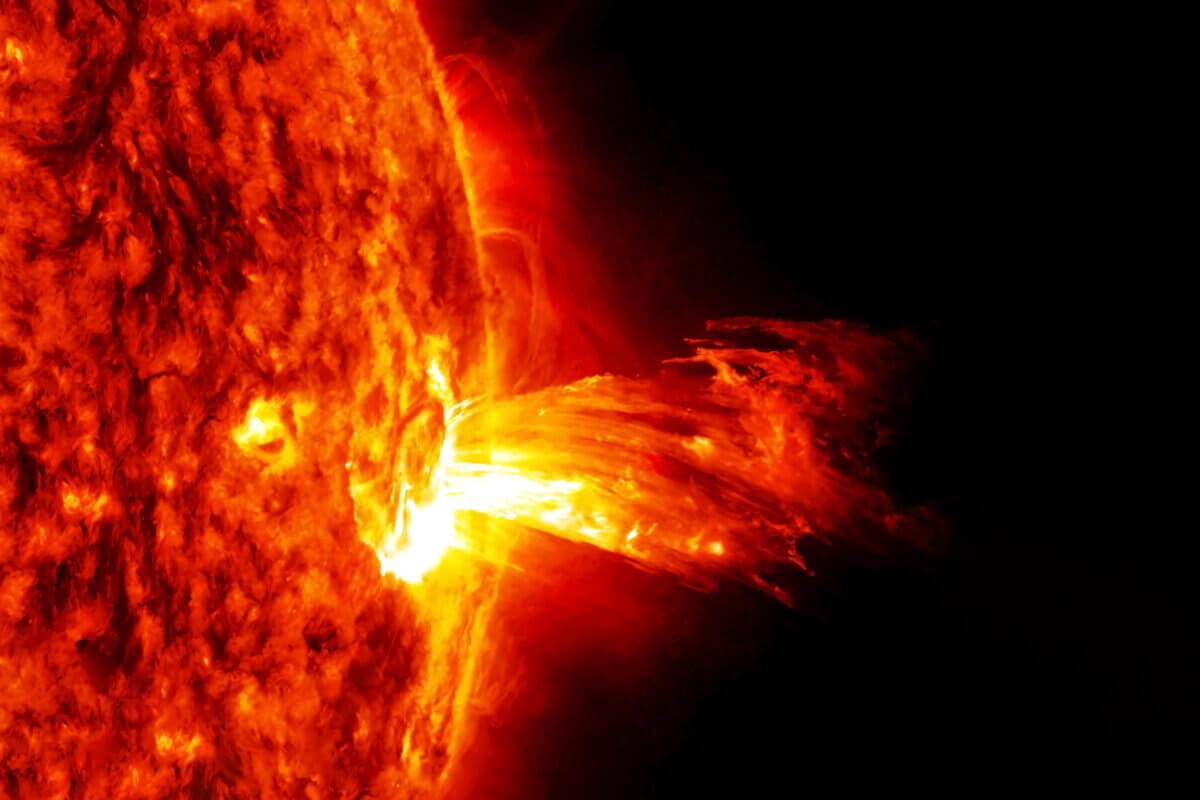
Depiction of a solar storm erupting from Sun's surface. Elements of this image furnished by NASA.(Image by Artsiom P on Shutterstock)
In a nutshell
- Scientists have identified the most powerful solar storm ever recorded, an extreme event that struck Earth around 12,350 BC, by analyzing a massive radiocarbon spike in ancient tree rings.
- Using a new climate model built for ice age conditions, researchers found the storm was about 18% stronger than the previously known record-holder from 775 AD, despite the radiocarbon signal appearing nearly twice as large due to weaker magnetic shielding and lower atmospheric CO₂ at the time.
- If a storm of similar magnitude occurred today, it could cause widespread technological disruption, damaging satellites, GPS systems, power grids, and internet infrastructure with little warning.
OULU, Finland — Fourteen thousand years ago, when humans were still painting on cave walls and hunting woolly mammoths, the sun unleashed hell. A solar storm so powerful it would make today’s worst space weather look like a light drizzle slammed into Earth, leaving a permanent scar that scientists can still read in ancient tree rings. Now, a new study from Finland confirmed what that scar means: our ancestors witnessed the strongest solar storm in history.
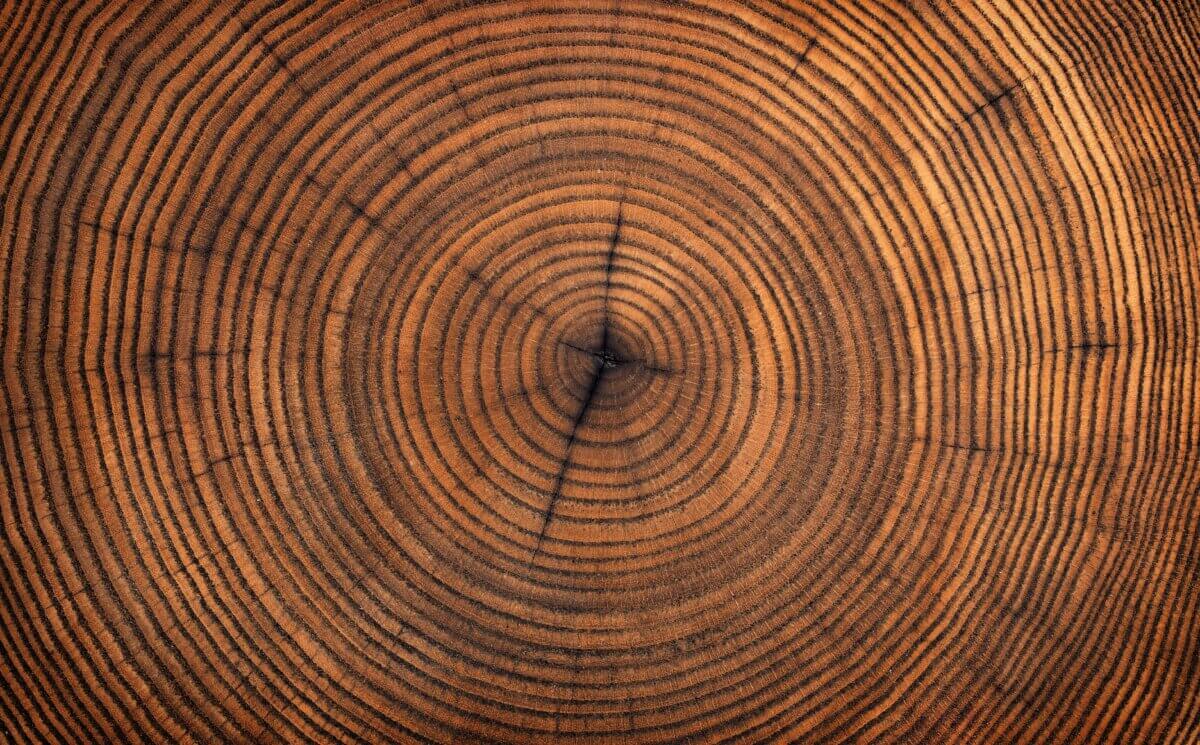
According to new research published in Earth and Planetary Science Letters, this ancient solar storm was about 18% more powerful than the previous record-holder from 775 AD. Ancient tree rings in southeastern France that absorbed radiocarbon (carbon-14) were created when the storm’s charged particles bombarded Earth’s atmosphere, leaving a permanent signature.
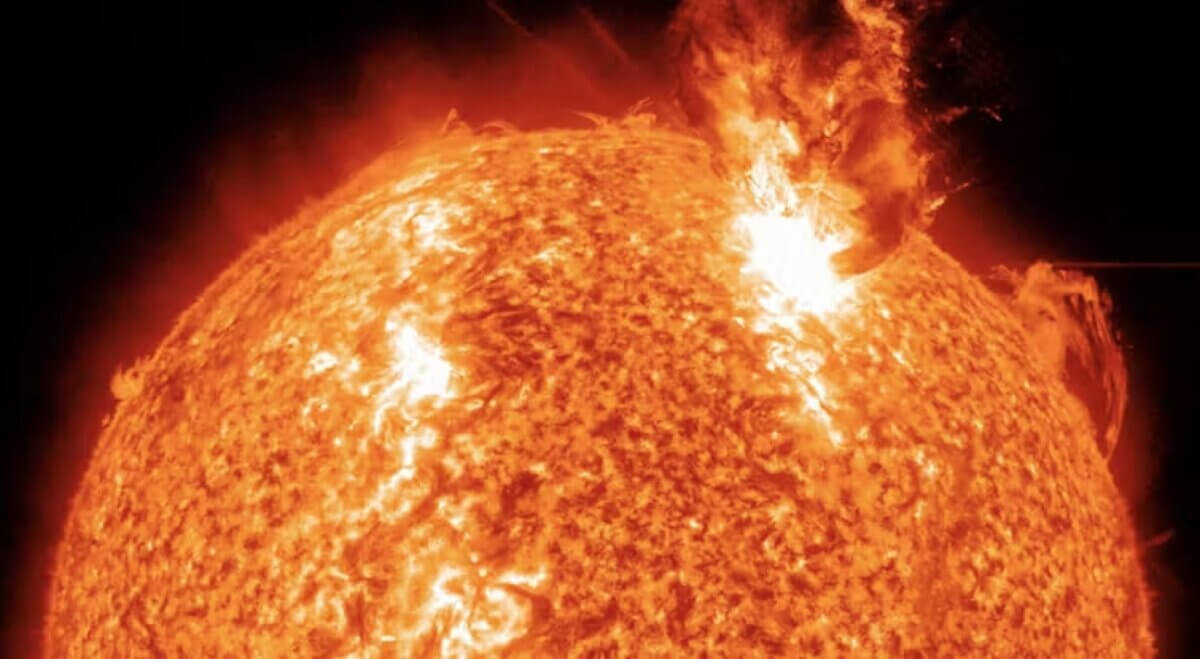
Scientists describe extreme solar particle events as rare occurrences when our sun hurls massive amounts of charged particles toward Earth at incredible speeds. These events are stronger than anything directly observed in modern times, and they can greatly distort the production of radiocarbon in Earth’s atmosphere.
The 12,350 BC storm occurred during a period when Earth’s magnetic field, our primary shield against solar radiation, was significantly weaker than it is today. This meant more of the storm’s energy could penetrate our atmosphere, creating the enormous radiocarbon spike that scientists can still detect 14,000 years later.
For comparison, the previous record-holder from 775 AD was already considered catastrophic by modern standards. That storm left its mark in tree rings across multiple continents and would have been visible to medieval observers as brilliant auroras dancing across skies far from the poles. But the newly discovered ice age storm dwarfs even that event.
Decoding Ancient Solar Storm Data
Scientists developed a new computer model called SOCOL:14C-Ex, specifically designed to analyze how radiocarbon moves through Earth’s atmosphere during different climate conditions. Previous models only worked for modern climate conditions, leaving scientists unable to study these ancient events.
The research team focused on tree ring data from southeastern France that showed an enormous spike in radiocarbon around 12,350 BC. This spike was nearly twice as large as the one from 775 AD, but scientists couldn’t determine if that meant the storm itself was twice as powerful or if other factors were amplifying the signal.
Using their new model, the researchers discovered that three main factors made the ice age storm appear more dramatic in the tree ring record than it actually was. Earth’s magnetic field was weaker during the ice age, allowing more solar particles to reach the atmosphere. Atmospheric carbon dioxide levels were lower (240 parts per million compared to 285 ppm in 775 AD), making the radiocarbon signal more concentrated. Another factor was that the colder climate affected how radiocarbon moved through the atmosphere.
When the scientists accounted for all these factors, they found the actual storm was stronger by 18% than the 775 AD event, still enough to claim the title of strongest known solar storm in human history.
Beyond determining the storm’s strength, the researchers were able to pinpoint when it likely occurred. By comparing different scenarios, they concluded the storm most probably hit Earth sometime between January and April of 12,350 BC, with early March being the most likely timeframe.
This level of precision might seem impossible for an event that happened 14,000 years ago, but it comes down to understanding how trees grow. Since trees only absorb carbon during their growing season, the radiocarbon signature varies depending on when during the year the storm occurred. By modeling different scenarios and comparing them to the actual tree ring data, scientists can narrow down the timing with surprising accuracy.
What Would a Storm Like This Do Today?
While our ice age ancestors likely experienced nothing more than spectacular light shows in the sky, a similar storm today would be catastrophic for our technology-dependent civilization. Modern estimates suggest an extreme solar storm could cause trillions of dollars in damage, knock out satellites, disrupt GPS navigation, and leave millions without power for months.
Currently, space weather monitoring gives us at most a few days’ warning before a major solar storm hits Earth. While that’s enough time to shut down sensitive equipment and protect astronauts, it’s not nearly enough to prepare for a civilization-threatening event like the 12,350 BC storm.
Solar storms this extreme are incredibly rare; scientists have only identified eight such events in the past 12,000 years. Most of these occurred during periods of otherwise normal solar activity, suggesting that even a “quiet” sun can occasionally unleash devastating storms with little warning.
This research represents the first time scientists have been able to analyze an extreme solar storm from before the current geological epoch known as the Holocene, which began about 11,700 years ago. Previously, climate models couldn’t handle the vastly different conditions that existed during the ice age.
Development of the SOCOL:14C-Ex model now opens the door for studying even older cosmic events, potentially extending our knowledge of solar behavior back tens of thousands of years. Scientists are particularly excited about the possibility of finding more ancient storms in tree ring records from around the world.
The 12,350 BC event also serves as what researchers call a “global tie point” for dating archaeological sites and geological events from the ice age period. Since the radiocarbon spike appears in tree rings worldwide, it provides a precise timestamp that archaeologists can use to synchronize their findings across different continents.
Every smartphone, GPS satellite, and power grid on Earth exists at the mercy of our sun’s mood swings. The 12,350 BC event shows that extreme solar storms aren’t just theoretical threats; they’re historical facts written in wood. We’ve been warned by trees that survived the ice age; now it’s up to us to listen.
Paper Summary
Methodology
Researchers developed a new 3D chemistry-climate model called SOCOL:14C-Ex to study how radiocarbon moves through Earth’s atmosphere during different climate conditions. They analyzed tree ring data from southeastern France showing a massive radiocarbon spike around 12,350 BC. The model was first tested on the well-studied 775 AD solar storm event, then applied to ice age conditions including lower atmospheric CO2 levels (240 ppm vs 285 ppm today), weaker magnetic field strength, and colder climate patterns. Scientists ran multiple simulations with different storm timings and strengths to find the best match with actual tree ring measurements.
Results
The 12,350 BC solar storm was 18% stronger than the previous record-holder from 775 AD, making it the most powerful solar storm in recorded history. The storm most likely occurred between January and April of 12,350 BC, with early March being the most probable timing. While the radiocarbon spike in tree rings was nearly twice as large as the 775 AD event, the actual storm strength difference was much smaller due to ice age conditions that amplified the radiocarbon signal. The model successfully reproduced measured radiocarbon levels from multiple global locations for the 775 AD event, validating its accuracy.
Limitations
The study made several simplifying assumptions, including treating radiocarbon as instantly oxidized to carbon dioxide and ignoring the return flow of carbon from oceans and vegetation back to the atmosphere. The model also assumed constant magnetic field strength and neglected 11-year solar cycle variations. Researchers focused only on a seven-year period after each storm and didn’t account for carbon decay during atmospheric transport, though they determined these factors had minimal impact on their conclusions.
Funding and Disclosures
The research was partially supported by the Research Council of Finland (Project no. 354280). One author disclosed a potential financial interest related to this funding. The team acknowledged computational support from CSC Finland and consulting assistance from international collaborators. Additional support came from the MARCARA ANR project and Saint Petersburg State University research project 116234986.
Citation
The paper “New SOCOL:14C-Ex model reveals that the Late-Glacial radiocarbon spike in 12350 BC was caused by the record-strong extreme solar storm” was authored by Golubenko, K., Usoskin, I., Rozanov, E., & Bard, E. (2025). It was published in Earth and Planetary Science Letters (661, 119383).


