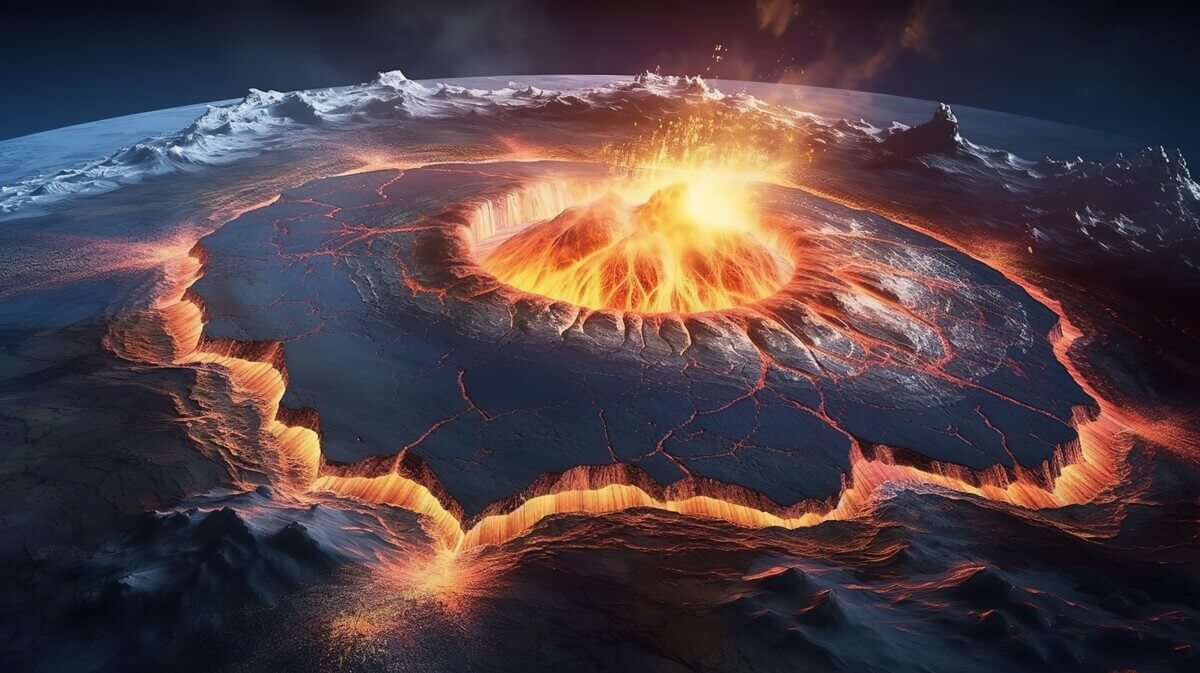
Artwork of the Ring of Fire, a region of tectonic plate boundaries around the Pacific Ocean. (© Zaleman - stock.adobe.com)
COLLEGE PARK, Md. — Scientists have uncovered evidence of a long-lost underwater collision that occurred over 100 million years ago, dramatically altering the landscape of Earth’s deep interior. This ancient event, hidden beneath the waves of the eastern Pacific Ocean, has left its mark on the very fabric of our planet, shaping the mysterious structures that lie thousands of miles below our feet.
A team of researchers, led by Jingchuan Wang from the University of Maryland, used advanced seismic imaging techniques to peer into Earth’s mantle, the layer between the crust and the core. Their findings, published in Science Advances, reveal an unexpected anomaly in the mantle transition zone, a region located roughly 250 to 400 miles beneath the surface.
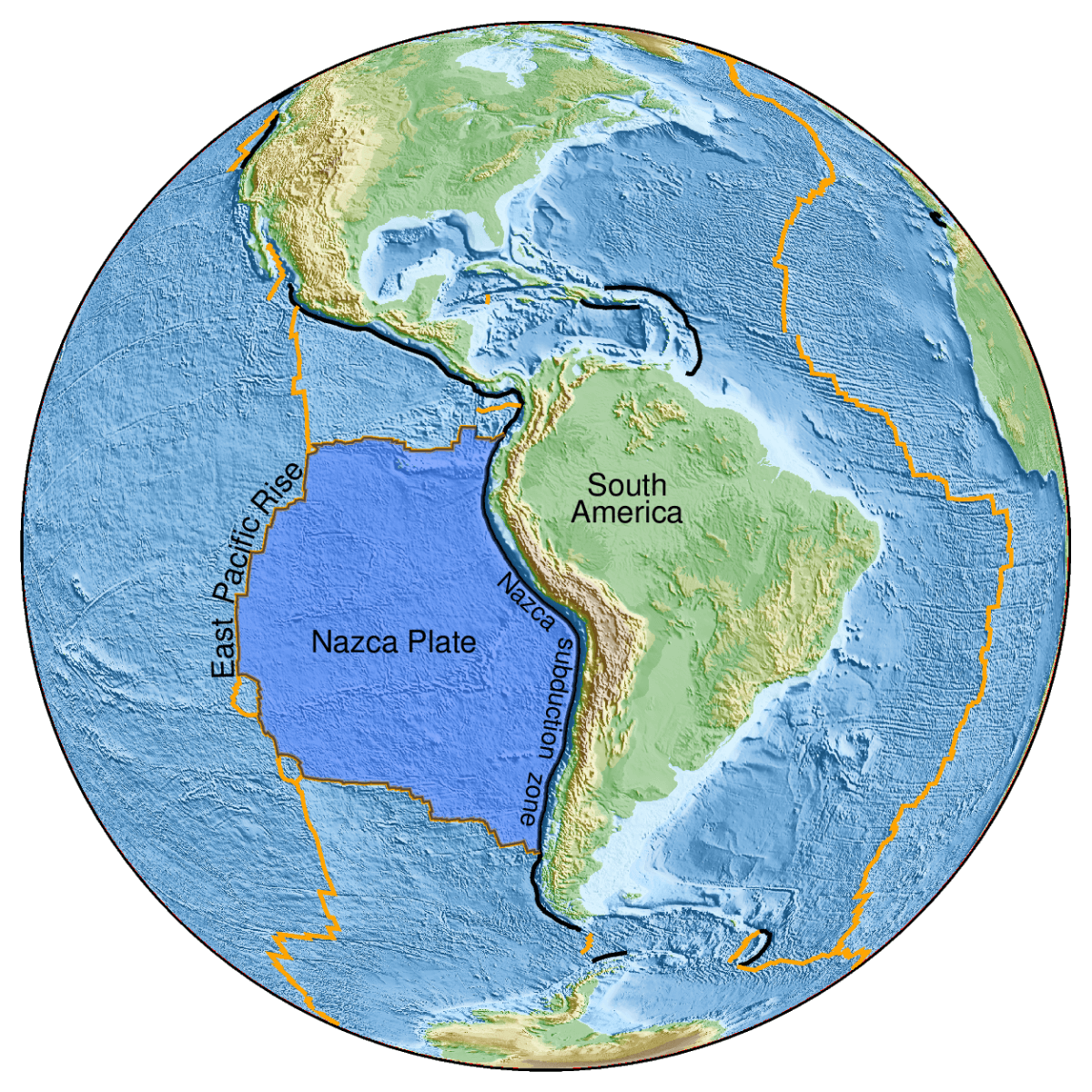
This anomaly takes the form of an unusually thick section of the mantle transition zone located east of the East Pacific Rise – the world’s fastest-spreading underwater mountain range. The thickened area, spanning about 1,200 miles, is accompanied by faster-than-average seismic velocities, suggesting the presence of colder material.
What could cause such a cold spot deep within the Earth?
The researchers propose an intriguing explanation: the remnants of an ancient tectonic plate that sank into the mantle during the Mesozoic era, between 250 and 120 million years ago.
“This thickened area is like a fossilized fingerprint of an ancient piece of seafloor that subducted into the Earth approximately 250 million years ago,” Wang says in a university release. “It’s giving us a glimpse into Earth’s past that we’ve never had before.”
This sunken plate, part of what geologists call the Phoenix Plate, likely dove beneath another oceanic plate in a process known as intraoceanic subduction. As it sank, it carried cooler material from the surface into the depths of the mantle, leaving behind a lasting thermal signature that we can detect today.
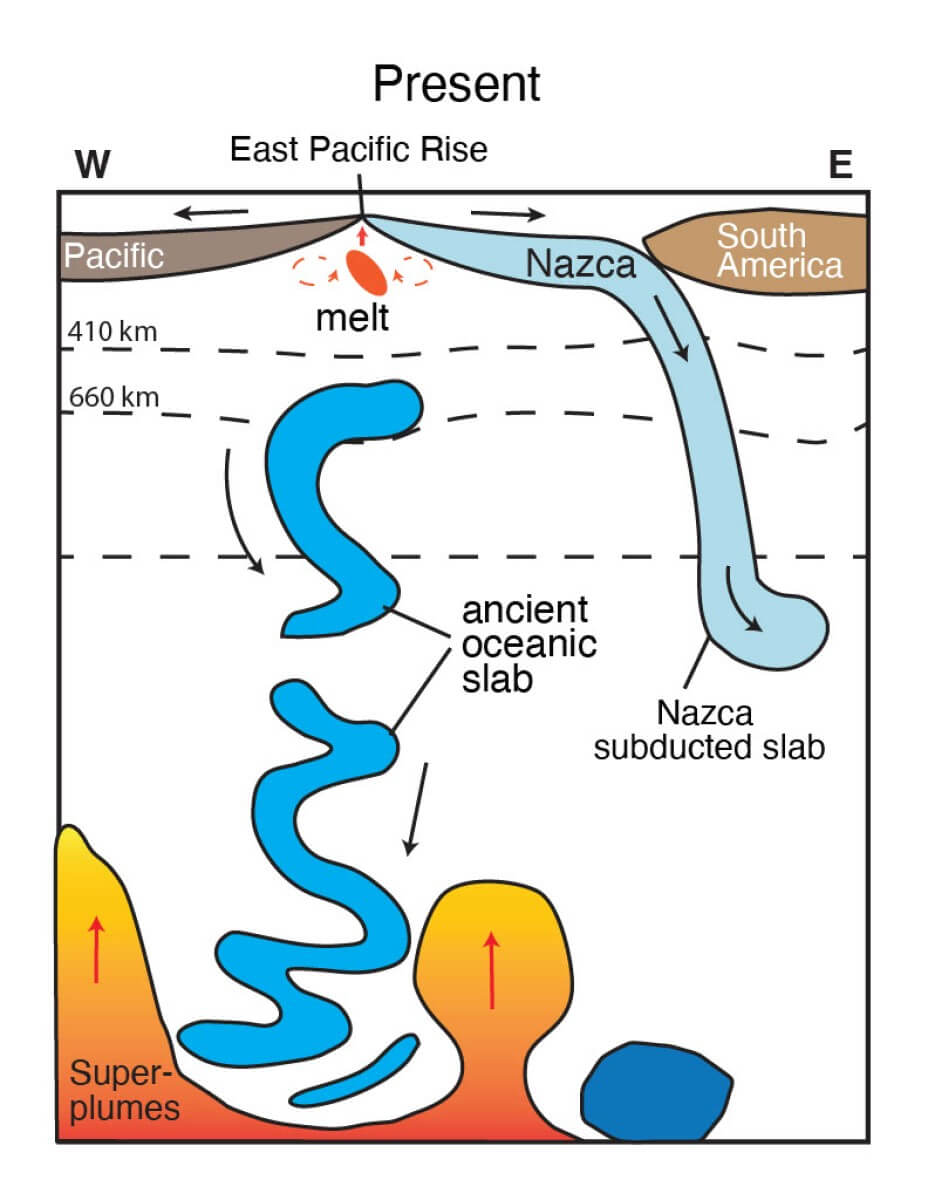
The discovery of this ancient subduction zone is particularly exciting because it helps explain a puzzling gap in one of Earth’s most enigmatic deep structures – the Large Low Shear Velocity Province (LLSVP) beneath the Pacific Ocean. LLSVPs are massive, continent-sized regions in the lowermost mantle characterized by slow seismic velocities. The Pacific LLSVP has long been known to have a curious gap in its eastern portion, and now we may know why.
As the ancient Phoenix Plate sank deeper into the mantle, it appears to have split the eastern arm of the Pacific LLSVP, much like a ship’s bow cutting through water. This interaction between the sinking plate and the LLSVP offers new insights into the dynamic processes shaping Earth’s deep interior.
“We found that in this region, the material was sinking at about half the speed we expected, which suggests that the mantle transition zone can act like a barrier and slow down the movement of material through the Earth,” Wang explains. “Our discovery opens up new questions about how the deep Earth influences what we see on the surface across vast distances and timescales.”
This discovery also provides crucial information for improving models of plate tectonics and mantle dynamics, which in turn can help us better understand phenomena ranging from the formation of mineral deposits to the long-term evolution of Earth’s climate.
Moreover, this study demonstrates the power of seismic imaging in unveiling Earth’s hidden history. By analyzing the echoes of seismic waves as they travel through the planet, scientists can create detailed maps of structures far beyond the reach of direct observation.
“This is just the beginning,” Wang concludes. “We believe that there are many more ancient structures waiting to be discovered in Earth’s deep interior. Each one has the potential to reveal many new insights about our planet’s complex past—and even lead to a better understanding of other planets beyond ours.”
Paper Summary
Methodology
The researchers used a technique called SS precursor analysis to study Earth’s mantle transition zone. This involves examining seismic waves that bounce off the boundaries of the transition zone before reaching seismometers on the surface. By analyzing the timing and strength of these “precursor” waves, scientists can map out the depth and characteristics of the transition zone boundaries. The team collected over 34,000 seismic recordings from earthquakes around the Pacific, focusing on an area east of the East Pacific Rise. They then used advanced data processing techniques to enhance the weak signals and create detailed maps of the transition zone structure.
Key Results
The study found that the mantle transition zone east of the East Pacific Rise is about 12 miles thicker than average, primarily due to a depression of the 660-kilometer discontinuity (one of the transition zone boundaries). This thickening coincides with faster-than-average seismic velocities, indicating the presence of colder material. The researchers interpreted this as evidence of an ancient subducted tectonic plate that has been stuck in the transition zone for over 100 million years.
Study Limitations
While the seismic evidence is compelling, there are some limitations to the study. The exact timing and duration of the proposed ancient subduction event remain uncertain due to the lack of surface geological evidence. Additionally, other factors like changes in mantle composition could potentially contribute to the observed anomalies, although the authors argue that a thermal origin (i.e., a cold subducted plate) best explains all the observations.
Discussion & Takeaways
The discovery of this ancient subduction zone provides new insights into the history of plate tectonics in the Pacific region and helps explain the unusual structure of the Pacific LLSVP. It suggests that subducted plates can have long-lasting effects on mantle structure and dynamics, persisting for over 100 million years. This finding has implications for our understanding of mantle mixing processes and the evolution of Earth’s deep interior over geological timescales.
Funding & Disclosures
The study was supported by NASA’s Solar System Exploration Research Virtual Institute and the Natural Sciences and Engineering Research Council of Canada. The authors declared no competing interests.


Our personal homemade seismic scanning instruments indicate a layer of solid gold 2.3′ thick, covering 40 acres, approximately 12 – 16′ below the surface of our Back 40.
At this point it is only an opinion based on other opinions!!!!!!
Genesis 1:1 – In the beginning, God created …
All we need to know.
We’ve HAD this scanning resolution for decades now…you should SEE the county sized city 50′ below the Sahara sand, it’s a city built for “people” that were 20′-40′ tall. ALL deeply salt encrusted now, of course. And then, there are the scans of the asteroid belt….and frozen oceans/atmosphere and “things”…and one more thing, you should see this scan under the Yellowstone caldera…that is all.
Drugs are a terrible thing…
Yeah right millions of years ago, B.S.
In the beginning God, Aleph Tav, created the heaven and earth! And the earth was void! The Spirit of God brooded upon the face of the waters and said, “Let there be light!”
And God said…’let there be light!’, and there was light. And you could see for miles…
What is being discovered are a few of the geologic events resulting in/from the earth-wide Biblical flood of Genesis 8 – 11, which occurred 4-5,000 years ago.
Job 28:5 As for the earth, out of it cometh bread: and under it is turned up as it were fire…9 He putteth forth his hand upon the rock; he overturneth the mountains by the roots.