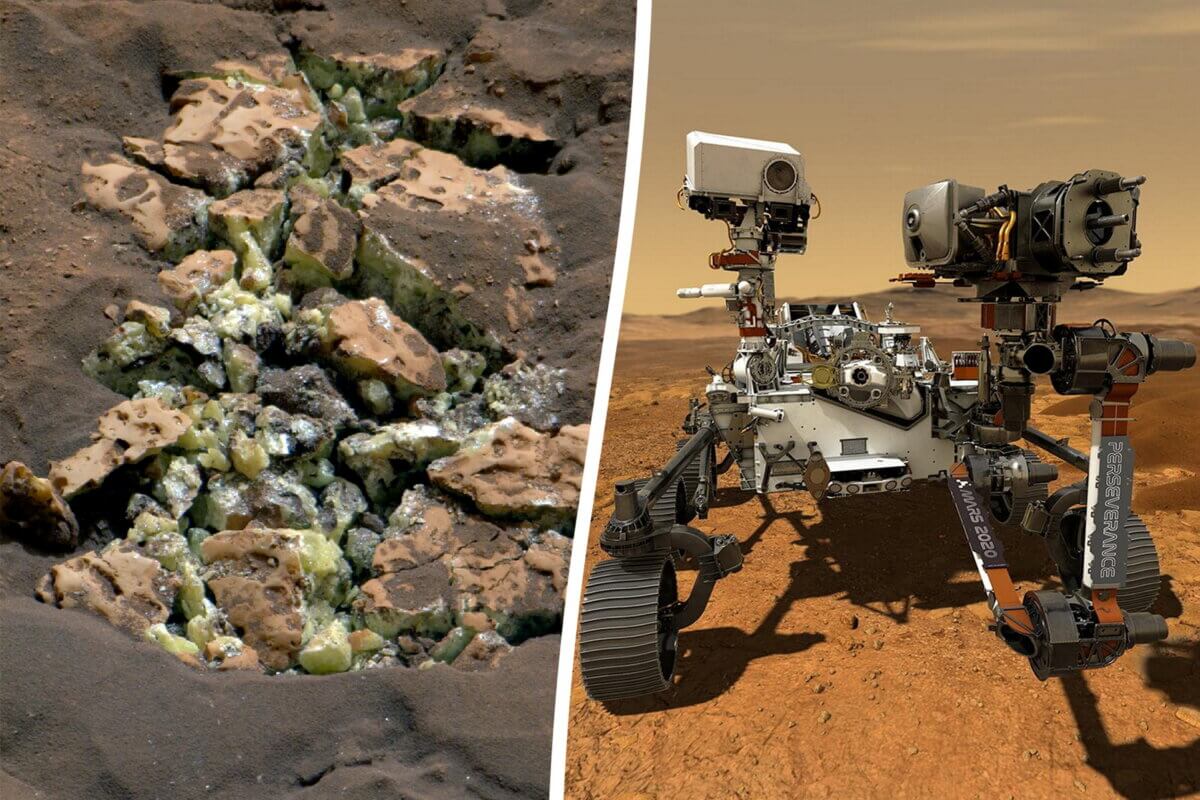
Left: Yellow sulfur crystals discovered after NASA's Curiosity rover (right) drove over a rock, cracking it open.
In the barren landscape of Mars, NASA’s intrepid explorer Curiosity has stumbled upon a series of unexpected discoveries that are rewriting our understanding of the Red Planet’s geological history. From pure sulfur crystals to evidence of violent floods, these findings are painting a picture of a Mars that was once far more dynamic and water-rich than previously imagined.
On May 30, 2024, Curiosity made a groundbreaking discovery as it trundled across the Martian terrain. As its wheels crushed a seemingly ordinary rock, scientists back on Earth were stunned to see something entirely new gleaming from the fractured surface: bright yellow sulfur crystals. This marks the first time pure, elemental sulfur has been found on Mars, a discovery that has left researchers both excited and “stunned.”
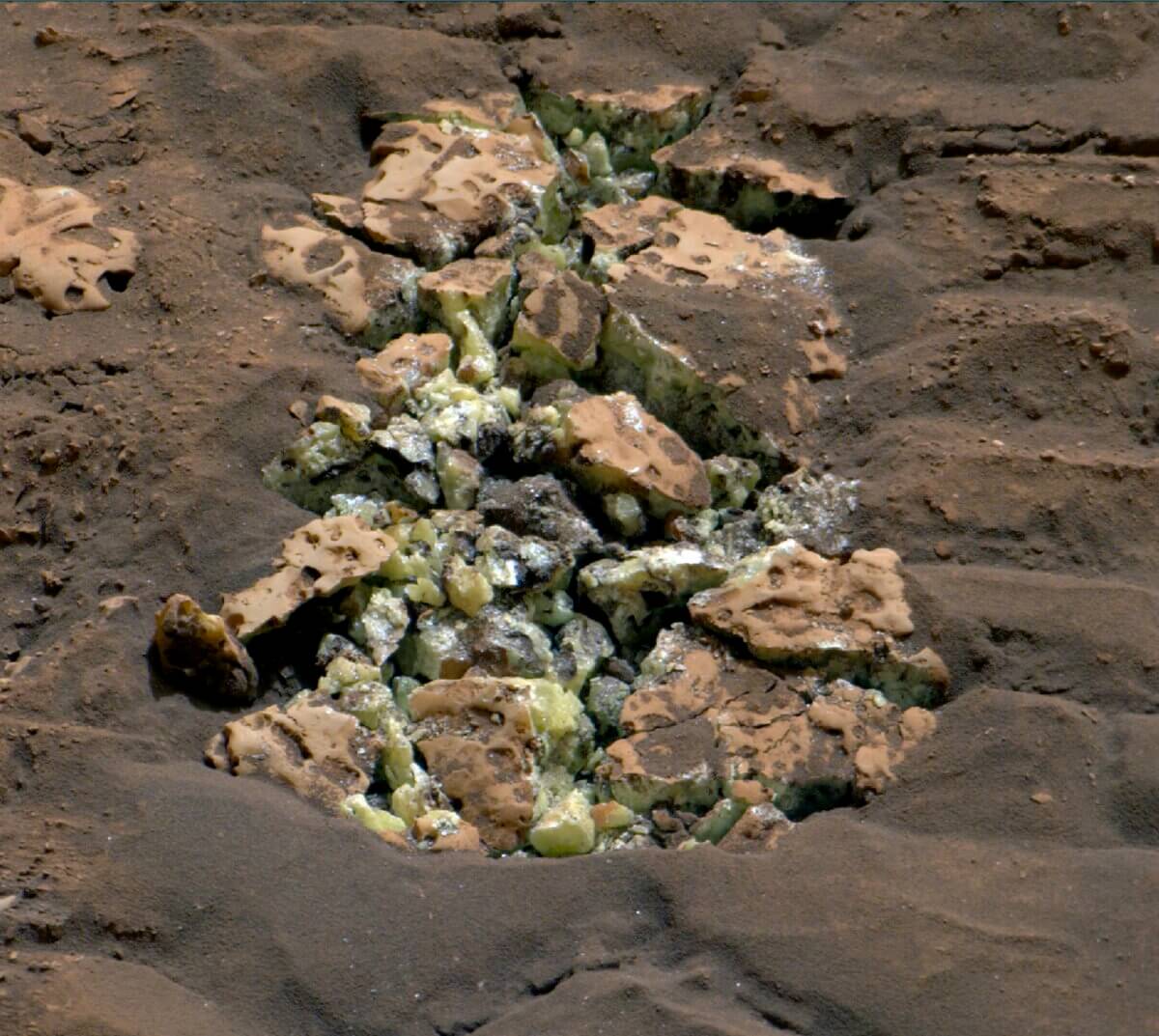
“Finding a field of stones made of pure sulfur is like finding an oasis in the desert,” says Dr. Ashwin Vasavada, Curiosity’s project scientist at NASA’s Jet Propulsion Laboratory, in a statement. “It shouldn’t be there, so now we have to explain it. Discovering strange and unexpected things is what makes planetary exploration so exciting.”
What is elemental sulfur?
Elemental sulfur is sulfur in its pure form, not combined with other elements. While most people associate sulfur with the smell of rotten eggs, that odor actually comes from hydrogen sulfide gas. Pure sulfur is odorless and typically forms under very specific conditions, making its presence on Mars particularly intriguing to scientists.
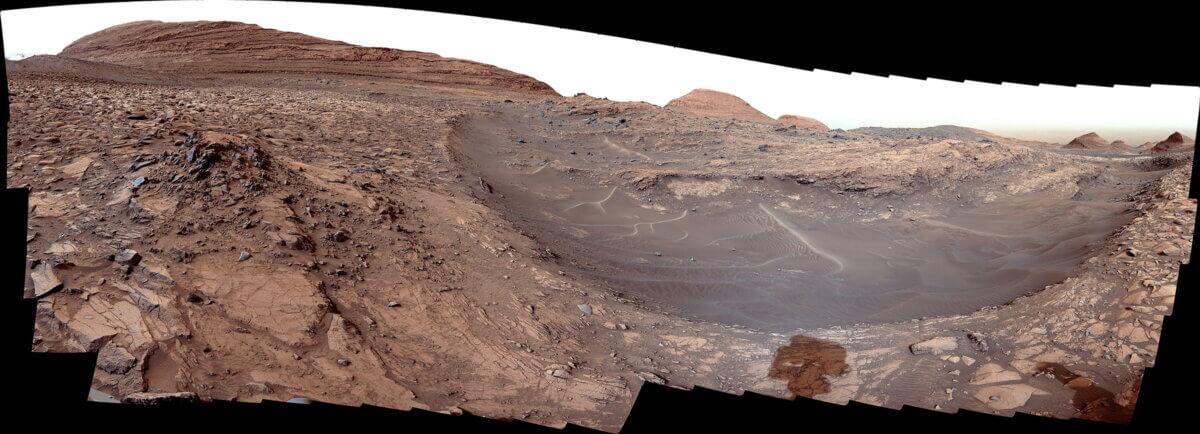
This sulfurous surprise is just one of several discoveries made by Curiosity as it explores Gediz Vallis channel, a winding groove carved into the side of Mount Sharp. This 3-mile-tall mountain has been the rover’s stomping ground since 2014, with each layer of rock representing a different chapter in Mars’ history.
The channel itself, spotted from orbit years before Curiosity’s launch, was one of the primary reasons scientists chose to send the rover to this particular region. They believed it might hold clues to Mars’ watery past, and Curiosity’s recent findings have not disappointed.
As the rover navigated the channel, it encountered large mounds of debris rising from the floor. Initially, scientists were uncertain whether these formations were the result of ancient floods or landslides. Curiosity’s close-up examinations have revealed that both processes likely played a role in shaping this dramatic landscape.
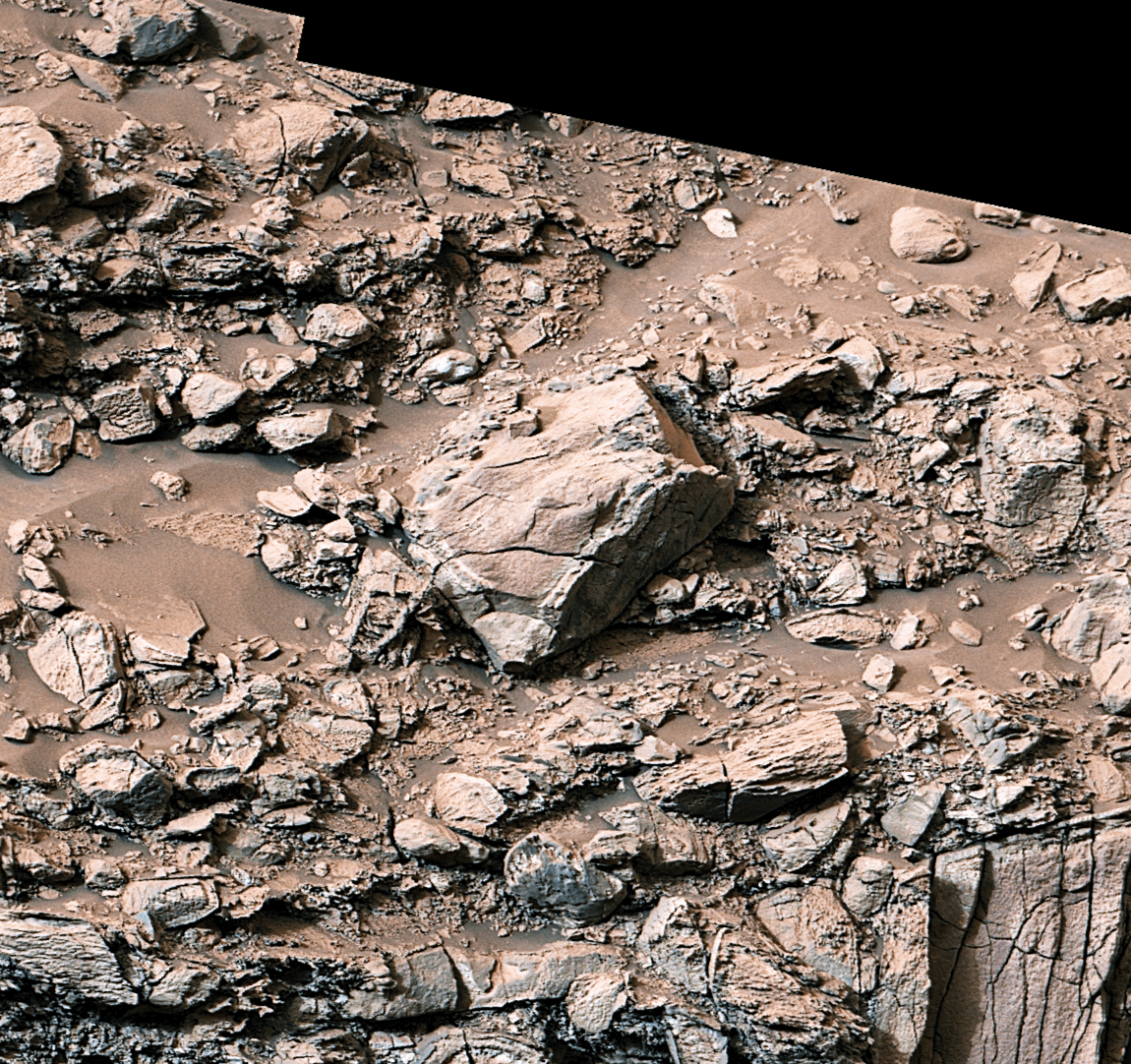
Some of the debris piles contain rounded rocks, similar to those found in Earth’s riverbeds, suggesting they were carried and shaped by flowing water. Others are filled with more angular stones, pointing to dry avalanches as their source. This mix of water-worn and freshly broken rocks paints a picture of a dynamic, changing Mars.
“This was not a quiet period on Mars,” explains Becky Williams, a scientist with the Planetary Science Institute and deputy principal investigator for Curiosity’s Mastcam. “There was an exciting amount of activity here. We’re looking at multiple flows down the channel, including energetic floods and boulder-rich flows.”
Further evidence of water’s influence can be seen in the white “halo” shapes bleached into some of the rocks. These markings, reminiscent of those found on Earth when groundwater seeps into fractured stone, suggest that water continued to play a role in shaping the landscape long after the floods and avalanches subsided.
To gain a deeper understanding of this complex geological history, the Curiosity team set their sights on obtaining a rock sample from within the channel. On June 18, they successfully drilled into a large rock nicknamed “Mammoth Lakes,” marking the rover’s 41st drilling operation on Mars.
The powdered rock sample was carefully deposited into instruments within Curiosity’s body for detailed analysis. Scientists hope this sample will provide crucial information about the materials that make up the channel and offer further insights into Mars’ past.
These recent discoveries continue to challenge and expand our understanding of Mars’ history. The presence of pure sulfur crystals, in particular, raises intriguing questions about the chemical processes that once occurred on the planet’s surface. Sulfur, a key element in many biological processes on Earth, could potentially offer clues about the habitability of ancient Mars.
As Curiosity continues its journey through Gediz Vallis channel, scientists eagerly await what other surprises might be uncovered. Each new finding brings us closer to unraveling the mysteries of Mars’ past and understanding the potential for life beyond Earth.
The Curiosity mission, led by NASA’s Jet Propulsion Laboratory on behalf of the Science Mission Directorate, has been exploring Mars since its landing in 2012. Its primary goal is to study the planet’s geology and climate, assessing whether Mars could have ever supported microbial life. Discoveries like these sulfur crystals and evidence of ancient floods not only contribute to this goal but also pave the way for future exploration of the Red Planet.


