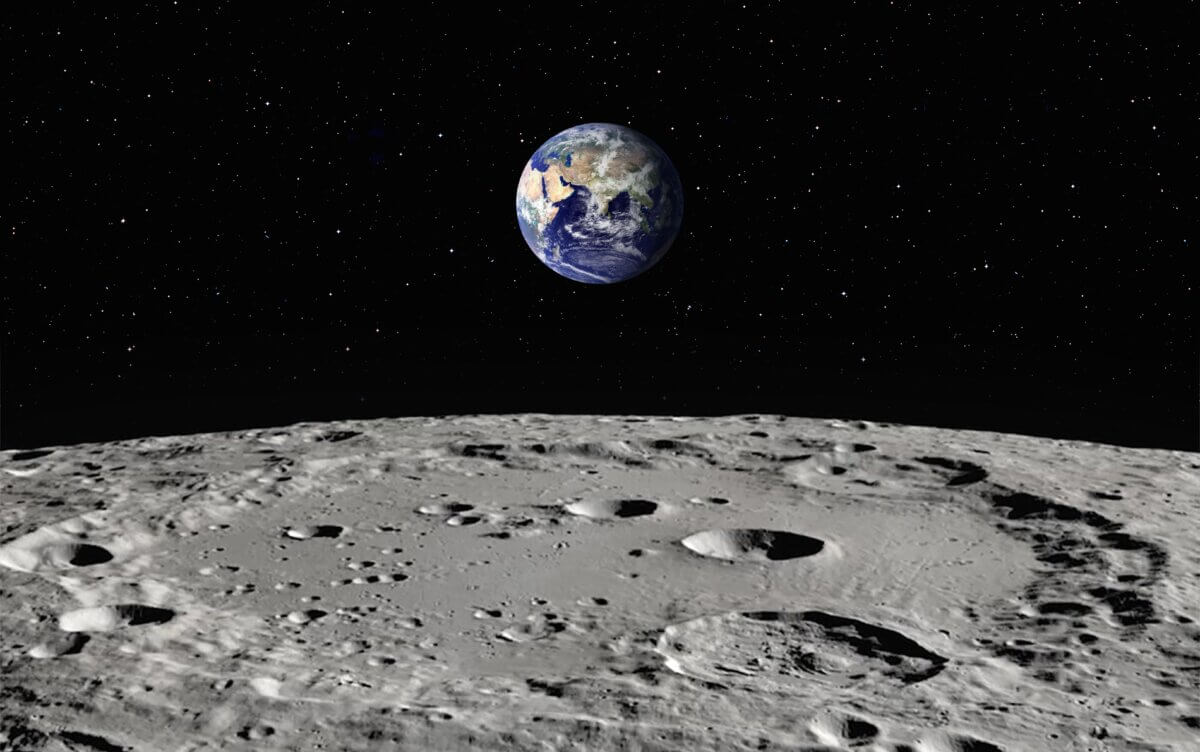
It's theorized Theia hit proto-Earth at an angle, producing a catastrophic impact that vaporized rock and created an orbiting ring of debris around the young planet. Eventually, that material formed our moon. (Credit: muratart/Shutterstock)
WASHINGTON — Does switching time zones give you jet lag? Just wait until you have to adjust your watch to sync up with the Moon! NASA is moving ahead with plans to give our lone natural satellite its own time zone.
The space agency is coordinating with government stakeholders and international standards organizations to create Coordinated Lunar Time (LTC). It’s all part of an effort to revolutionize space exploration and pave the way for a thriving lunar ecosystem.
Think of it like the “stardate” on Star Trek. Scientists are working on a uniform system of time that’ll help future missions throughout our solar system. As we gear up for long-term lunar missions and potential colonization, having a reliable timekeeping system becomes crucial.
So, why can’t we just use Earth time on the Moon? The answer lies in the mind-bending realm of relativity.
Believe it or not, time doesn’t tick at the same rate everywhere in the universe. Einstein’s theory of relativity explains that gravity affects the passage of time. The Moon’s weaker gravitational field means that time moves slightly faster there than on Earth – by about 56 microseconds per day. A microsecond is one-millionth of a second. While that might not sound like much, it can make a big difference when it comes to precision space navigation and communication.
“For something traveling at the speed of light, 56 microseconds is enough time to travel the distance of approximately 168 football fields,” says Cheryl Gramling, the lead on lunar position, navigation, timing, and standards at NASA Headquarters, in a media release. “If someone is orbiting the Moon, an observer on Earth who isn’t compensating for the effects of relativity over a day would think that the orbiting astronaut is approximately 168 football fields away from where the astronaut really is.”
This discrepancy might seem trivial for everyday life, but for space missions, where split-second timing and pinpoint accuracy are essential, it could mean the difference between a successful landing and a costly mistake.
So how exactly will NASA create this lunar timekeeping system? The plan is to use a network of atomic clocks on the Moon’s surface. These incredibly precise instruments will work together to create a weighted average time, similar to how we determine Coordinated Universal Time (UTC) on Earth. However, the exact locations for these lunar clocks are still being determined, as their placement can affect their timekeeping accuracy due to variations in the Moon’s gravitational field.
The project is being spearheaded by NASA’s Space Communication and Navigation (SCaN) program. This initiative is part of a broader vision to create a sustainable and scalable infrastructure for future lunar exploration.
“As the commercial space industry grows and more nations are active at the Moon, there is a greater need for time standardization. A shared definition of time is an important part of safe, resilient, and sustainable operations,” says Dr. Ben Ashman, navigation lead for lunar relay development, part of NASA’s SCaN program.
The implications of this project extend far beyond the Moon. The lessons learned and systems developed for LTC could be applied to future missions to Mars and other moons in our solar system, which have shown signs of harboring the building blocks of life.


