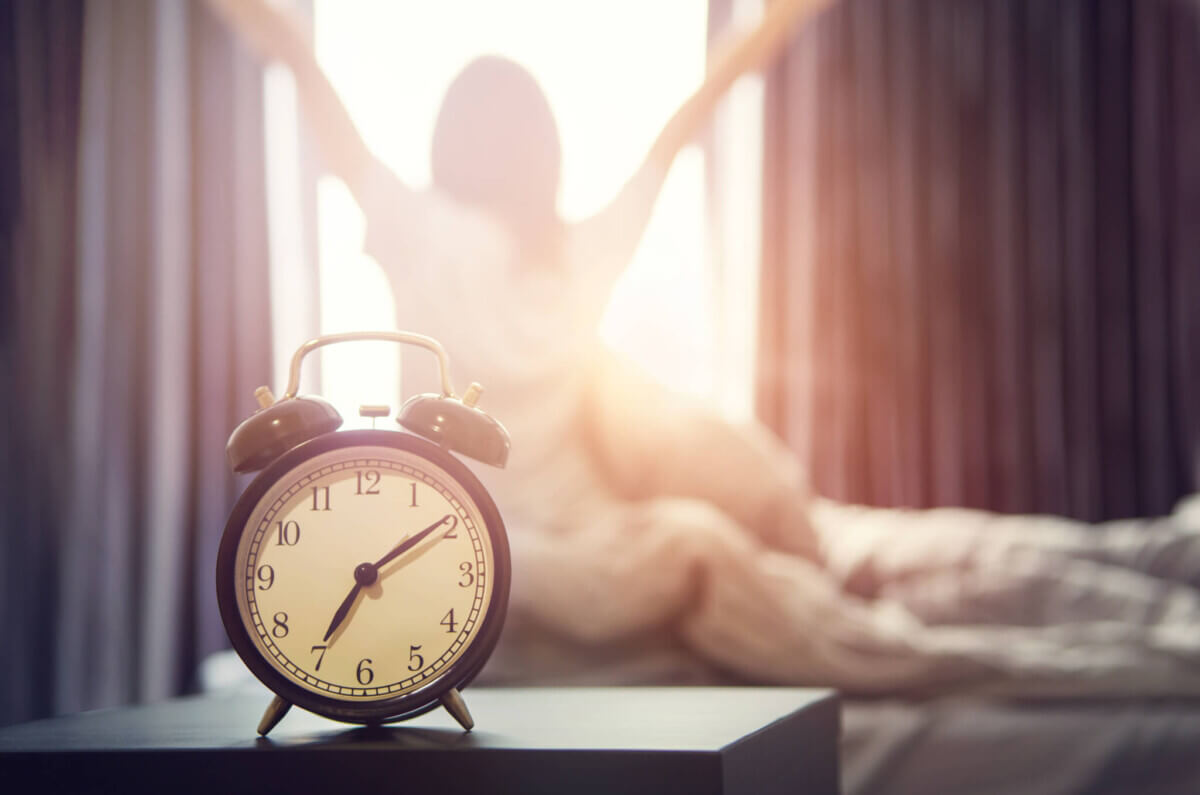
Researchers from Japan found that precisely timed exposure to natural daylight in the morning helps you feel more alert. (© oatawa - stock.adobe.com)
In a nutshell
- Letting natural light into your bedroom 20 minutes before waking up significantly improves alertness and reduces grogginess—more so than letting light in from dawn or not at all.
- Opening curtains too early can disrupt sleep and cause more awakenings before your alarm goes off, especially for people who go to bed late.
- Automating natural light exposure with motorized curtains offers a simple, non-pharmaceutical way to boost morning performance and mood.
OSAKA, Japan — Ever struggled to wake up in the morning? That groggy, disoriented feeling isn’t just in your head; it’s actually called “sleep inertia,” and it can linger for up to two hours after waking, even if you’ve had a full eight hours of sleep. While many of us reach for coffee to combat this sluggishness, Japanese researchers have discovered a surprisingly effective alternative: letting natural morning light into your bedroom at precisely the right time.
A new study published in the journal Building and Environment found that using motorized curtains to control natural light exposure before waking significantly improved alertness, reduced sleepiness, and enhanced overall morning functioning. The most effective approach? Opening curtains just 20 minutes before your alarm goes off.
Researchers from Osaka Metropolitan University emphasize that bringing natural light into bedrooms provides dual benefits of energy conservation and improved physical and mental health.
Insufficient sleep has become a growing public health concern. According to a 2023 survey by the American Academy of Sleep Medicine, 64% of Americans use some form of assistance to fall or stay asleep. Poor awakening quality—characterized by sleepiness, fatigue, and reduced alertness—affects countless individuals daily, potentially impacting productivity, mood, and overall well-being.
Morning Light and Sleep Quality

The study examined how different patterns of natural light exposure affected college students’ awakening quality. Participants spent three consecutive nights in a laboratory designed to resemble a typical bedroom, with east-facing windows equipped with motorized curtains that could be programmed to open at specific times.
Researchers tested three different natural light conditions: one where curtains opened 20 minutes before waking (Intervention A), another where they opened at dawn and remained open until waking (Intervention B), and a control condition where curtains stayed closed until after waking.
Using a combination of brain wave activity, heart rate variability, reaction time tests, and questionnaires about sleepiness and fatigue, the researchers tracked how participants felt upon waking under each condition.
Less Light Exposure May Be Better
Both light conditions significantly improved subjective sleepiness and objective alertness compared to the control condition. However, Intervention A, where curtains opened just 20 minutes before waking, performed best overall, particularly in reducing objective sleepiness measured by brain wave activity.

Osaka Metropolitan University)
More light exposure isn’t always better. In fact, the study found that excessive or premature exposure to natural light (as in Intervention B) appeared to increase mid-sleep awakenings, potentially disrupting sleep quality in the crucial period just before waking.
For those who sleep late or struggle with light sensitivity, rather than leaving curtains open all night or keeping them completely closed, a timed approach with motorized curtains or similar technology could provide the best of both worlds—protection from nighttime light pollution and beneficial morning light exposure when it matters most.
As increasing numbers of people face sleep challenges in our modern, indoor-focused society, architectural design that accounts for natural light exposure could play a crucial role in improving public health. Smart homes with automated window coverings might one day be suggested as readily as sleep medications.
Sunrise alarm clocks that simulate dawn with artificial light have gained popularity in recent years, but the researchers point out that natural daylight offers advantages that artificial light cannot replicate. Our circadian rhythms evolved in response to natural light conditions, making actual sunlight potentially more effective for regulating sleep-wake cycles. By harnessing something as fundamental as sunlight—at precisely the right time—we might improve our mornings without reaching for that extra cup of coffee.
Paper Summary
Methodology
The researchers conducted a crossover randomized controlled trial with 19 young adult participants (9 female, mean age 25.84 years) who typically went to bed after 11 PM on weekdays. Each participant experienced three different natural light conditions in random order: Intervention A (natural light exposure for 20 minutes before waking), Intervention B (natural light exposure from dawn until waking), and a control condition (no natural light exposure before waking). The experiment took place in a laboratory setting designed to resemble a typical bedroom with east-facing windows equipped with motorized curtains. The study measured awakening quality through objective assessments including electroencephalogram (EEG) readings, heart rate variability, and psychomotor vigilance tests, as well as subjective questionnaires regarding sleepiness and fatigue. The experiment was conducted during January and February to minimize weather variability and ensure consistent morning light conditions.
Results
The study found that both light exposure conditions (Interventions A and B) significantly improved objective alertness and reduced subjective sleepiness compared to the control condition with no light exposure. However, Intervention A (20-minute exposure) performed significantly better than Intervention B (dawn-to-waking exposure) in reducing objective sleepiness as measured by alpha wave activity in the brain. There was no statistically significant difference in the cumulative or maximum illuminance between the two light exposure conditions, suggesting that timing rather than total light exposure was the critical factor. The researchers also observed that Intervention A was associated with longer total sleep time in the 90 minutes before waking compared to Intervention B, suggesting that excessive early light exposure might increase mid-sleep awakenings and potentially harm overall sleep quality.
Limitations
The study acknowledged several limitations. The relatively small sample size of 19 participants consisted exclusively of university students in their 20s and 30s, limiting generalizability to other age groups or populations. The experiment lacked a washout period between different conditions, which could have introduced carryover effects despite statistical controls. Additionally, the study focused primarily on illuminance (light intensity) and did not extensively analyze other parameters such as light spectrum, which might also affect sleep and awakening quality. The researchers also noted that geographical location and housing conditions could influence natural morning light exposure, suggesting that further studies across different settings are needed to confirm the reliability of their findings.
Funding and Disclosures
The study was supported by JSPS KAKENHI (Grant Numbers 21H01509 and 24K01053) and JST SPRING (Grant Number JPMJSP2139). The authors declared no competing financial interests or personal relationships that could have influenced the work.
Publication Information
The study titled “Natural light control to improve awakening quality” was authored by Xiaorui Wang, Yangcheng Gu, Jihui Yuan, and Daisuke Matsushita from the Department of Living Environment Design, Graduate School of Human Life and Ecology, Osaka Metropolitan University, Japan. It was published in Building and Environment (volume 273, 2025, article 112733) and is available online as of February 14, 2025, as an open access article under the CC BY license.


A great study for those that live close to the equator. In latitudes around 45 degrees the sunrises anywhere from 5am in the summer to 8am in the winter.