
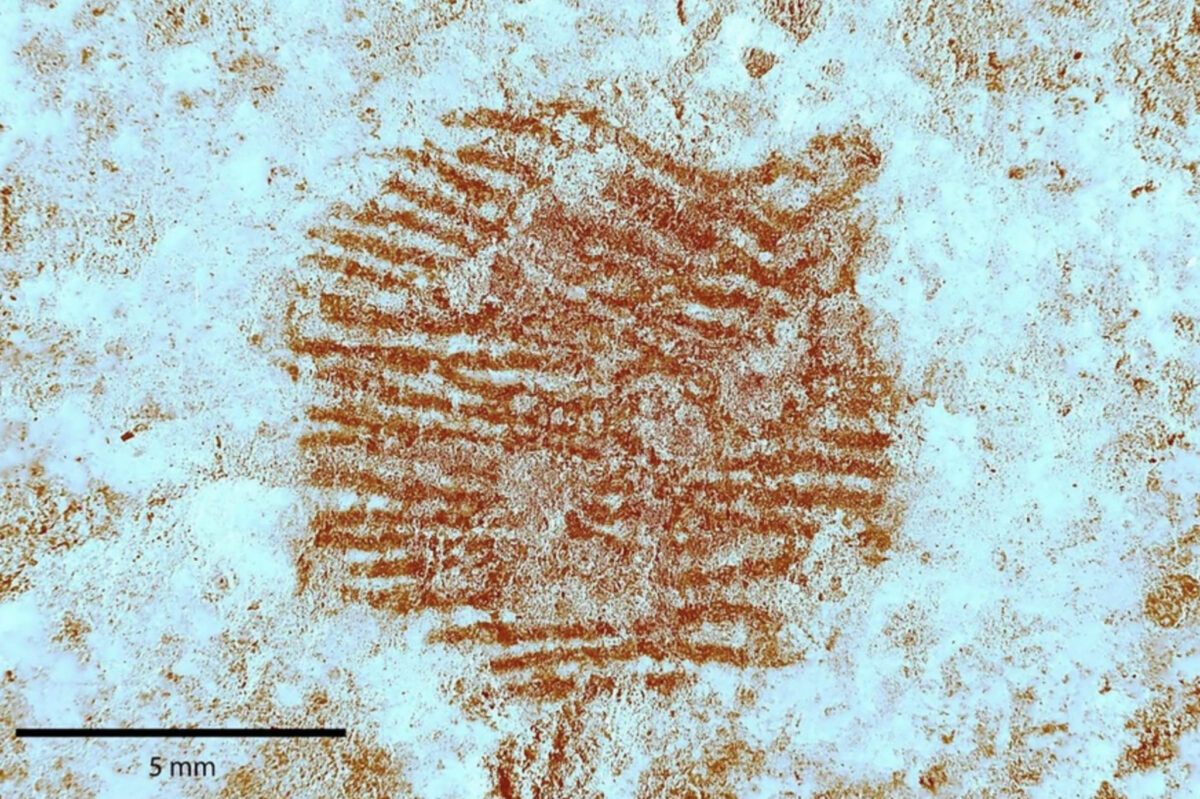
The fingerprint is the oldest and most complete to date. (Credit: Samuel Miralles-Mosquera Policía Científica / Archaeological and Anthropological Sciences)
In a nutshell
- A 43,000-year-old fingerprint preserved in red ochre on a Spanish pebble represents the oldest known evidence of Neanderthal symbolic behavior in Europe
- Statistical analysis shows only a 0.31% chance the red dot’s placement was random, indicating deliberate artistic intent by our extinct cousins
- The discovery adds to growing evidence that symbolic thinking and artistic expression weren’t unique to modern humans, but shared traits among human species
MADRID — A single fingerprint pressed into red clay 43,000 years ago is adding new evidence to debates about our extinct cousins. The print, discovered on a painted pebble in a Spanish cave, represents the oldest known evidence of Neanderthal symbolic behavior in Europe. It’s adding to growing questions about whether the ability to create art and think symbolically was ever unique to modern humans.
The discovery, published in Archaeological and Anthropological Sciences, comes from the San Lázaro rock shelter in central Spain, where archaeologists found a granite pebble unlike any other artifact at the site. While most stones showed clear signs of being used as tools or hammers, this one was different. Someone had carefully painted a red dot on its surface using ochre pigment, and multispectral analysis revealed something preserved within that ancient paint: a complete human fingerprint.
Evidence of Deliberate Artistic Behavior
The stone itself seems to have been chosen deliberately. At 21.4 by 11.3 by 7.6 centimeters, it’s much larger than any other rock found in the same layer of the cave and has three natural dents, called “cupules,” on one side. The red dot appears to be intentionally placed right among these features, forming what might resemble a face.
Statistical analysis revealed the red dot’s placement was highly unlikely to be random. As the researchers write, “The Monte Carlo simulation indicates a probability of only 0,31% that a configuration of the red dot on the pebble, like the one we observed, would occur by chance.” In other words, the positioning is almost certainly intentional.
Even more compelling: forensic experts from the Spanish National Police analyzed the fingerprint using the same system used in modern criminal investigations. They identified 13 distinct ridge features, enough to confirm it came from a real human hand. The ridges measured about half a millimeter wide, which is consistent with human fingerprints today.
Chemical analysis confirmed the red marking was ochre. According to the study, “The results show that the samples of the red dot contain iron oxides and clay minerals, with no evidence of organic binders. Thus, it is an ocher added to the surface of the pebble.”

What the Fingerprint Tells Us About Neanderthals
For decades, scientists believed that abstract thinking, like creating art or assigning symbolic meaning to objects, was a unique trait of modern humans. But this find adds to a growing body of evidence suggesting that Neanderthals may have shared that ability.
The researchers point out a key aspect of their find: “It can be observed that the morphology of the ridge is not perfectly smooth; both sides are irregular, which may be assimilated to the morphology described as pearling or beading.” This natural imperfection actually supports the authenticity of the ancient print.
Study authors note that signs of Neanderthal symbolic behavior “are increasingly abundant,” including “pieces of ocher with traces of use and personal adornments found at occupation sites” and other examples of symbolic artifacts across Europe. Previous discoveries have included decorated shells, worked animal teeth, and cave engravings.
The team also considered whether the red dot might be accidental,”like when grasping or using the pebble,” but found this explanation inadequate.
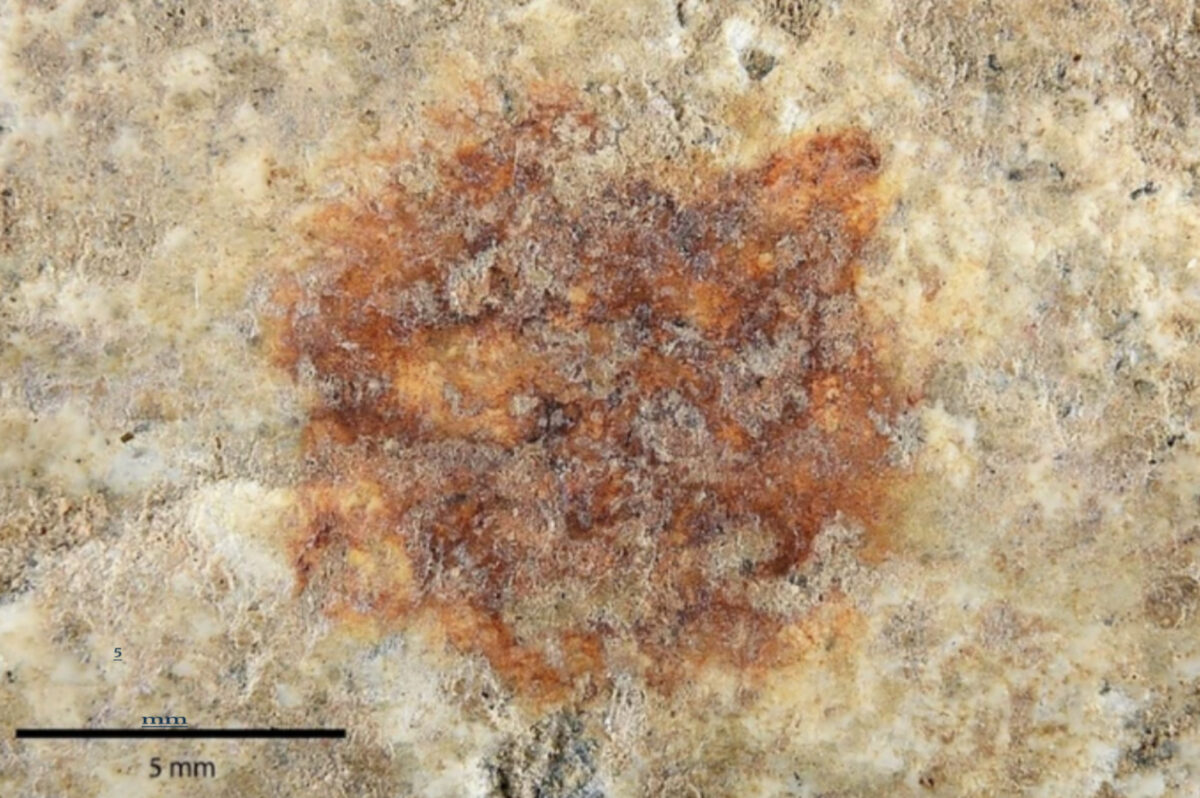
They note several problems with the accidental hypothesis: “It would be necessary to explain why there is only one fingerprint in a central position of the surface of the pebble, and there are no more fingerprints” and “why, if Neanderthal hands were stained with ocher, there are no more stains in the same pebble.”
Instead, the evidence suggests deliberate selection and modification. The pebble had to be transported from the riverbed to the cave, a distance of about 10 meters above the ancient river level. The researchers emphasize: “The presence of this type of pebble in the archeological layer is due to human selection and transport from the river to the rock-shelter.”
The geometric relationships between the natural cupules and the painted dot also show careful planning. According to the study, “The distances A-C and B-C are nearly identical, suggesting that point C is almost equidistant from A and B, forming an almost isosceles triangle.”
The San Lázaro fingerprint adds a deeply personal dimension to this evidence. Unlike abstract paintings or mysterious engravings, a fingerprint is unmistakably individual — the unique mark of a specific person who lived in prehistoric Spain.
As the study puts it: “The fact that the pebble was selected because of its appearance and then marked with ocher shows that there was a human mind capable of symbolizing, imagining, idealizing and projecting his or her thoughts on an object.”
Unlike the other 23 pebbles found in the same area that showed clear signs of use as hammerstones, this specimen displayed no wear patterns. The researchers conclude: “After all the analyses conducted, we have not documented any marks on the surface of the stone that we could interpret as functional.”

Could They Have Seen a Face in the Stone?
One of the most intriguing ideas in the paper is that the Neanderthal who handled the pebble might have seen something in it, perhaps a face. This phenomenon, called pareidolia, is something humans experience all the time: we see shapes or faces in clouds, trees, or even electrical outlets.
“Could the morphology of the piece,” they write, “with the presence of three cupules on the same surface and the positioning of the red dot in relation to them, represent a composition explained by the phenomenon of pareidolia?”
The three natural dents on the pebble could resemble eyes and a mouth. The red dot — deliberately placed between them — may have completed the image. Researchers stress that this is just a hypothesis, but it’s based on a real psychological tendency that even non-human primates experience.
They suggest this could represent “one of the earliest human facial symbolizations in Prehistory” and note that “this pebble could thus represent one of the oldest known abstractions of a human face in the prehistoric record.”

A Neanderthal’s Creativity Frozen in Time
The archaeological context provides strong evidence for both the age and the creators of this symbolic artifact. It’s believed the samples are from between 42,300 and 43,000 years ago based on radiocarbon dating of horse teeth found in the same layer.
This timeline proves Neanderthal authorship because modern humans didn’t reach interior Spain until thousands of years later. As the study explains, “Archaeological and chronological data from the interior of the peninsula currently rule out the possibility of the superposition, continuity or mixing between Mousterian levels and Early Upper Paleolithic levels produced by Homo sapiens.”
What’s remarkable about this discovery is how clearly it captures a moment of human — or Neanderthal — thought. Someone picked up that stone, saw something special in it, and decided to mark it. They didn’t just use it to hammer bones or build a fire. They did something expressive with it.
In the words of the researchers, the find shows “three fundamental cognitive processes involved in creating art: the mental conception of an image, deliberate communication, and the attribution of meaning.”
Whether or not we can call it art in the modern sense, the San Lázaro fingerprint gives us a rare and moving glimpse into the inner life of an ancient Neanderthal — one that feels surprisingly familiar.
Paper Summary
Methodology
Researchers excavated the San Lázaro rock shelter in Segovia, Spain, and discovered a granite pebble marked with red ochre in a well-preserved Mousterian archaeological layer. They used multiple analytical techniques including 3D scanning with a David SLS-3 Scanner, X-ray fluorescence spectroscopy using an Olympus VANTA M Series analyzer, and scanning electron microscopy with a Jeol JSM-820 microscope. Most importantly, they employed multispectral analysis in the Image Technology Section of the Spanish National Police to reveal details invisible to the naked eye. Forensic experts analyzed any dermatoglyphic evidence using the ABIS system employed in criminal investigations. The team conducted statistical analysis including Monte Carlo simulation and performed radiocarbon dating on horse teeth from the same archaeological layer.
Results
Multispectral analysis revealed a complete fingerprint preserved in the ochre pigment showing human dermatoglyphic patterns. The print displayed 13 distinct identification points including six abrupt ends, two bifurcations, and five convergences, with average ridge width of 0.48 millimeters. Chemical analysis confirmed the red marking was ochre (iron oxides and clay minerals) with no organic binding agents. The pebble measured 21.4 x 11.3 x 7.6 centimeters and showed no signs of functional use. Monte Carlo simulation indicated only a 0.31% probability that the red dot’s positioning was random. Radiocarbon dating placed the artifact’s age between 42,300 and 43,000 years ago within a Mousterian occupation level.
Limitations
The researchers acknowledge that interpreting a 40,000-year-old object from a modern perspective means “it is unlikely that all doubts surrounding this hypothesis can be fully dispelled.” They present their pareidolia interpretation “not as a definitive claim, but as a possible cognitive mechanism” and emphasize their findings “remain a compelling working hypothesis.” While statistical analysis strongly suggests intentional placement, the specific meaning behind the action remains unknown. Without Neanderthal fingerprints in modern databases, species attribution relies on archaeological context, though this strongly supports Neanderthal origin.
Funding and Disclosures
The 2022 archaeological season was funded by the Junta de Castilla y León (B2022/011624) and Complutense University of Madrid (PR44/21-29904). One researcher received grant RYC2021-034813-I funded by MCIN/AEI and European Union NextGenerationEU/PRTR. Authors declared no competing interests and acknowledged assistance from Spanish institutions including the Forensic Police headquarters and multiple universities.
Publication Information
The study was published in Archaeological and Anthropological Sciences, volume 17, article 131, in 2025. Research was conducted by David Álvarez-Alonso and colleagues from Complutense University of Madrid, the Geological and Mining Institute of Spain, and Spanish National Police forensic units. The paper was received March 11, 2024, accepted May 5, 2025, and published online May 24, 2025, under Creative Commons Attribution 4.0 International License.


