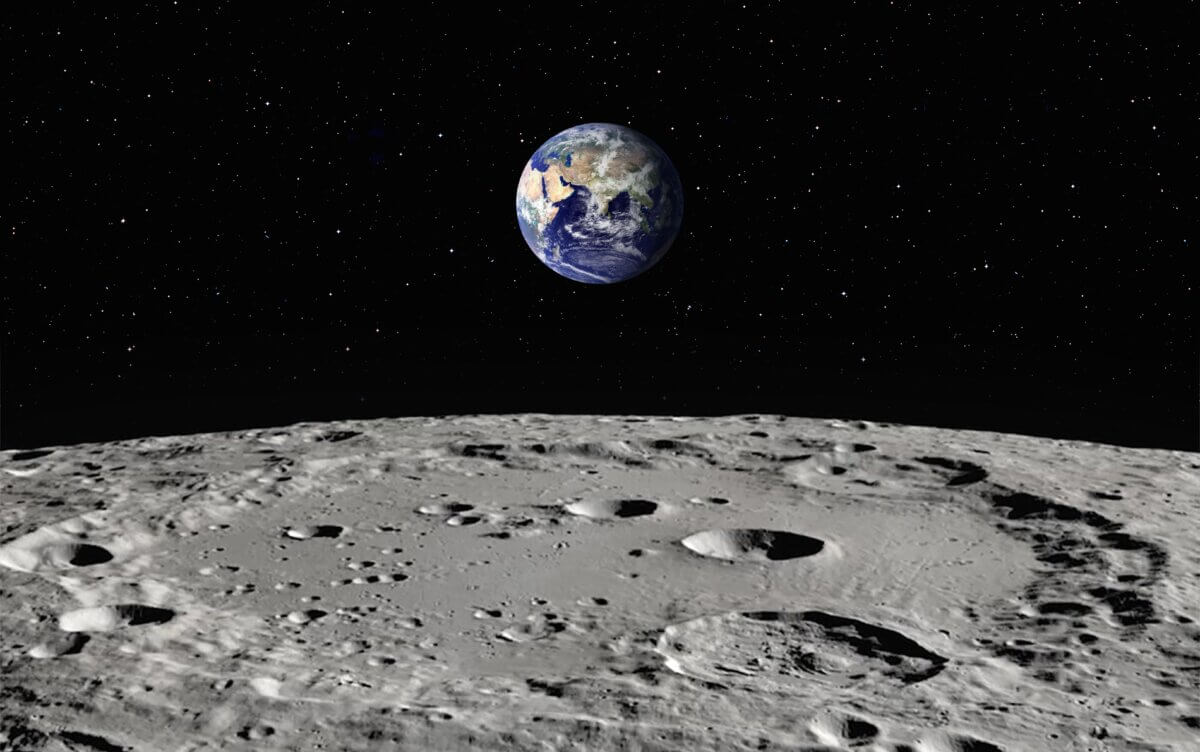
It's theorized Theia hit proto-Earth at an angle, producing a catastrophic impact that vaporized rock and created an orbiting ring of debris around the young planet. Eventually, that material formed our moon. (Credit: muratart/Shutterstock)
ERIE, Pa. — For nearly 40 years, scientists have generally agreed that Earth’s Moon formed from debris after a Mars-sized object slammed into our young planet. However, new research suggests a different possibility: our Moon may have been captured from space, originally paired with another rocky object before Earth’s gravity pulled it into orbit.
This new theory helps address some puzzling aspects of the Moon’s orbit that are difficult to explain with the traditional collision theory. Moreover, the traditional belief doesn’t account for certain chemical signatures found in Moon rocks brought back by Apollo astronauts.
The study, published in The Planetary Science Journal by Penn State researchers Darren Williams and Michael Zugger, demonstrates that Earth could have acquired its Moon through a process called binary-exchange capture – the same mechanism thought to explain how Neptune captured its largest moon, Triton.
“The Moon is more in line with the sun than it is with the Earth’s equator,” Williams explains in a media release.
This observation doesn’t align well with the collision theory, which suggests the Moon should orbit above Earth’s equator. The process of binary-exchange capture occurs when a planet encounters two objects orbiting each other. During this cosmic encounter, the planet’s gravity can separate the pair, capturing one object as a satellite while ejecting the other into space. This mechanism has already been demonstrated for larger planets in our solar system, but this new research shows it could work for Earth-sized planets as well.
Through mathematical modeling and computer simulations, the researchers found that Earth could potentially capture satellites ranging from 1% to 10% of its mass through this process. Our Moon, at 1.2% of Earth’s mass, falls comfortably within this range. The study showed that specific conditions would need to be met for successful capture: the approaching speed would need to be less than three kilometers per second, or about 6,700 miles per hour. While that might sound fast, it’s actually quite leisurely by solar system standards. Second, the binary pair needed to pass within about 20 Earth radii of our planet (about 80,000 miles) for Earth’s gravity to work its magic.
But catching a Moon is only half the story. The researchers also had to explain how a captured Moon would settle into its current well-behaved circular orbit. When first captured, the Moon would have followed a highly elliptical path, swooping very close to Earth at its nearest approach and far away at its most distant point. This is where the power of tides comes into play.
The team’s calculations showed that tidal forces between Earth and its newly captured Moon would have gradually civilized this wild orbit. Over time, these gravitational interactions would have pulled the Moon into a more circular path and slowed its rotation until it always showed the same face to Earth – exactly what we observe today.
“Today, the Earth tide is ahead of the Moon,” Williams explains in a statement. “High tide accelerates the orbit. It gives it a pulse, a little bit of boost. Over time, the Moon drifts a bit farther away.”
This ongoing process continues today, with the Moon moving approximately three centimeters farther from Earth each year.
This new theory could help explain some lunar mysteries that have puzzled scientists. For instance, it might account for why Moon rocks show chemical similarities to Earth (because the Moon formed in the same region of the solar system) while also having some distinct differences (because it originally formed as part of a separate object).
The researchers acknowledge that their scenario requires some fortunate circumstances. Not only would Earth need to encounter a binary pair of objects, but one member of that pair would need to be just the right size to become our Moon. However, they point out that binary objects were likely common in the early solar system – we still see many of them today in the asteroid belt and Kuiper belt beyond Neptune.
Perhaps the most intriguing aspect of this research is that it suggests similar captures could occur around planets in other solar systems. This raises the possibility that large moons might be more common around rocky planets than previously thought, with potential implications for habitability and the emergence of life.
Of course, proving this theory will be challenging, as the events in question occurred over 4.5 billion years ago. However, the mathematical modeling shows it’s physically possible, adding an intriguing new chapter to the ongoing debate about our Moon’s origins.
“No one knows how the Moon was formed. For the last four decades, we have had one possibility for how it got there. Now, we have two. This opens a treasure trove of new questions and opportunities for further study,” Williams states.
Whether captured or created, borrowed or built, the Moon remains Earth’s faithful companion – even as its ancient origin story continues to evolve in the light of new scientific understanding.
Paper Summary
Methodology
The study employed both analytical calculations and numerical simulations. The researchers first used mathematical equations to determine theoretical limits for satellite capture through binary-exchange. They then conducted computer simulations using a leap-frog orbit integrator to test various encounter scenarios. The accuracy of their integrator was verified against the IAS15 routine in the REBOUND package. They also employed a constant time-lag tidal model to study post-capture orbital evolution.
Key Results
The research demonstrated that Earth-sized planets could capture satellites between 0.01 and 0.1 Earth masses through binary-exchange, given approach velocities below 3 km/s and close passages within about 20 Earth radii. The simulations showed successful captures of objects up to Mercury’s mass, with post-capture orbital evolution leading to more circular orbits through tidal interactions.
Study Limitations
This was a pilot study with several inherent limitations. The simulations used simplified models and didn’t account for all possible variables in a real solar system environment. The researchers note that while they demonstrated the physical possibility of binary-exchange capture, they did not test whether such encounters would occur with measurable frequency within a realistic, three-dimensional swarm of planetesimals with randomized binary orientations.
Discussion & Takeaways
The study demonstrates that binary-exchange capture, previously shown to work for gas giant planets, could also function for Earth-sized planets. This mechanism provides an additional pathway for terrestrial planets to acquire large satellites, though specific conditions would need to be met for successful capture and orbital stability.
Funding & Disclosures
The research was conducted by scientists from Penn State Behrend’s School of Science and Penn State Applied Research Laboratory. The authors are affiliated with Penn State’s Center of Exoplanets and Habitable Worlds, Planetary Systems Science Center, and Consortium for Planetary and Exoplanetary Science and Technology. One author is additionally affiliated with the Blue Marble Space Institute of Science in Seattle, WA. The Penn State Consortium for Planetary and Exoplanetary Science and Technology supported this research.


The real question to ask is who built the moon, and why did they put it in orbit around the earth?
To propagate and enable human life?
And where are those beings now?
Good explanation, but the true story is quite different. The Moon’s origin is hidden in the most primeval events in the galaxy, it is hollow based on a metallic sphere and used to be a satellite of Maldek destroyed 18+ million years ago, after which it was put around the earth.
Pretty sure Ancient Aliens show hosts already covered this theory in depth including past civilizations that talk of the moon arriving.