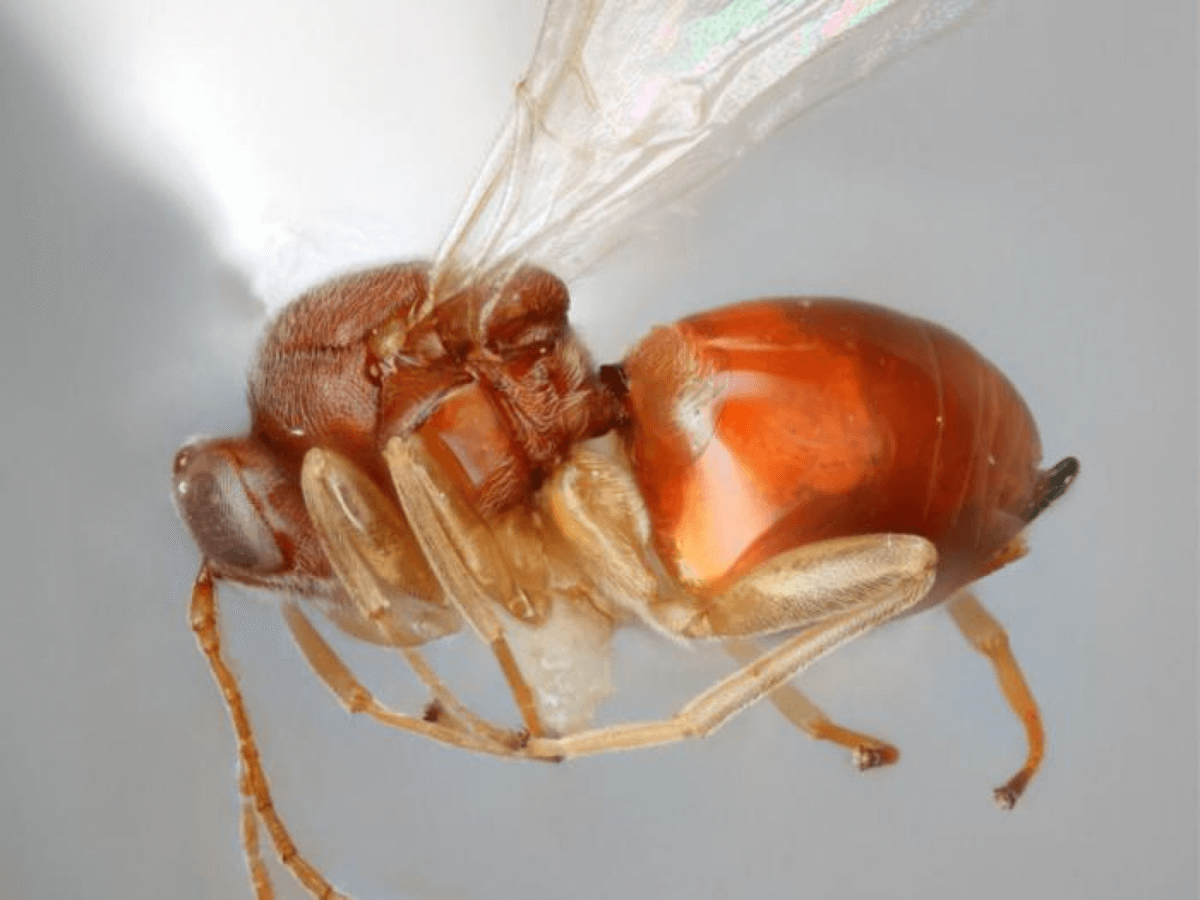
Ceroptres promethea is one of the newly identified and named gall wasps. (Credit: Penn State)
UNIVERSITY PARK, Pa. — The most famous thieves, tricksters, and rogues were recently honored by having a brand new group of bugs named after them. Insect researchers named 22 new species of gall wasps after figures like Catwoman, Han Solo, and the man who betrayed Julius Caesar.
These tiny wasps live in small structures known as galls, where they steal from other wasps. Researchers from Penn State named them after these famous figures in history, mythology, and pop culture to make them easier to identify. The discovery of these wasps, published in the journal Zootaxa, has doubled the genus of wasps.
Some names were right on the nose. One fiery red-colored wasp was named after Prometheus, a titan in Greek mythology who stole fire from the gods to give to humans.
“By naming these species, we give other researchers an anchor they can carry forward to other studies because now they can identify wasps that were previously unknown,” says Louis Nastasi, a doctoral student of entomology at Penn State and lead author of the study, in a media release. “It provides a base and a tool kit for future work that could help us understand these species and their ecosystems more broadly.”
The recent work was possible because of a separate study from another team that looked at the evolution of gall wasps. Though the researchers collected DNA data from multiple wasps, they had trouble identifying the different wasp species.
“I ended up in conversation with Andrew Forbes, who’s the leader of the University of Iowa team, and he told me about the difficulties they were having,” explains Nastasi. “And since my area of expertise is species identification, description and diagnosis of these tiny wasps, he asked if it would be possible for me to get involved and figure out what exactly is going on.”
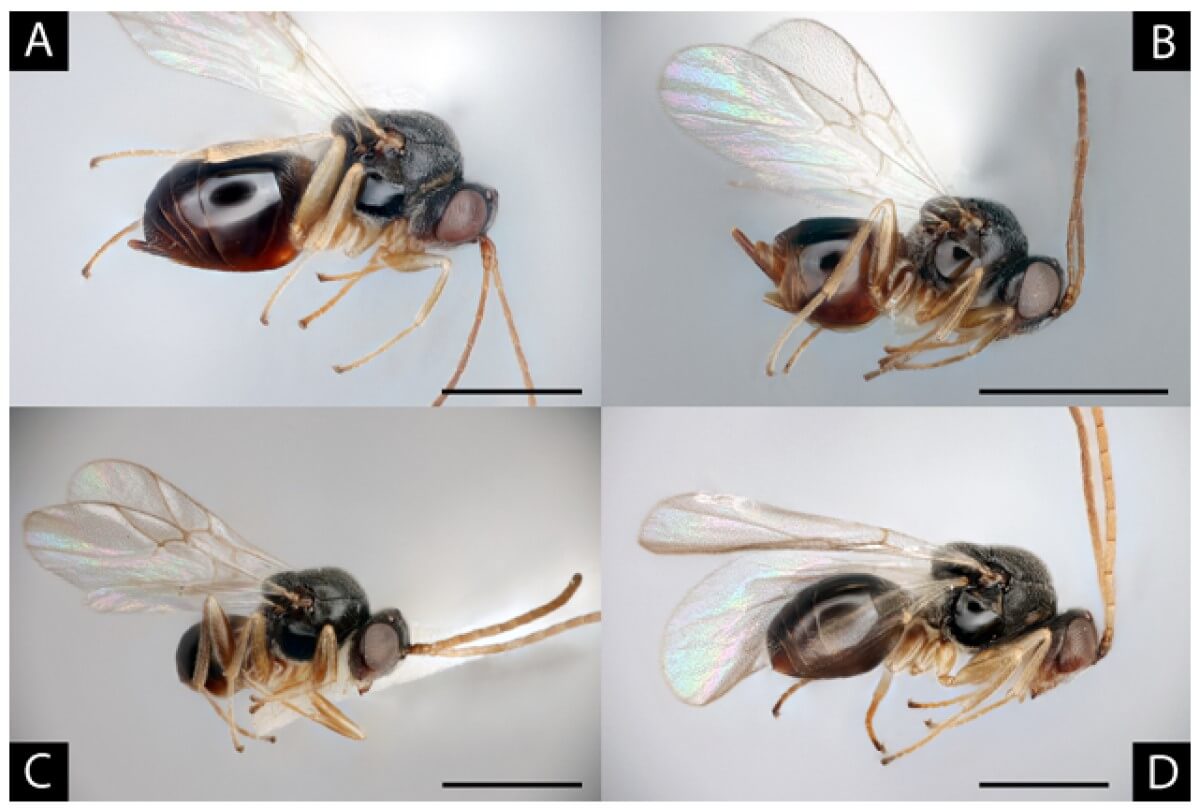
Holotype female (PSUC_FEM_255534) reared from gall of Philonix nigra on Quercus alba. B: Paratype female
(PSUC_FEM_255505) reared from gall of Acraspis macrocarpae on Quercus macrocarpa. C: Paratype male
(PSUC_FEM_255504) reared from gall of Acraspis quercushirta on Quercus macrocarpa. D: Paratype male
(PSUC_FEM_255506) reared from gall of Acraspis erinacei on Quercus alba (Credit: Zootaxa)
When Natasi received the wasp samples, he quickly saw the issue. These species could not be easily identified because they had never been officially discovered and labeled until now. To start, Natasi studied the biological and molecular information of the wasps taken from the other study, along with his analysis of insect anatomy and physical characteristics.
“We found that some of the insects thought to be one single species were actually two independent species, and that using only the molecular data did not sufficiently separate them into multiple species,” Natasi says. “We had to combine that information with this new morphological analysis, and then by combining those types of data, it allowed us to get a clear vision of what each of these species are.”
Soon after the wasps were organized into species, the fun part began. Natasi gave the previously unknown wasps iconic names. For example, one wasp was named Ceroptres selinae — a tribute to Selina Kyle, known as Catwoman from the DC universe. Another wasp species is Ceroptres bruti, named after the Roman politician Marcus Junius Brutus, who stabbed Julius Caesar. There was also Ceroptres soloi inspired by the smuggler and thief Han Solo from Star Wars.
“We tried to get a little more personal than just matching a list of names to a list of species,” Nastasi says. “It’s definitely fun to hypothesize why a name is suited to a certain species. A lot of effort goes into identifying these species and there’s a lot of art in choosing a good species name, so it was exciting to exemplify that and really carefully select names for these new species.”
Naming these wasp species is only the beginning. Natasi notes that more unknown species of gall wasps have been collected over the years and have remained unnamed. Samples of these wasp species are likely collecting dust in museum drawers, waiting for someone to name them. Once these gall wasps are named, Natasi is hopeful it will jumpstart more research into understanding their biology.
“We know they live in these galls, we know which galls they live in, but there’s still so much we don’t know,” Nastasi says. “For instance, how do they actually use the contents of the gall to feed themselves? It’s going to be interesting to see how our new species inform both future species discovery studies and research on the wasps themselves.”
Paper Summary
Methodology
The researchers focused on identifying new species of a group of wasps called Ceroptres. They collected wasps from galls on oak trees, which are small growths caused by other insects, and then raised these wasps in controlled environments to observe them as they developed. Once collected, the wasps were examined under a microscope to study their physical characteristics. This included measuring specific parts of the body, such as antennae and wings, which help identify different species. For additional confirmation, the researchers also used genetic analysis from DNA samples.
Key Results
The study found 22 new wasp species that belong to the genus Ceroptres. These new species are mostly found in North America, often linked to oak trees where they live in galls created by other insects. The researchers named each species and identified key characteristics that set them apart, such as body color and antenna shape. Some of these wasps have never been recorded in certain areas before, adding to our knowledge of where these species exist.
Study Limitations
One major limitation is that many Ceroptres species are still unknown, so this study is not a complete list of all Ceroptres species. Additionally, the study mostly focused on female wasps, as they have more identifiable traits than males, which makes it challenging to identify male wasps. Another limitation is that the wasps were mostly raised in lab conditions, which might differ slightly from their natural environments.
Discussion & Takeaways
The researchers emphasize that this study adds valuable information about the diversity of Ceroptres wasps. These wasps are highly specialized and tend to live in specific types of galls on oaks. The findings suggest that many other species are likely yet to be discovered, especially since Ceroptres wasps are not well-studied. The study provides a foundation for future research to better understand these wasps and their roles in ecosystems, particularly in oak forests.
Funding & Disclosures
The research was supported by the U.S. National Science Foundation, Society for Systematic Biologists, Erickson Discovery Grant at Penn State, Center for Global and Regional Environmental Research, and the University of Iowa. The researchers disclosed no specific conflicts of interest.


