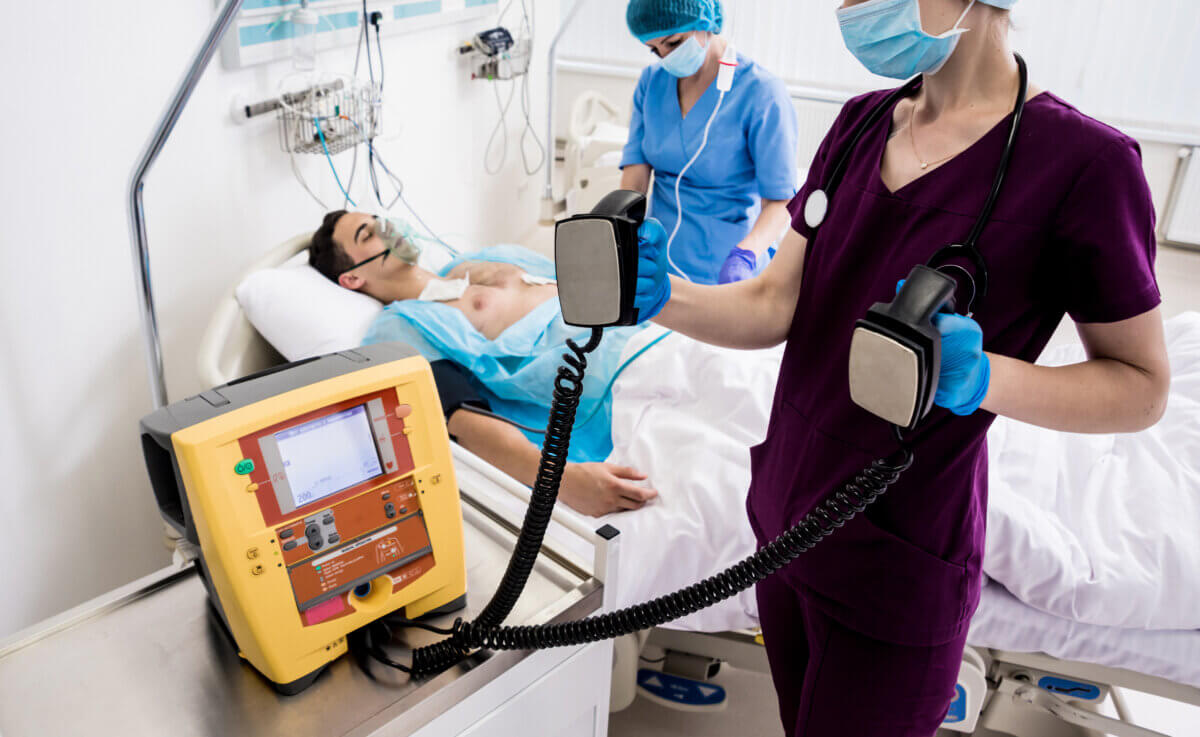
(Credit: Roman Zaiets/Shutterstock)
PORTLAND — When someone’s heart suddenly stops beating, every second counts. A new study suggests that a simple change to where emergency responders place defibrillator pads could make a crucial difference when it comes to saving lives.
Researchers from Oregon Health and Science University have found that placing defibrillator pads in an “anterior-posterior (AP) position” — meaning one pad on the front of the chest and one on the back — may be more effective than the traditional anterior-lateral (AL) position, where both pads are placed on the front of the chest.
The study, published in JAMA Network Open, looked at 255 patients who experienced out-of-hospital cardiac arrest with a “shockable” heart rhythm. These are cases where the heart isn’t pumping effectively but still has some electrical activity that can potentially be corrected with a shock from a defibrillator.
Changing pad positions made a shocking difference. Patients who received defibrillator shocks using the AP position were 2.64 times more likely to achieve a return of spontaneous circulation (ROSC) — essentially, getting their heart to start beating on its own again — compared to those with AL-positioned pads.

This difference could be critical. While 74.1% of patients with AP pad placement achieved ROSC at some point during their treatment, only 50.5% of those with AL placement did. That’s nearly a 25% difference in the chance of restarting a patient’s heart.
“The less time that you’re in cardiac arrest, the better,” says Dr. Joshua Lupton, the study’s lead author and an assistant professor of emergency medicine at the OHSU School of Medicine, in a media release. “The longer your brain has low blood flow, the lower your chances of having a good outcome.”
The study also found that AP placement seemed to work better for heavier patients. As patient weight increased, the effectiveness of AL placement decreased, while AP placement remained consistently effective.
These findings challenge current guidelines. The European Resuscitation Council recommends AL placement as the position of choice, while American Heart Association guidelines suggest either position is reasonable. This study indicates that AP placement might be the better initial choice.
“The key is, you want energy that goes from one pad to the other through the heart,” explains senior author Mohamud Daya, M.D., professor of emergency medicine at the OHSU School of Medicine.
Dr. Daya adds that placing the pads in the front and back effectively creates a “sandwich” around the heart, raising the likelihood that the electrical current will be delivered thoroughly to the organ.
While the study didn’t find significant differences in long-term survival rates between the two pad positions, the increased likelihood of achieving ROSC with AP placement could be a game-changer. Every minute without a heartbeat decreases a person’s chances of survival, so anything that helps restart the heart faster could potentially save more lives.
Paper Summary
Methodology
The researchers looked at data from 255 patients who had cardiac arrests outside of a hospital setting. They compared outcomes between patients who had defibrillator pads placed in the AP position (158 patients) versus the AL position (97 patients). They used statistical methods to account for other factors that might affect outcomes, such as the patient’s age, whether someone witnessed the cardiac arrest, and how quickly emergency services arrived.
Key Results
The main finding was that patients with AP pad placement were 2.64 times more likely to achieve ROSC than those with AL placement. This difference held up even after accounting for other factors. The researchers also found that AP placement seemed to work better for heavier patients, while AL placement became less effective as patient weight increased.
Study Limitations
The study was observational, meaning the researchers couldn’t control which patients received which pad placement. This could introduce some bias. Also, the study was conducted with a single emergency medical service in one area, so the results might not apply everywhere. The researchers also relied on emergency responders’ estimates of patient weight, which might not be perfectly accurate.
Discussion & Takeaways
The researchers suggest that AP pad placement might be more effective because it creates a better pathway for the electrical current through the heart. They emphasize that while their study shows a clear benefit in terms of restarting the heart, more research is needed to see if this translates to better long-term survival rates. They also point out that their findings could be particularly important for patients who don’t respond to initial defibrillation attempts with AL pad placement.
Funding & Disclosures
The study was supported by grants from the Zoll Foundation, the Society for Academic Emergency Medicine Foundation, and the National Institutes of Health. The authors reported no conflicts of interest.


