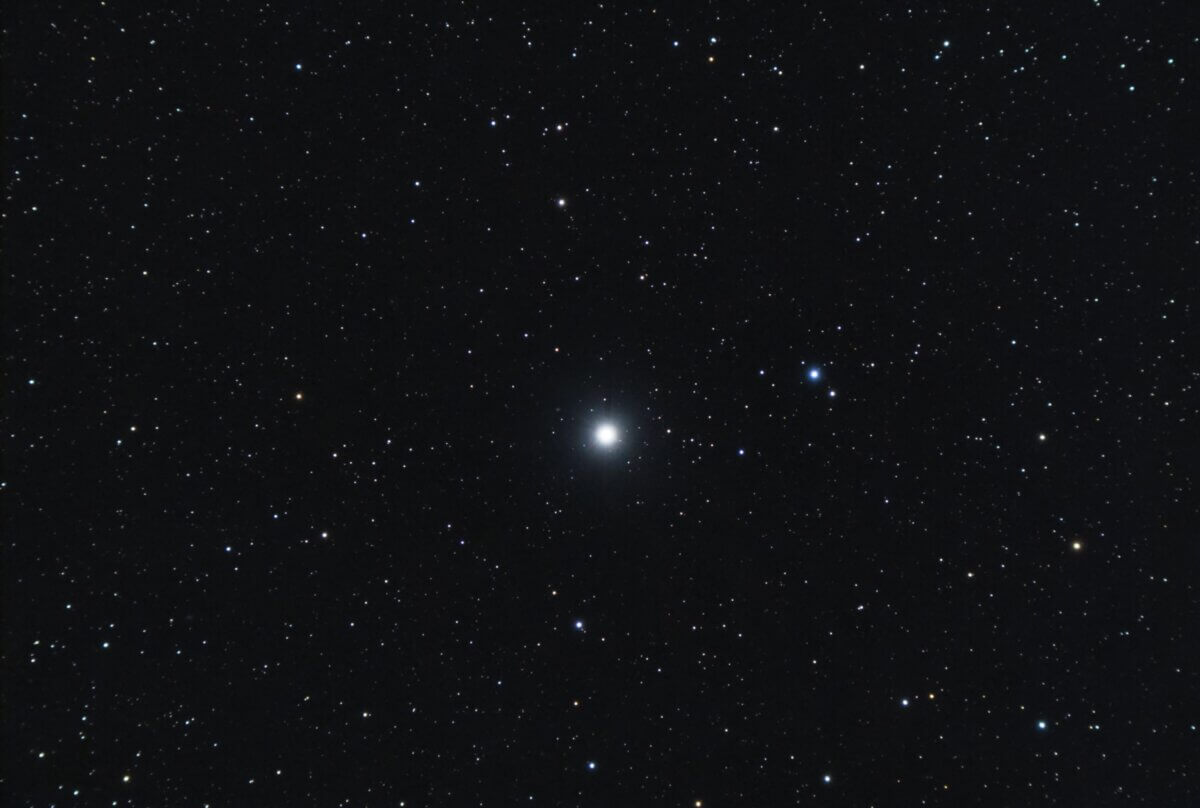
Polaris, a star in the northern circumpolar constellation Ursa Minor commonly called the North Star or Pole Star. (Image by Franco Tognarini on Shutterstock)
CAMBRIDGE, Mass. — For centuries, the North Star, Polaris, has guided travelers and captured the imagination of stargazers. Now, a new study reveals new insights about this celestial beacon and its elusive companion star. Researchers have used advanced technology to measure Polaris’s mass more accurately than ever before, shedding light on the star’s unusual properties and challenging our understanding of stellar evolution.
Polaris is actually a system of multiple stars, with the main star (Polaris Aa) orbited by a smaller companion (Polaris Ab) every 30 years. This study focused on precisely measuring the orbit and masses of these two stars. The team, led by Nancy Remage Evans of the Smithsonian Astrophysical Observatory and colleagues, used a combination of techniques to observe Polaris over several years.
One key method was interferometry, which combines light from multiple telescopes to create ultra-sharp images. The researchers used the CHARA Array, a set of six telescopes in California, to observe Polaris from 2016 to 2021. They also analyzed data from the Hubble Space Telescope and used a technique called speckle interferometry at the Apache Point Observatory.
By tracking the motion of Polaris Ab around Polaris Aa, the team could calculate the mass of the main star. They found that Polaris Aa has a mass of about 5.13 times that of our Sun, with an uncertainty of only 5%. This is more massive than previous estimates and provides crucial data for testing theories of how stars evolve.

The study, published in The Astrophysical Journal, also revealed some surprises. Polaris appears to be more luminous (brighter) than expected for a star of its mass, based on current models of stellar evolution. This suggests that our understanding of how stars like Polaris change over time may need revision.
Additionally, the researchers detected signs of “starspots” on Polaris’s surface – darker, cooler regions similar to sunspots on our own star. This is unusual for a star of Polaris’s type and could help explain some of its peculiar behavior, such as variations in its brightness and pulsation rate.
Polaris is known as a Cepheid variable star, a type of star that regularly pulsates, changing in brightness. These pulsations make Cepheid variables crucial for measuring distances in the universe. By better understanding Polaris, astronomers can refine their cosmic distance measurements and potentially resolve conflicts in how we measure the expansion rate of the universe.
This study demonstrates the power of combining multiple observational techniques and long-term data collection to uncover the secrets of even our most familiar stars. As we continue to study Polaris and other stars like it, we may need to update our models of stellar evolution and gain new insights into the workings of our galaxy and beyond.
Paper Summary
Methodology
The researchers employed a multi-faceted approach to study Polaris, combining three primary techniques. Interferometry, using the CHARA Array in California, allowed them to combine light from six telescopes spread over hundreds of meters, effectively creating a giant virtual telescope capable of resolving the faint companion star with incredible detail. Radial velocity measurements provided crucial orbital data by analyzing the spectrum of light from Polaris, detecting tiny shifts that indicate the star’s motion towards or away from Earth.
Additionally, speckle interferometry at the Apache Point Observatory helped overcome the blurring effects of Earth’s atmosphere by taking and combining many quick snapshots of the star. By integrating these methods over several years, the team was able to track the orbit of Polaris Ab around Polaris Aa with unprecedented precision, yielding a comprehensive understanding of the Polaris system.
Key Results
The study’s findings paint a detailed picture of the Polaris system, challenging some existing models of stellar evolution. The researchers determined that Polaris Aa has a mass 5.13 times that of our Sun, with a margin of error of only 0.28 solar masses. They also confirmed that Polaris Ab orbits its larger companion approximately every 29.4 years.
Intriguingly, the team found evidence of starspots on Polaris Aa’s surface, a feature not typically associated with stars of this type. Perhaps most significantly, they discovered that Polaris Aa is more luminous than current models predict for a star of its mass, suggesting that our understanding of how such stars evolve may need revision. These results provide a more accurate and nuanced view of the Polaris system, offering valuable data for testing and refining stellar evolution models.
Study Limitations
The observations cover only about three-quarters of Polaris Ab’s orbit, necessitating future observations to further refine the measurements. Polaris’s extreme brightness poses challenges for some instruments, particularly those designed for observing fainter stars, like the Gaia space telescope. The study’s reliance on combining data from multiple instruments and techniques, each with its own potential sources of error, adds complexity to the analysis.
Moreover, some of Polaris’s unusual behaviors, such as its changing pulsation rate, remain incompletely explained by these findings. Despite these limitations, the study provides a solid foundation for future research and highlights areas where additional investigation is needed.
Discussion & Takeaways
By providing a more accurate mass for Polaris, the study offers a crucial test for models of stellar evolution, particularly for stars of this type and mass range. The unexpected brightness of Polaris relative to its mass challenges current theoretical models, suggesting that our understanding of how these stars evolve may need significant revision.
The detection of starspots on Polaris opens new avenues for understanding the star’s unusual behaviors and may help explain some of its peculiar characteristics, such as variations in brightness and pulsation rate. Given Polaris’s importance as a key calibrator for measuring cosmic distances, these findings could have profound implications for our measurement of the universe’s expansion rate, potentially helping to resolve ongoing discrepancies in cosmology.
More broadly, this study underscores the power of long-term, multi-technique observations in astronomy, highlighting the importance of continued investment in diverse observational capabilities to push the boundaries of our understanding of the universe.
Funding & Disclosures
This research represents a collaborative effort supported by a variety of institutions and funding bodies. The National Science Foundation, the European Research Council, and NASA provided significant financial support, enabling the use of advanced instruments and long-term observational campaigns. The CHARA Array, a key instrument in this study, is operated by Georgia State University, showcasing the crucial role of academic institutions in advancing astronomical research.
The researchers declared no conflicts of interest, ensuring the integrity of their findings. It’s worth noting that studies of this magnitude often involve international collaboration and substantial public funding, underscoring the importance of continued support for basic scientific research. This approach not only advances our understanding of the cosmos but also fosters international cooperation and drives technological innovation that can have broader societal benefits.


