
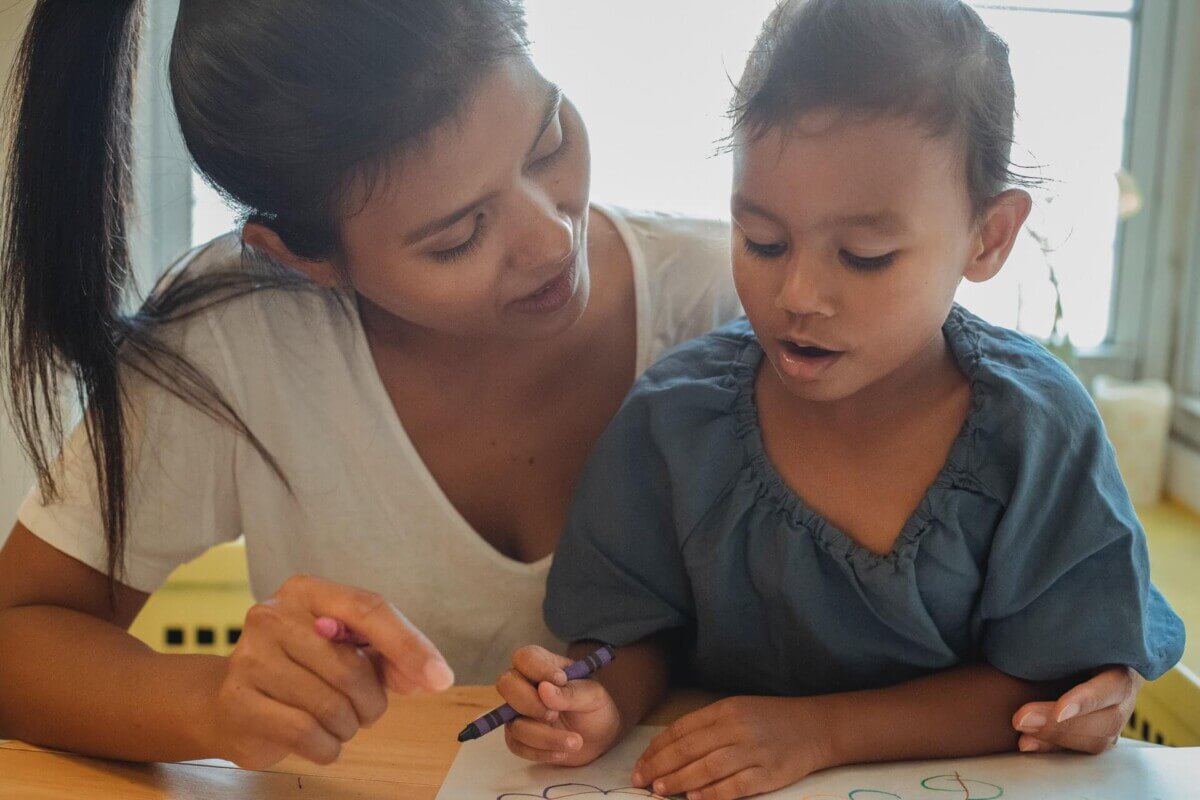
(Credit: August de Richelieu from Pexels)
COLUMBUS, Ohio – Picture this: You’re playing a game of “Guess Who?” with a five-year-old. You’ve narrowed it down to the character with the red hat, but instead of triumphantly declaring their guess, the child keeps flipping over cards, examining every detail from mustaches to earrings. Frustrating? Maybe. But according to new research, this seemingly inefficient behavior might be a key feature of how young minds learn about the world.
A study published in Psychological Science by researchers at The Ohio State University has shed new light on a longstanding puzzle in child development: Why do young children seem to pay attention to everything, even when it doesn’t help them complete a task? The answer, it turns out, is more complex and fascinating than anyone expected.
For years, scientists have observed that children tend to distribute their attention broadly, taking in information that adults would consider irrelevant or distracting. This “distributed attention” has often been chalked up to immature brain development or a simple lack of focus. But Ohio State psychology professor Vladimir Sloutsky and his team suspected there might be more to the story.
“Children can’t seem to stop themselves from gathering more information than they need to complete a task, even when they know exactly what they need,” Sloutsky explains in a media release.
This over-exploration persists even when children are motivated by rewards to complete tasks quickly.
To investigate this question, Sloutsky and lead author Qianqian Wan designed clever experiments involving four to six-year-old children and adults. Participants were shown images of cartoon creatures and asked to sort them into two made-up categories called “Hibi” and “Gora.” Each creature had seven features like horns, wings, and tails. Importantly, only one feature perfectly predicted which category the creature belonged to, while the other features were only somewhat helpful for categorizing.
The key twist was that all the features were initially hidden behind “bubbles” on a computer screen. Participants could reveal features one at a time by tapping or clicking on the bubbles. This setup allowed the researchers to see exactly which features people chose to look at before making their category decision.
If children’s broad attention was simply due to an inability to filter out distractions, the researchers reasoned that hiding irrelevant features should help them focus only on the most important one. However, that’s not what happened. Even when they quickly figured out which feature was the perfect predictor of category, children – especially younger ones – continued to uncover and examine multiple features on each trial. Adults, on the other hand, quickly zeroed in on the key feature and mostly ignored the rest.
Interestingly, by age six, children started to show a mix of strategies. About half the six-year-olds behaved more like adults, focusing mostly on the key feature. The other half continued to explore broadly like younger children. This suggests the study may have captured a key transition point in how children learn to focus their attention.
To rule out the possibility that children just enjoyed the action of tapping to reveal features, the researchers ran a second experiment. This time, they gave children the option to either reveal all features at once with one tap or uncover them one by one. Children of all ages strongly preferred the single-tap option, indicating their goal was indeed to gather information rather than simply tapping for fun.
So, why do children persist in this seemingly inefficient exploration? Sloutsky proposes two intriguing possibilities. The first is simple curiosity – an innate drive to learn about the world that overrides task efficiency. The second, which Sloutsky favors, relates to the development of working memory.
“The children learned that one body part will tell them what the creature is, but they may be concerned that they don’t remember correctly. Their working memory is still under development,” Sloutsky suggests. “They want to resolve this uncertainty by continuing to sample, by looking at other body parts to see if they line up with what they think.”
This research challenges our understanding of how children learn and raises important questions about the role of exploration in cognitive development. Far from being a bug in the system, children’s tendency to “overexplore” might be a feature that allows them to build rich, flexible knowledge about the world.
As we watch young children seemingly waste time examining every detail of their environment, we might do well to remember: what looks like distraction to us could be the gears of young minds working overtime, constructing the foundations of knowledge that will serve them for a lifetime.
Paper Summary
Methodology
The researchers conducted two main experiments to investigate children’s attention patterns. In the first experiment, they presented 4 to 6-year-old children and adults with images of fictional creatures called “Hibi” and “Gora.” These creatures had seven distinct body parts, each with unique colors and shapes. Crucially, only one body part perfectly predicted the creature’s category, while the others were less reliable indicators.
All body parts were initially hidden behind “bubbles” on a computer screen. Participants could reveal features one at a time by tapping or clicking. This clever design allowed the researchers to see exactly which features people chose to examine before making their category decision.
In the second experiment, the researchers used real animal photos (cats and squirrels) instead of cartoon creatures. This time, they gave children the option to either reveal all features at once with one tap or uncover them one by one. This helped determine whether children’s exploration was driven by enjoyment of the tapping action or by information-seeking behavior.
Key Results
The first experiment revealed a striking difference between children and adults. Even after quickly identifying the single feature that perfectly predicted the creature’s category, children continued to uncover and examine multiple features before making their decision. This was especially true for younger children. Adults, in contrast, focused almost exclusively on the key feature once they identified it.
Interestingly, 6-year-olds showed a mix of strategies, with about half behaving more like adults and half exploring broadly like younger children. This suggests that age 6 might be a transition point in the development of selective attention.
The second experiment showed that when given the choice, children strongly preferred to uncover all features at once rather than one by one. This indicates that their goal was indeed to gather information, not simply to enjoy the action of tapping.
Study Limitations
While this study provides valuable insights, it has some limitations to consider:
- The sample size was relatively small and drawn from a specific region (Columbus, Ohio), which may limit the generalizability of the findings to all children.
- The artificial nature of the task – categorizing cartoon creatures or photos on a computer screen – might not perfectly reflect how children learn categories in real-world situations.
- The study focused on a narrow age range (4-6 years old), so we don’t have a complete picture of how attention strategies develop across childhood.
- The research doesn’t definitively determine whether curiosity or working memory limitations drive children’s broad sampling behavior.
Discussion & Takeaways
This study challenges the notion that young children’s broad attention is simply due to an inability to focus or filter out distractions. Instead, it suggests that this “overexploration” might be a deliberate strategy that helps children learn more comprehensively about their world.
The research highlights an important balance between exploration and efficiency in learning. While adults’ selective attention allows them to complete tasks quickly, children’s broad sampling might protect them from overlooking important but unexpected information.
These findings could have significant implications for education and parenting. Rather than always pushing for focused attention on specific details, there may be value in allowing and encouraging broader exploration in some learning contexts.
The study also opens up exciting avenues for future research. Understanding the precise mechanisms driving children’s exploratory behavior – whether it’s curiosity, working memory limitations, or a combination of factors – could provide valuable insights into cognitive development and learning strategies.
Funding & Disclosures
This research was supported by a grant from the Eunice Kennedy Shriver National Institute of Child Health and Human Development, part of the U.S. National Institutes of Health. The researchers declared no conflicts of interest in conducting this study.


