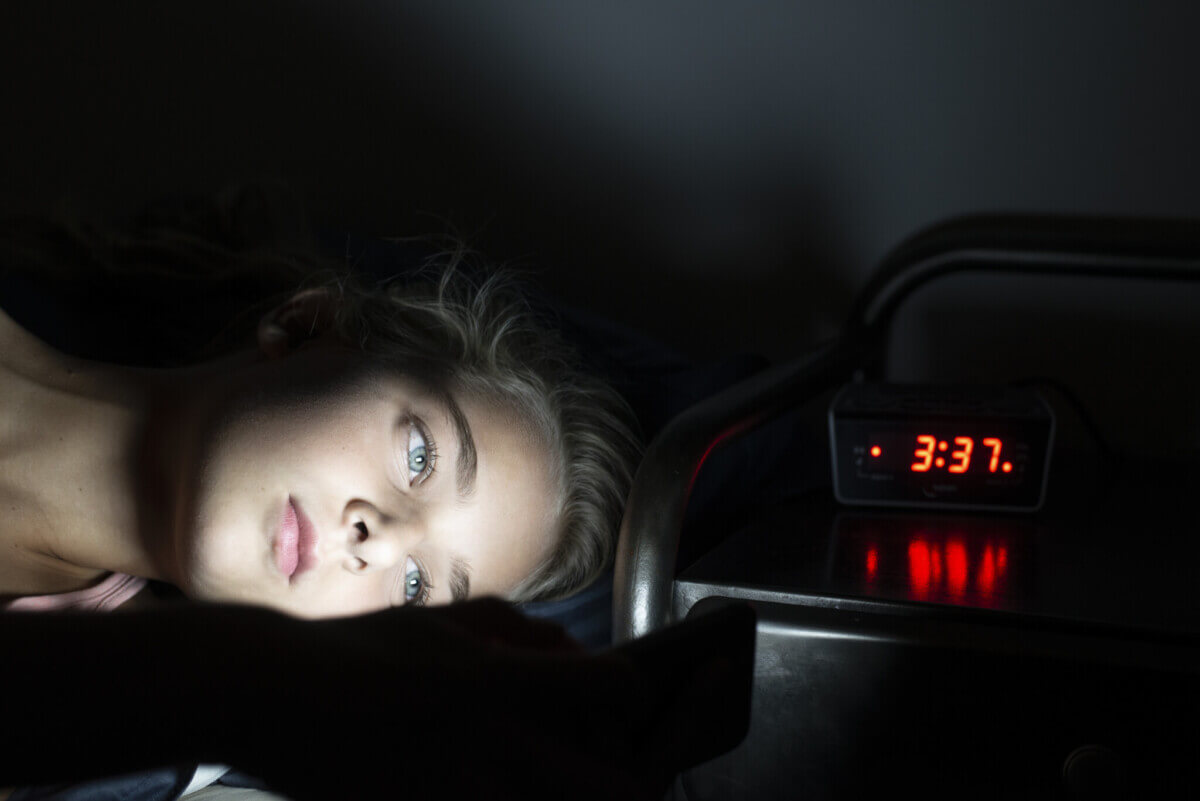
Poor sleep habits can have lasting impacts on the teenage brain. (© patrick - stock.adobe.com)
In A Nutshell
- Parental mental health and family conflict are linked to teens’ later bedtimes, evening chronotypes, and poorer sleep quality.
- Parental monitoring improves sleep quality, while screen use partially explains why family stress leads to worse sleep.
- Girls showed earlier chronotypes when exposed to more parental warmth, though this effect did not hold up in all analyses.
- Findings highlight family dynamics as important (but modest) contributors to adolescent sleep health.
MELBOURNE — When teenagers stumble out of bed looking exhausted, many parents point fingers at late-night phone scrolling or video games. But a study following over 3,400 children for four years reveals something different: family conflict and parents’ mental health struggles show connections to teen sleep problems that extend beyond screen use alone.
Scientists found associations between parents experiencing psychological difficulties and teenagers who went to bed later, woke up later, and had poorer sleep quality overall. Family arguments and tension showed similar patterns, while appropriate parental monitoring was linked to better sleep quality.
The study, published in JAMA Network Open, also uncovered a gender difference: girls whose parents showed more warmth tended to develop earlier sleep schedules, while boys showed no such pattern. However, this finding did not remain statistically significant when researchers used different analytical methods, suggesting caution in interpretation.
Family Environment Plays Key Role in Teen Sleep Patterns
Researchers from the University of Melbourne analyzed data from the Adolescent Brain Cognitive Development (ABCD) Study, tracking children from elementary school (ages 9-11) through middle school (ages 13-14). They measured family relationships in the earlier years and sleep patterns in the later ones.
The study used actigraphy (Fitbit devices worn for three weeks) to collect objective sleep data, though only participants with at least seven valid nights were included in analyses. This meant sleep timing and duration data were available for 1,161 participants, while sleep quality data came from parent questionnaires completed for the full sample of 3,419 participants.

The associations were consistent across measures, though the effect sizes were small. Parents dealing with mental health symptoms were linked to teens who went to bed and woke up later. These same teens also showed poorer overall sleep quality according to parent reports.
Households with frequent conflict showed similar patterns. These associations remained even after researchers accounted for age, socioeconomic status, pubertal development, and sex.
“Higher parental monitoring showed a positive association with sleep quality,” the researchers wrote in their paper.”Parental psychopathology was associated with later sleep timing, later chronotype, and poorer sleep quality.”
Screen Time Explains Part of the Family–Sleep Connection
The study found potential pathways linking family difficulties to sleep problems. Children from high-conflict homes or those with parents experiencing mental health challenges spent more time on screens. This increased screen use then partially explained some of the associations between family factors and sleep outcomes.
The researchers calculated what proportion of each association could be explained by screen use. For example, screen use accounted for about 25% of the link between family conflict and later chronotype (evening preference), and about 20% of the link between parental mental health problems and later chronotype.
Emotional regulation skills also played a role as a potential mediator. Teens with weaker emotional regulation showed poorer sleep quality, particularly in families with conflict or parental mental health issues.
“Adolescents in high-conflict households might turn to screens to escape family stress or manage negative emotions,” the researchers explained. While screens may provide temporary relief, excessive use can delay bedtime and increase mental stimulation before sleep.
Girls and Boys Show Different Responses to Parental Warmth
The research revealed what appeared to be a gender-specific pattern. Girls who experienced more parental warmth and acceptance developed earlier chronotypes (preferring to go to bed and wake up earlier). Boys showed no similar response to parental warmth.
“Sex moderated the association between parental warmth and earlier chronotype in girls” but not in boys, the study found.
However, when researchers re-analyzed the data using multiple imputation methods to handle missing data, this gender difference lost statistical significance. The authors noted this finding “warrants cautious interpretation” and requires further research to confirm.
Why Family Dynamics Matter for Teen Sleep Health
These findings add to existing approaches for adolescent sleep difficulties. Most current strategies focus on individual behaviors like enforcing bedtime routines and limiting device use. The research suggests that considering family-level factors could also play a role in comprehensive approaches.
For families, this means recognizing that household emotional climate and parental mental health may connect to teenage sleep patterns. Addressing family conflict and seeking support for parental mental health concerns could complement traditional sleep hygiene approaches.
Healthcare providers might consider broadening their assessment of teen sleep problems to include family dynamics and parental well-being alongside individual sleep behaviors.
The researchers noted that while effect sizes were small, they are “consistent with other large-scale ABCD studies” and “can have meaningful public health implications at the population level.” Small effects across large populations can translate to meaningful numbers of affected individuals.
The study’s observational design means it cannot establish whether family factors actually cause sleep problems or whether other unmeasured factors explain the associations. More research would be needed to determine causation and test whether family-focused interventions actually improve teen sleep outcomes.
Disclaimer: This article is for informational purposes only. It is not a substitute for professional medical advice, diagnosis, or treatment. Always seek the advice of a qualified healthcare provider with any questions you may have regarding a medical condition or sleep difficulties.
Paper Summary
Methodology
Researchers analyzed data from 3,419 children in the ABCD Study. They measured parental warmth, monitoring, family conflict, and parental mental health symptoms when children were ages 9-11. Screen time and emotion regulation were assessed at ages 12-13. Sleep outcomes at ages 13-14 were measured using both Fitbit actigraphy (for participants with at least 7 valid nights during a 3-week period) and parent questionnaires. Sample sizes varied from 571 to 3,419 depending on the specific analysis. Models controlled for age, pubertal status, socioeconomic status, and sex, with study site included as a random effect.
Results
Higher levels of family conflict and parental psychological symptoms were associated with teenagers who preferred later bedtimes and had poorer sleep quality. Parental monitoring was linked to better sleep quality. Screen use partially mediated several associations, explaining varying proportions of the links between family factors and sleep outcomes. Emotion regulation also served as a mediator for sleep quality outcomes. Girls showed an association between parental warmth and earlier chronotype, but this finding did not remain significant in sensitivity analyses using multiple imputation.
Limitations
The observational design cannot establish causation. Sleep timing and duration data were only available for about one-third of participants due to actigraphy requirements. Researchers could not distinguish between school and vacation periods. Children with existing sleep disorders were not excluded. Effect sizes were small, though the authors note these can still have population-level significance. The study used single time-point assessments that may not capture the dynamic nature of family relationships.
Funding and Disclosures
Research was supported by grants from the Melbourne Research Scholarship, National Health and Medical Council, and University of Melbourne. The ABCD Study receives funding from multiple National Institutes of Health grants and federal partners. Authors reported no conflicts of interest.
Publication Information
Published September 11, 2025, in JAMA Network Open with the title “Modifiable Parental Factors and Adolescent Sleep During Early Adolescence.” Research was conducted by Rosalind Ge and colleagues from the University of Melbourne and Monash University in Australia.


