
(© Justlight | Dreamstime.com)
In a nutshell
- Scientists have created the most precise atomic clock ever built, using a crystal of multiple atoms instead of just one. This new design would only lose one second if it had been running since the beginning of the universe.
- Unlike traditional atomic clocks that use microwaves, this next-generation clock uses laser light and multiple types of atoms working together, dramatically reducing the time needed for accurate measurements from weeks to days.
- Beyond keeping better time, this breakthrough could improve GPS navigation, help test theories about the universe, and even measure how gravity changes at different heights on Earth’s surface by detecting tiny differences in how time passes.
1 quintillionth of a second: New atomic clock pushes limits of precision
BRAUNSCHWEIG, Germany — Time measurement is entering a new era. The next generation of atomic clocks uses laser light instead of microwaves to track time, oscillating about 100,000 times faster than current timekeeping standards. Now, scientists at The Physikalisch-Technische Bundesanstalt (PTB), Germany’s national metrology institute, have developed an innovative atomic clock that achieves unprecedented precision, with an uncertainty of just 2.5 parts in a quintillion.
To help visualize this extraordinary precision: if this clock had been running since the Big Bang, approximately 13.8 billion years ago, it would have lost at most one second over that entire span of time. This level of accuracy represents a dramatic improvement over existing atomic clocks and brings us closer to redefining how we measure time itself.
Current atomic clocks, which use cesium atoms and microwaves, have served as the global time standard for decades. But a new generation of clocks using laser light instead of microwaves has already demonstrated accuracy up to 100 times better than these traditional standards. The latest breakthrough from PTB pushes these boundaries even further.
At the heart of this innovation is a unique design using a mixed-species “Coulomb crystal,” a precise arrangement of different types of electrically charged atoms (ions) held in place by electric fields. “We use indium ions as they have favorable properties to achieve high accuracy. For efficient cooling, ytterbium ions are added to the crystal,” explains PTB physicist Jonas Keller. Think of it as a microscopic team effort, where different atoms work together to achieve better results than any could alone.
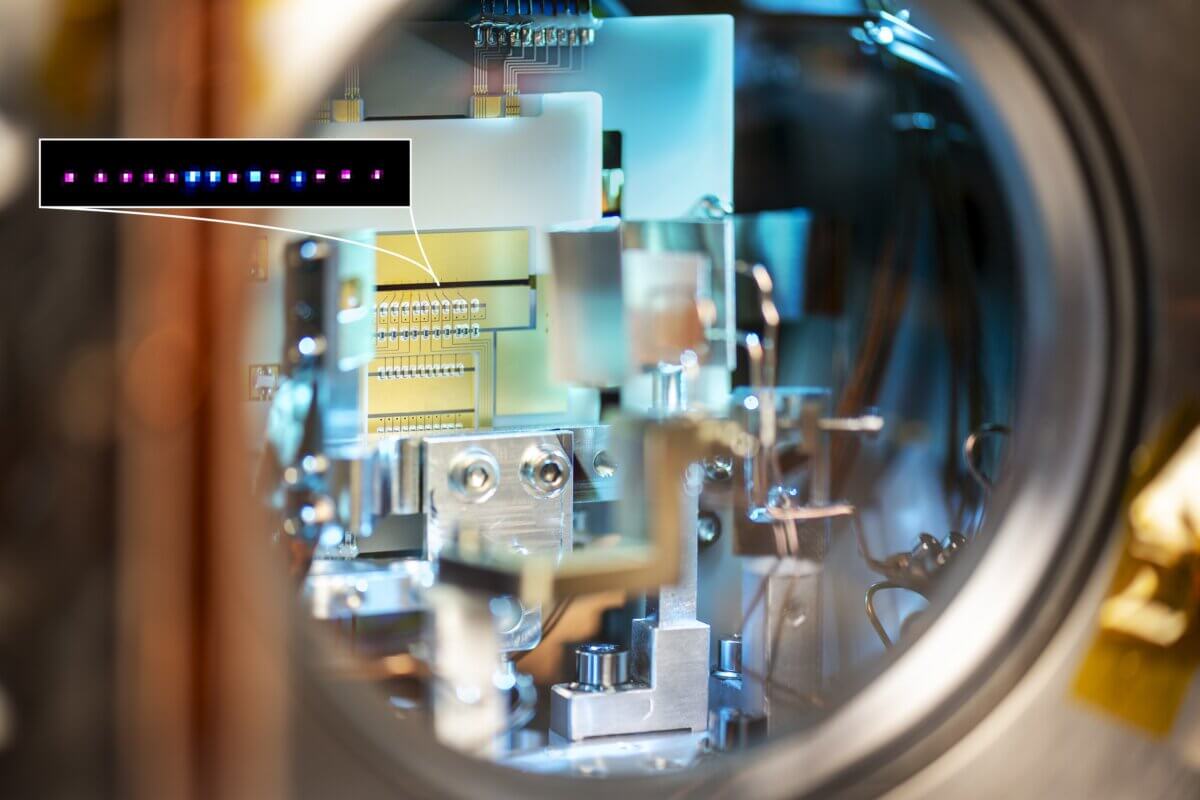
Traditional ion-based atomic clocks face a significant limitation: they typically use just one ion, requiring measurement periods of up to two weeks to achieve high precision. To reach their theoretical maximum precision, they would need to run for more than three years. The new clock overcomes this challenge by using multiple ions simultaneously, dramatically reducing the time needed for precise measurements.
Creating this multi-ion system required solving several complex engineering challenges. The research team, led by Tanja Mehlstäubler, developed specialized ion traps capable of maintaining precise conditions for multiple ions rather than just one. They also created new methods for positioning the cooling ions within the crystal structure, ensuring optimal performance.
When tested against other cutting-edge atomic clocks, including a strontium-based clock and another type of ytterbium clock, the new timepiece demonstrated exceptional stability. The comparisons, conducted over about a week, achieved some of the most precise frequency ratio measurements ever recorded. Most notably, when measuring against the ytterbium-based clock, they achieved an uncertainty of just 4.4 parts in a quintillion – marking a crucial milestone in the journey toward redefining the fundamental unit of time.

The implications of this advancement extend far beyond simply keeping better time. These ultra-precise clocks could enable new tests of fundamental physics theories and enhance our understanding of the universe. More practical applications might include improved global navigation systems and more accurate measurements of Earth’s shape and gravitational field, a technique known as chronometric leveling, where slight differences in gravity’s effect on time can be measured between different heights.
The design’s versatility suggests even broader future applications. The technology could be adapted to work with different types of ions and might enable entirely new approaches to precision measurement, including the use of quantum effects across multiple atoms or sequential measurements of multiple groups of atoms.
Paper Summary
Methodology
The researchers created their clock using a combination of indium and ytterbium ions trapped in a specialized 3D chip ion trap. They developed a unique preparation sequence that ensures the ions maintain specific positions within the crystal structure, using laser cooling techniques to keep the ions at extremely low temperatures. The clock operates through a series of stages: preparation, cooling, interrogation, and detection, with each stage carefully controlled to maintain precision.
Results
The clock achieved a systematic uncertainty of 2.5 × 10^-18, with measurements showing consistent performance over extended periods. When operated with four clock ions, it demonstrated an instability of 9.2 × 10^-16 per square root of averaging time in seconds. The team conducted frequency ratio measurements with other atomic clocks, achieving record-breaking precision in their comparisons.
Limitations
Current limitations include the need for spontaneous decay of excited states during state preparation, which introduces additional dead time and reduces efficiency. The uncertainty in measuring the angle between the clock laser and radial mode axes also contributes to measurement uncertainty. Temperature variations and magnetic field fluctuations present ongoing challenges that need to be managed.
Discussion & Takeaways
This research demonstrates the feasibility of multi-ion clocks for achieving unprecedented precision in time measurement. The scalable design opens paths toward even more precise measurements, potentially enabling new applications in fundamental physics research and practical technologies. The achievement of the most accurate frequency ratio measurement to date represents a significant milestone in precision metrology.
Funding and Disclosures
The research received support from multiple sources, including the EMPIR programme co-financed by Participating States and the European Union’s Horizon 2020 research and innovation programme. Additional funding came from the Deutsche Forschungsgemeinschaft and the Max-Planck-RIKEN-PTB-Center for Time, Constants and Fundamental Symmetries.
Publication Information
Published in Physical Review Letters, Volume 134, Issue 023201 (2025), this paper was authored by a team of researchers primarily from the Physikalisch-Technische Bundesanstalt in Braunschweig, Germany, with additional contributions from the Institut für Quantenoptik and Laboratory for Nano and Quantum Engineering at Leibniz Universität Hannover. The research was additionally supported by the German Research Foundation (DFG) within the framework of the Quantum Frontiers Cluster of Excellence and the DQ-mat Collaborative Research Center.


