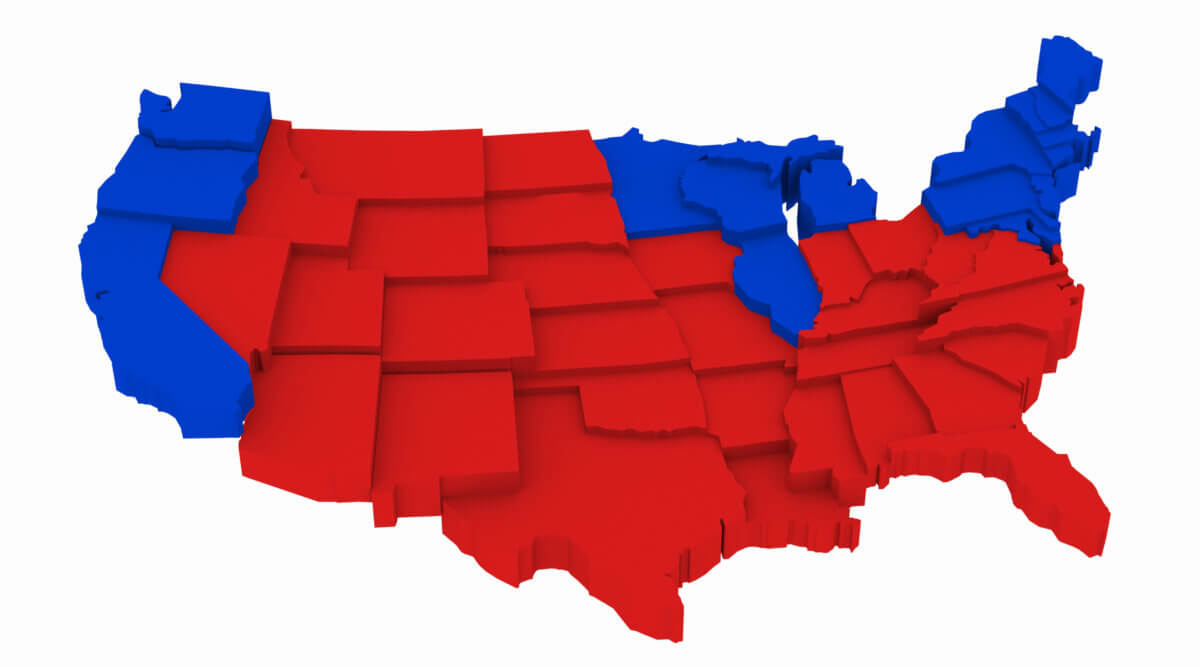
(Credit: america365/Shutterstock)
NEW YORK — With 2024 being an election year, plenty of people are sizing up each state in America based on its impact on the Electoral College. Since the population of each state helps to determine this number, it really does matter when people say they’re moving to a “red” or “blue” state. With that in mind, a new study finds that the United States could see some major voting changes in the decades to come.
By the year 2100, researchers with Click Storage predict that California will lose its title as the most populous state, falling way behind currently red states Texas and Florida. The survey’s strongest findings suggest a seismic transformation of America’s population landscape, with Sun Belt states poised for explosive growth while traditional powerhouses face potential stagnation.
“The data we have now shapes our infrastructure, healthcare, and housing policies for the future,” says Karl Graham, a demographic expert at Click Storage, in a statement to StudyFinds. “By examining population trends, we can anticipate and plan for the changes expected to come.”
The most striking revelation is the projected dominance of Texas and Florida. The Lone Star State is expected to nearly triple its population, reaching a staggering 97,840,519 residents by 2100. Florida isn’t far behind, with its population set to almost triple as well, reaching 63,029,910.
America’s New Top 5
- Texas: With a robust annual growth rate of 1.3%, Texas is set to become the undisputed population giant of the United States. “Texas’ economic attractiveness, combined with its vast expanses of land and relatively lower cost of living, will continue to draw people in,” Graham notes.
- Florida: Boasting the highest annual growth rate among the top states at 1.7%, Florida’s appeal shows no signs of waning. “Florida’s population growth is a testament to its enduring allure as a retirement haven and its expanding job market,” Graham observes.
- California: Despite recent challenges, including a modest decline of -0.2% in 2023, the Golden State is projected to grow to 53,376,507 residents by 2100. “The Golden State remains a global hub for technology and entertainment, which will sustain its growth,” Graham explains.
- North Carolina: The Tar Heel State is on track to more than double its population, reaching 23,681,944 by 2100. With a 1.2% annual growth rate, North Carolina’s rise is noteworthy. “North Carolina’s rise as a tech and education center makes it a magnet for young professionals,” Graham highlights.
- Georgia: Mirroring North Carolina’s trajectory, Georgia is set to double its population to 23,681,282 by 2100, driven by a 1.1% annual growth rate. “The Peach State’s strategic location and economic diversity will continue to attract businesses and residents,” notes Graham.
| RANK | STATE | 2024 POPULATION | 2100 POPULATION |
| 1 | Texas | 30,976,754 | 97,840,519 |
| 2 | Florida | 22,975,931 | 63,029,910 |
| 3 | California | 38,889,770 | 53,376,507 |
| 4 | North Carolina | 10,975,017 | 23,681,944 |
| 5 | Georgia | 11,145,304 | 23,681,282 |
| 6 | New York | 19,469,232 | 21,382,259 |
| 7 | Washington | 7,841,283 | 18,976,768 |
| 8 | Arizona | 7,497,004 | 17,586,556 |
| 9 | Virginia | 8,752,297 | 15,029,698 |
| 10 | Colorado | 5,914,181 | 15,024,451 |
Americans Projected to Face New Challenges and Opportunities in 2100
The projected population boom in Sun Belt states could end up bringing both challenges and new opportunities for residents entering the 22nd century.
“To navigate this surge, proactive policy-making is essential. Infrastructure needs significant investment for sustainable urban development, while healthcare must adapt to increasing and aging populations with specialized facilities and workforce training,” Graham warns.
Researchers believe the economic potential will be immense, with these growing states positioned to become powerhouses by attracting investment and job creation in the years leading up to 2100. However, sustainability remains crucial, requiring innovative approaches to problems such as land use, waste management, and renewable energy.
The Click Storage team says technology will play a pivotal role, with smart city initiatives and healthcare advancements streamlining population management. Education investment also emerged as a key factor in long-term prosperity, ensuring a skilled workforce through expanded facilities and curricula adapted to future job demands.
As we look ahead to 2100, one thing is certain: America’s electoral map will look much different than it does in 2024.
Methodology
The study’s methodology estimates each U.S. state’s population in 2100 using current population data and historical growth rates from the past 15 years. It assumes a constant growth rate, acknowledging limitations due to not accounting for fluctuations in birth and death rates or net migration. While basic, this framework highlights the importance of understanding its assumptions and potential inaccuracies.


Wrong direction. Plenty of countries with stabilized population and their economic situation is just fine. We’ve got to stop the population growth in the US, whether that’s from immigration or from domestic births. Do we want to end up like China and India? Planet resources cannot handle this already.