
Quantum computer programmer writing code for quantum algorithms (© Microgen - stock.adobe.com)
QUEBEC CITY, Quebec — Scientists have created a new system that could revolutionize how we process and transmit information securely. This innovation uses light particles in a novel way to perform complex calculations and manipulate quantum information.
At its core, this research takes advantage of the strange world of quantum mechanics, where particles can exist in multiple states at once and influence each other instantly across vast distances. While this might sound like science fiction, it’s the foundation of emerging technologies that promise to transform computing, communication, and data security.
The research team, led by scientists from Canada and Germany, has built a system using ordinary fiber-optic cables – the same kind used for high-speed internet – to create what they call a “synthetic temporal photonic lattice.” In simpler terms, they’ve found a way to use pulses of light traveling through loops of fiber-optic cable to create a playground for quantum information.
Imagine a game of hopscotch, but instead of a child hopping through squares on the ground, you have particles of light (photons) “hopping” through different time slots as they travel through the fiber-optic loops. By controlling how these light particles split and recombine in the loops, scientists can perform complex quantum operations.
One of the key innovations in this study is how they encode information. Instead of using physical quantum bits (qubits), which are notoriously difficult to maintain, they use the arrival times of light particles to represent different quantum states. This approach, called time-bin encoding, is more robust against disturbances and fits well with existing telecommunications technology.
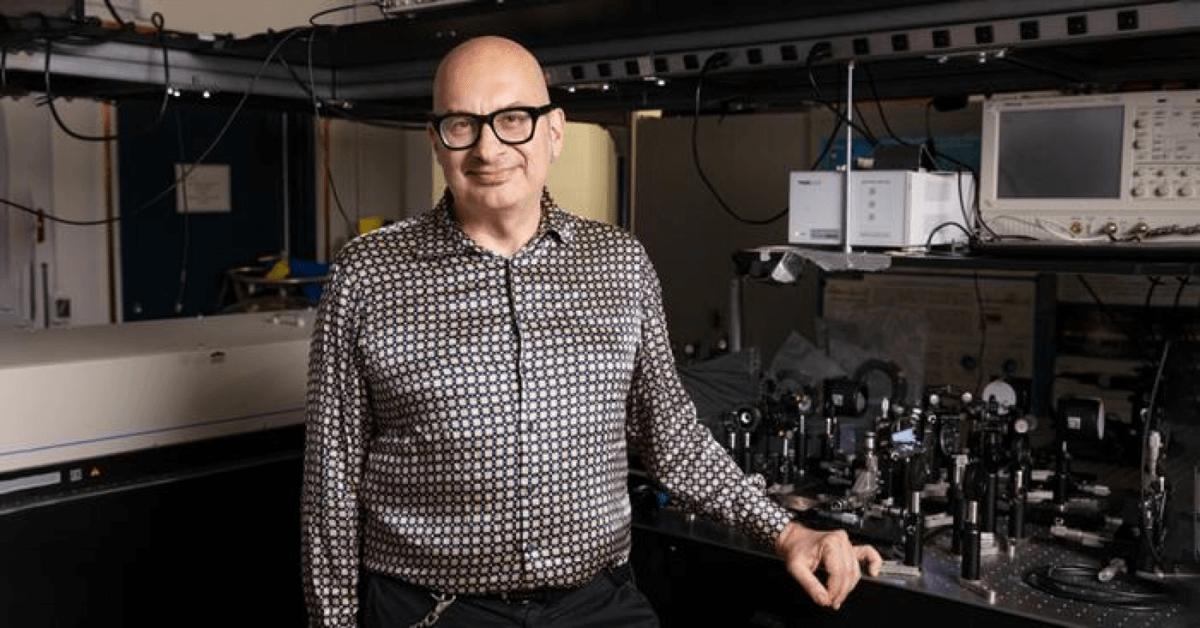
“Our team has discovered how to use synthetic photonic lattices to process quantum information, based on the quantum walks of high-dimensional photons entangled in their temporal states,” says co-lead author Professor Roberto Morandotti of Quebec’s Institut national de la recherche scientifique (INRS), in a statement. “The system doesn’t require a lot of resources, as it consists of fiber devices, which are compatible with standard telecom infrastructures.”
The researchers demonstrated their system’s capabilities by creating and manipulating pairs of entangled photons – light particles that are connected in such a way that the state of one instantly affects the other, no matter how far apart they are. They showed they could create and control both two-level (like a quantum version of a binary bit) and four-level quantum states, opening up possibilities for more complex quantum operations.
“Our system is entirely based on fiber-optic devices used in the telecommunications field and can be combined with current and future telecommunications infrastructures,” notes study co-author Dr. Stefania Sciara, also from INRS.
This breakthrough could lead to advancements in several areas:
- Quantum Computing: Enabling more efficient ways to solve complex problems that are beyond the reach of today’s supercomputers.
- Secure Communications: Creating unbreakable encryption methods for transmitting sensitive information.
- Precision Measurements: Improving our ability to measure extremely small changes in physical systems with applications in fields like medical imaging and navigation.
While there are still challenges to overcome, such as reducing signal loss and increasing the speed of operations, this research represents a significant step towards making quantum technologies more practical and accessible. By using components that are compatible with existing telecommunications infrastructure, it brings us closer to a future where quantum networks could become as commonplace as today’s internet.
“This discovery is proof that it is possible to realize high-performance quantum systems using devices, techniques, and infrastructures that are within reach. It also demonstrates that it is possible to use quantum networks to transmit personal data securely,” adds Sciara.
The study is published in the journal Nature Photonics.
Paper Summary
Methodology
The researchers built a setup with two fiber optic loops of different lengths connected by a dynamic optical coupler. A laser pulse is injected into the longer loop and splits into two pulses that circulate in the two loops. As the pulses travel through the loops, they arrive at the coupler at different times, creating a series of time-bin modes that form a one-dimensional synthetic lattice.
The researchers then used this temporal lattice to generate and process quantum states in the form of time-bin entangled photon pairs. They did this by sending the pulse sequence through nonlinear crystal waveguides to produce the entangled photons. The entangled photons were then injected back into the fiber loop system, where the researchers could control their evolution and perform quantum interference measurements.
The key to this approach is the dynamic control over the coupling between the two fiber loops. By actively adjusting the coupling ratio, the researchers were able to optimize the quantum interference patterns and increase the detection efficiency compared to previous fixed-coupling designs.
Key Results
The researchers demonstrated their ability to generate and manipulate both two-level (qubit) and four-level (qudit) time-bin entangled states using this system. For the qubit states, they were able to achieve quantum interference visibilities exceeding 96% without the need for post-selection. For the higher-dimensional qudit states, they reached visibilities over 89%.
These high-visibility quantum interference measurements show the researchers’ precise control over the quantum state evolution within the synthetic temporal lattice. This level of control is crucial for applications in quantum computing, communication, and metrology.
Study Limitations
The main limitation of this approach is the optical loss accumulated as the photons circulate through the fiber loops. After just a few roundtrips, the losses become significant, limiting the maximum number of time bins that can be practically generated and manipulated. Improving the component efficiencies, such as the optical switches and couplers, will be necessary to scale this system to higher dimensions.
Discussion & Takeaways
This work demonstrates how synthetic dimensions created in the time domain can be leveraged for quantum information processing. The use of a reconfigurable fiber-based platform provides a compact and stable implementation compared to free-space or chip-based approaches.
The researchers highlight several potential applications for this technology, including quantum phase estimation, boson sampling, and the exploration of topological phases of matter. The ability to generate high-dimensional entangled states and precisely control their evolution is a significant step toward realizing these advanced quantum information protocols.
Overall, this study showcases how innovative use of temporal degrees of freedom can expand the toolbox for manipulating quantum systems, with implications for a variety of quantum technologies.
Funding & Disclosures
This research was supported by funding from the Deutsche Forschungsgemeinschaft, the Italian Ministry of University and Research, the Japan Society for the Promotion of Science, and the Natural Sciences and Engineering Research Council of Canada, among other sources. The authors declare no competing interests.


