
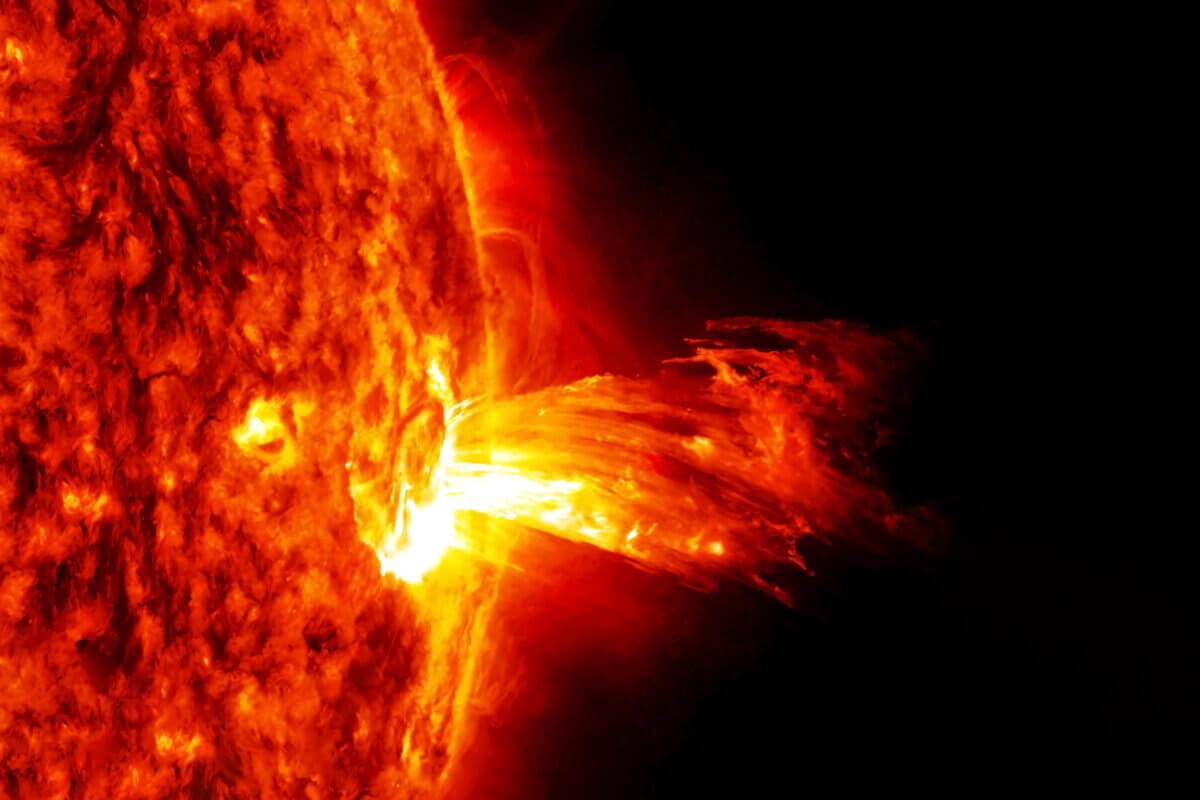
Screenshot of NASA PUNCH mission imaging of the Sun. (Credit: SwRI)
PUNCH Spacecraft Show First Complete Images Of Sun’s Corona And Solar Wind Together
In A Nutshell
- Four suitcase-sized spacecraft spread 8,000 miles apart are working as a single virtual telescope to capture unprecedented images of the Sun’s outer atmosphere and solar wind
- The mission tracked a massive solar storm in November that created colorful auroras across America, showing space weather violence in three dimensions for better forecasting
- PUNCH discovered it can see comets that are completely invisible to other telescopes, including tracking an interstellar visitor and monitoring another comet for nearly 40 days straight
- The spacecraft use extreme engineering to photograph the faint solar wind, reducing sunlight by more than 16 orders of magnitude (like comparing a human to a virus)
Four spacecraft working as a single virtual instrument are producing unprecedented images of the Sun and its outer atmosphere, revealing how the star’s corona transforms into the solar wind that fills our solar system. Less than a year after launch, NASA’s PUNCH mission has captured the Sun like never before, showing solar activity sweeping past the Moon and planets while tracking enormous space weather events as they race toward Earth.
The Southwest Research Institute-led mission uses four synchronized spacecraft spread 8,000 miles across to build wide-angle views impossible from any single vantage point. Since launching in March, PUNCH (Polarimeter to Unify the Corona and Heliosphere) has documented massive coronal mass ejections, monitored a solar storm that lit up American skies with auroras in November, and discovered an unexpected talent for tracking comets invisible to other telescopes.
“PUNCH imaging gives us a unique view on the pageantry of the planets and reveals the grandeur of our Sun in the cosmos,” said Dr. Craig DeForest, PUNCH mission principal investigator at Southwest Research Institute. “Seeing solar activity sweeping across the moon, planets and even passing comets gives us a sense of place in our solar system. It reminds me of the impact of the blue marble image of the Apollo era, though PUNCH data is more of a golden fishbowl view of our neighborhood in the cosmos. We live here.”
DeForest presented the mission’s accomplishments during a media roundtable at the AGU25 conference on December 16.

Creating an Earth-Sized Virtual Telescope
The four spacecraft orbit Earth along the day-night boundary, positioned to maintain an unobstructed view of the Sun at all times. Three satellites carry Wide Field Imagers developed by SwRI to observe the extremely faint outermost portions of the Sun’s corona and solar wind. A fourth spacecraft hosts a coronagraph called the Narrow Field Imager, provided by the Naval Research Laboratory, which blocks direct sunlight to capture details in the Sun’s atmosphere.
Each camera snaps three polarized images every four minutes and an unpolarized calibration image every eight minutes. Ground processing stitches these individual views into seamless mosaics spanning up to 45 degrees from the Sun in all directions.
Getting clear images of the solar wind requires extraordinary engineering. Deep baffles inside the wide-field cameras reduce direct sunlight by more than 16 orders of magnitude, comparable to the ratio between a human’s mass and a cold virus. Additional processing removes the background starfield, eliminating over 99% of the light in each frame to reveal the faint glow of solar particles streaming through space.
“PUNCH will make the invisible visible,” DeForest said when the mission launched. “Deep baffles in our wide-field imagers reduce direct sunlight by over 16 orders of magnitude or a factor of 10 million billion — the ratio between the mass of a human and the mass of a cold virus. Then state-of-the-art processing on the ground removes the background starfield, over 99% of the light in each image, to reveal the extremely faint glimmer of the solar wind.”
Tracking Space Weather Violence
PUNCH arrived just in time to witness major solar activity. The mission captured a massive coronal mass ejection in early November that triggered colorful auroras across the United States.
“PUNCH can actually show us directly the violence of space weather as clouds of electrons cross the solar system,” DeForest said. “Viewing the corona and solar wind as a single system provides a big-picture perspective essential to helping scientists better understand and predict space weather. This forecasting is critical to protecting astronauts, space satellites and electric grid technology from these events.”
By tracking these solar storms in three dimensions, PUNCH could give forecasters a clearer picture of when and how space weather will impact Earth. The mission’s polarized imaging helps scientists discern the exact trajectory and speed of coronal mass ejections as they move through the inner solar system, improving on current instruments that only measure the corona itself.

Bonus Science: Tracking Invisible Comets
Beyond its primary mission of imaging the Sun, PUNCH has proven remarkably adept at studying comets. The spacecraft tracked the third identified interstellar comet 3I/ATLAS as it traveled through the inner solar system during a period when bright sunlight rendered it invisible to other telescopes and space assets.
PUNCH also monitored Comet SWAN with unprecedented frequency from August 25 to October 2, capturing clear images every four minutes for nearly 40 days. That continuous observation may represent the longest continuous observation of a comet to date. The mission continues monitoring Comet Lemmon, which made its closest approach to Earth on October 21.
“We’ve discovered some incredible bonus science that PUNCH performs, tracking comets and other objects,” DeForest said. “We were able to track the third identified interstellar comet 3I/ATLAS as it traveled through the inner solar system while bright sunlight rendered it invisible to other telescopes and space assets.”
How the Mission Operates
After launch on March 11, the spacecraft began a 90-day commissioning phase. By August 7, all four had maneuvered into their final science orbits. SwRI’s Solar System Science and Exploration Division in Boulder, Colorado, leads the mission and operates all four spacecraft. The Science Operations Center began sharing data publicly through NASA’s Solar Data Analysis Center in June 2025.
The mission complements observations from NASA’s Parker Solar Probe, STEREO, SOHO, and the NASA/European Space Agency Solar Orbiter, which examine the corona at smaller scales and from different vantage points. Together, these missions provide scientists with the most complete view of the Sun’s outer atmosphere and solar wind ever assembled.
While other missions zoom in on specific features, PUNCH steps back to capture the full scope of solar activity across the inner solar system. The four spacecraft work together to track space weather from its origin at the Sun all the way to Earth, filling a gap in our ability to forecast potentially dangerous solar storms. DeForest noted that PUNCH could help revolutionize space weather forecasting much like geosynchronous satellites transformed weather prediction on Earth.
PUNCH images serve as both scientific data and a reminder that we share this corner of space with our home star and the energetic particles it constantly sheds into the solar system.


