
Conceptual image depicting end of the universe by generative AI (© The 2R Artificiality - stock.adobe.com)
In a nutshell
- Scientists discovered that neutron stars and white dwarfs are slowly evaporating, shortening the universe’s expected lifespan from 10^1100 years to 10^78 years.
- All massive objects lose energy through a process similar to how black holes evaporate, with denser objects deteriorating faster.
- Despite this “earlier” end, the universe’s death is still inconceivably far in the future—neutron stars will last 10^68 years and white dwarfs about 10^78 years.
NIJMEGEN, Netherlands — Scientists have just calculated that our universe will end much sooner than previously thought—although “soon” is still an almost inconceivable 10^78 years away (that’s a 1 followed by 78 zeros).
A research team from Radboud University in the Netherlands has discovered that even the most resilient cosmic objects—like neutron stars and white dwarfs—are actually evaporating through a previously overlooked process. This revelation dramatically shortens the universe’s estimated lifespan, though humans won’t be around to witness it.
“So the ultimate end of the universe comes much sooner than expected, but fortunately it still takes a very long time,” says lead author Heino Falcke of Radboud University, in a statement.
The Universe Has an Expiration Date
Previous studies had estimated white dwarfs—the most persistent stellar corpses—would last a mind-boggling 10^1100 years. The new calculations trim that to “just” 10^78 years when accounting for a process similar to how black holes evaporate.
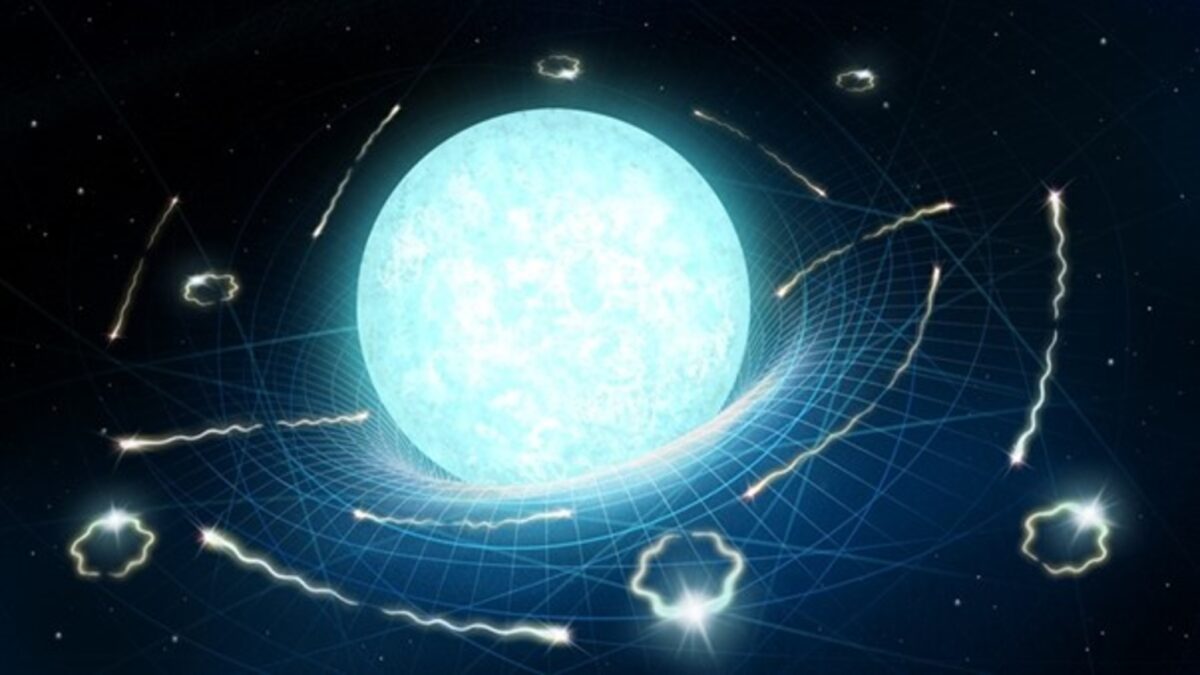
The Dutch researchers found that all massive objects leak energy through a process called “gravitational pair production.” In this process, the warping of space and time around heavy objects causes virtual particles to become real particles that escape, taking energy with them.
For decades, scientists believed this kind of evaporation only happened to black holes, through a process called Hawking radiation named after physicist Stephen Hawking. But this new research reveals you don’t need a black hole’s boundary (event horizon) for this evaporation to occur—just extremely curved spacetime.
This study follows up on the team’s 2023 paper. After showing that neutron stars can “evaporate” like black holes, they received many questions about timing, which led to this new research.
Not All Dense Objects Are Created Equal
To the researchers’ surprise, neutron stars and stellar black holes take almost the same amount of time to decay: approximately 10^67-68 years.
“But black holes have no surface,” says co-author and postdoctoral researcher Michael Wondrak. “They reabsorb some of their own radiation which inhibits the process.”
The Moon and a human body would take roughly 10^90 years to evaporate through this process. The researchers note that “there are other processes that may cause humans and the Moon to disappear faster than calculated.”
Rewriting the Rules of Cosmic Aging
The research challenges our understanding of how the universe ages. In 1975, Hawking proposed that particles could escape from black holes when two temporary particles form near the edge—one gets sucked in, the other escapes. This contradicted Einstein’s theory that black holes can only grow.
Walter van Suijlekom, mathematics professor and co-author, sees value in this cross-disciplinary work: “By asking these kinds of questions and looking at extreme cases, we want to better understand the theory, and perhaps one day, we unravel the mystery of Hawking radiation.”
One possibility raised in the paper involves “fossil neutron stars” from previous universes. Since these remnants would last 10^68 years, they could theoretically survive through multiple cosmic cycles—if universes recycle more frequently than once every 10^68 years.
The universe that started with a bang won’t end with one. Instead, over almost unimaginable timescales, even its most resilient objects will quietly fade away—dissolving into radiation through the effects of curved spacetime.
Paper Summary
Methodology
The researchers used covariant perturbation theory to calculate the creation of virtual pairs of massless scalar particles in spherically symmetric, asymptotically flat curved spacetimes. They investigated simplified optically thick, non-rotating spherically symmetric compact objects of constant density embedded in vacuum spacetime. The team calculated the probability that vacuum transitions to vacuum using the 1-loop effective action, which corresponds to a Feynman path integral over all closed paths of virtual field excitations. When this action has a positive imaginary part, it indicates that some virtual particle pairs escape re-annihilation and become real particles. The researchers applied this approach to neutron stars and white dwarfs, calculating their evaporation rates and estimating their lifetimes.
Results
The study found that all compact objects, including neutron stars and white dwarfs, will eventually evaporate through gravitational pair production. The evaporation timescale (τ) scales with the average mass density (ρ) as τ ∝ ρ^(-3/2). For neutron stars, this translates to a maximum lifetime of approximately 3.4 × 10^68 years, which is comparable to that of low-mass stellar black holes. White dwarfs would last much longer, about 3.3 × 10^78 years. The researchers also calculated a maximum stable density scale of ρmax ≈ 3 × 10^53 g/cm^3, above which objects would have already evaporated during the current age of the universe. Their calculations show that the emission from neutron stars would be slightly different from black holes, with both direct emission and surface emission components.
Limitations
The researchers acknowledged several limitations in their approach. First, they idealized neutron stars as optically thick objects with constant density, whereas real neutron stars have varying density profiles. Second, the calculations used an approximation that is second order in spacetime curvature and valid to arbitrary but finite order in proper time. The researchers note that there might be additional effects from re-summing infinitely many terms that are inaccessible with current methods. Finally, like Hawking radiation, this effect is not experimentally verified, and there is little hope it can be directly detected for macroscopic objects.
Funding and Disclosures
The work was supported by the ERC Synergy Grant “BlackHolistic,” the NWO Spinoza Prize, a grant from NWO NWA 6201348, and the Excellence Fellowship from Radboud University. The authors acknowledged discussions with Ethan Siegel about multiverses on Mastodon.
Publication Information
The paper titled “An upper limit to the lifetime of stellar remnants from gravitational pair production” was prepared for submission to JCAP (Journal of Cosmology and Astroparticle Physics). The authors are Heino Falcke, Michael F. Wondrak, and Walter D. van Suijlekom from the Department of Astrophysics/IMAPP and Department of Mathematics/IMAPP at Radboud University in the Netherlands. The paper was published on arXiv in February 2025.


