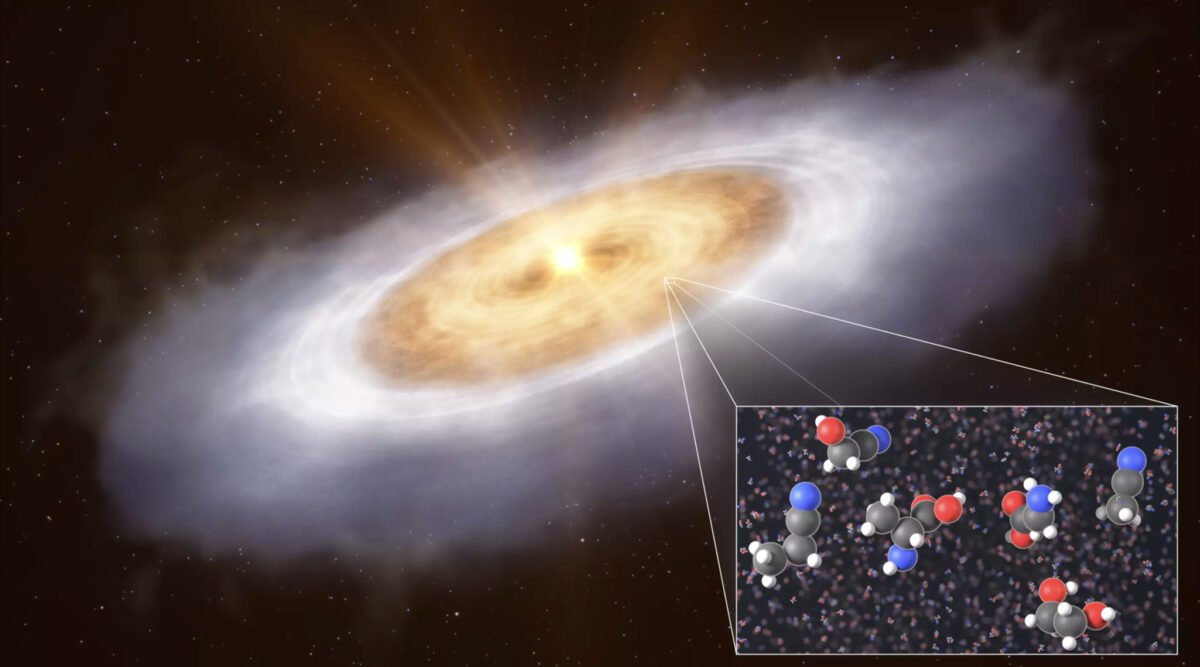
This artist’s impression shows the planet-forming disk around the star V883 Orionis. In the outermost part of the disc, volatile gases are frozen out as ice, which contains complex organic molecules. An outburst of energy from the star heats the inner disc to a temperature that evaporates the ice and releases the complex molecules, enabling astronomers to detect it. The inset image shows the chemical structure of complex organic molecules detected and presumed in the protoplanetary disc (from left to right): propionitrile (ethyl cyanide), glycolonitrile, alanine, glycine, ethylene glycol, and acetonitrile (methyl cyanide). (Credit: ESO/L. Calçada/T. Müller (MPIA/HdA))
In A Nutshell
- Scientists tentatively detected ethylene glycol and glycolonitrile — molecules linked to DNA and amino acids —i n a planet-forming disk.
- The discovery was made around the star V883 Orionis using the ALMA telescope during a rare stellar outburst.
- These prebiotic compounds may survive and even build up during planet formation, not just arrive via later impacts.
- The findings suggest that planets could form with life’s chemical building blocks already in place.
HEIDELBERG, Germany — Astronomers have made a discovery that could reshape how we think about the origins of life. For the first time, researchers have tentatively detected complex organic molecules considered essential building blocks for life in a protoplanetary disk, the swirling cloud of gas and dust where planets are born.
The molecules, ethylene glycol and glycolonitrile, are chemical precursors to nucleic acids, the fundamental components that make up DNA and RNA. Finding them in the V883 Orionis star system suggests that planets might inherit some of the raw ingredients for life directly from their cosmic nursery, rather than acquiring them later through asteroid impacts or other mechanisms.
“This suggests that the buildup of prebiotic molecules continues past the hot core phase into the epoch of planet formation,” the research team wrote in their study published in The Astrophysical Journal Letters. “Nascent planets in such environments may inherit essential building blocks for life, enhancing their potential habitability.”
How Scientists Detected Life’s Building Blocks in Space
Until now, scientists have found these complex life-related molecules in two main places: dense, hot regions of space called molecular clouds, and in comets and meteorites within our own solar system. The missing piece was whether these molecules could survive the turbulent process of planet formation and still be present when planets actually take shape.
Most planet-forming disks are extremely cold cosmic environments, which makes it nearly impossible to detect complex molecules because they freeze onto dust grains. But V883 Orionis provided a rare opportunity. This young star belongs to a special class of objects that undergo dramatic outbursts, suddenly becoming much brighter and hotter.
The outburst heated up the surrounding disk, causing frozen molecules to evaporate into gas form where they could be spotted by powerful telescopes. Using the Atacama Large Millimeter/submillimeter Array in Chile (ALMA), a collection of 66 radio dishes that work together as one giant telescope, researchers observed the system multiple times between late 2021 and late 2022.
Ethylene glycol, a sugar alcohol, and glycolonitrile, a nitrogen-containing compound, represent significant steps toward biological complexity. Ethylene glycol is closely related to glycolaldehyde, a sugar molecule, while glycolonitrile can lead to the formation of glycine, the simplest amino acid, and is considered key in adenine formation—one of the four bases that make up DNA.

ESO/C. Malin (christophmalin.com))
Molecular Fingerprints Suggest Prebiotic Chemistry in Action
The international team, led by Abubakar Fadul from the Max Planck Institute for Astronomy, tentatively detected 21 distinct spectral features from these molecules— 15 from ethylene glycol and 6 from glycolonitrile. Each signal represents different ways the molecules can vibrate and rotate, creating unique fingerprints in the radio spectrum.
The observations showed ethylene glycol exists at temperatures of at least 80 degrees Fahrenheit, while glycolonitrile was found at about minus 300 degrees Fahrenheit, which is still warm by cosmic standards. Both molecules were present in substantial concentrations (measured as column density—essentially how many molecules exist in a given area when looking through the disk) of about 3.6 × 10¹⁶ molecules per square centimeter.
When researchers compared the abundance of these molecules to methanol — one of the simplest organic compounds often used as a reference point — they found V883 Ori falls between stellar nurseries and comets in terms of chemical complexity. This suggests that molecular sophistication may build up during planet formation rather than getting erased by it.
What This Means for Finding Life in the Universe
The discovery could reshape scientists’ understanding of how widespread life’s chemical precursors might be. If planet-forming disks routinely develop complex organic molecules, then many planets may begin their existence already containing the molecular ingredients necessary for life to emerge.
Previously, it was widely assumed that the emergence of life required a rare sequence of favorable events: the right planet in the right location, followed by a lucky delivery of organic compounds via space rocks. This study implies that some planetary systems might start off with these compounds already in place.

The research team emphasized that these are “tentative” detections that still need confirmation through higher-resolution observations. At current resolution levels, overlapping signals from different molecules make it difficult to be completely certain about the findings.
Still, the implications extend beyond a single star system. Astronomers now discover thousands of new planets each year around distant stars. If V883 Ori represents conditions common during planet formation, then many of these planets might have begun with the molecular toolkit necessary for life to eventually evolve.
Rather than viewing life as a rare cosmic accident, scientists may need to consider it as a possible outcome of the chemical environment in which planets are born.
Paper Summary
Methodology
The research team used the Atacama Large Millimeter/submillimeter Array (ALMA) to observe the V883 Orionis star system across six observation sessions between December 2021 and September 2022. They focused on radio frequencies between 348–366 GHz with a spectral resolution of 488.281 kHz. The team used specialized software to identify molecular signatures by fitting spectral lines to known transition frequencies of ethylene glycol and glycolonitrile. They employed Markov Chain Monte Carlo analysis to determine the best-fit parameters for molecular column densities and temperatures, analyzing 15 transitions of ethylene glycol and 6 transitions of glycolonitrile.
Results
Researchers tentatively detected both ethylene glycol and glycolonitrile in the V883 Ori protoplanetary disk. Ethylene glycol showed a column density of 3.63 × 10¹⁶ cm⁻² at temperatures of at least 300 K, while glycolonitrile had a column density of 3.37 × 10¹⁶ cm⁻² at 88 K. When compared to methanol abundances, V883 Ori fell between hot stellar cores and comets in terms of chemical complexity, suggesting continued molecular evolution during planet formation. The team was unable to detect glycolaldehyde despite searching for it.
Limitations
The detections are considered tentative and require confirmation through higher spectral resolution observations. Significant line blending at the current resolution makes it difficult to completely rule out contamination from other molecular species. The team notes uncertainty in methanol column density measurements and variations in carbon isotope ratios that could affect abundance comparisons. Temperature constraints for ethylene glycol were poorly constrained by the model, requiring the researchers to fix the temperature rather than derive it independently.
Funding and Disclosures
The research was supported by the European Research Council Advanced Grant Origins 832428 under the Horizon 2020 Framework Program. The study used ALMA data from project 2021.1.00452.S. ALMA is an international partnership involving ESO, NSF, NINS, NRC, NSC, and ASIAA. The authors declared no competing interests.
Publication Information
A Deep Search for Ethylene Glycol and Glycolonitrile in the V883 Ori Protoplanetary Disk by Abubakar M. A. Fadul, Kamber R. Schwarz, Tushar Suhasaria, Jenny K. Calahan, Jane Huang, and Merel L. R. van ’t Hoff was published in The Astrophysical Journal Letters, Volume 988, Article L44, on August 1, 2025. The paper was received March 18, 2025, revised July 3, 2025, and accepted July 4, 2025.


