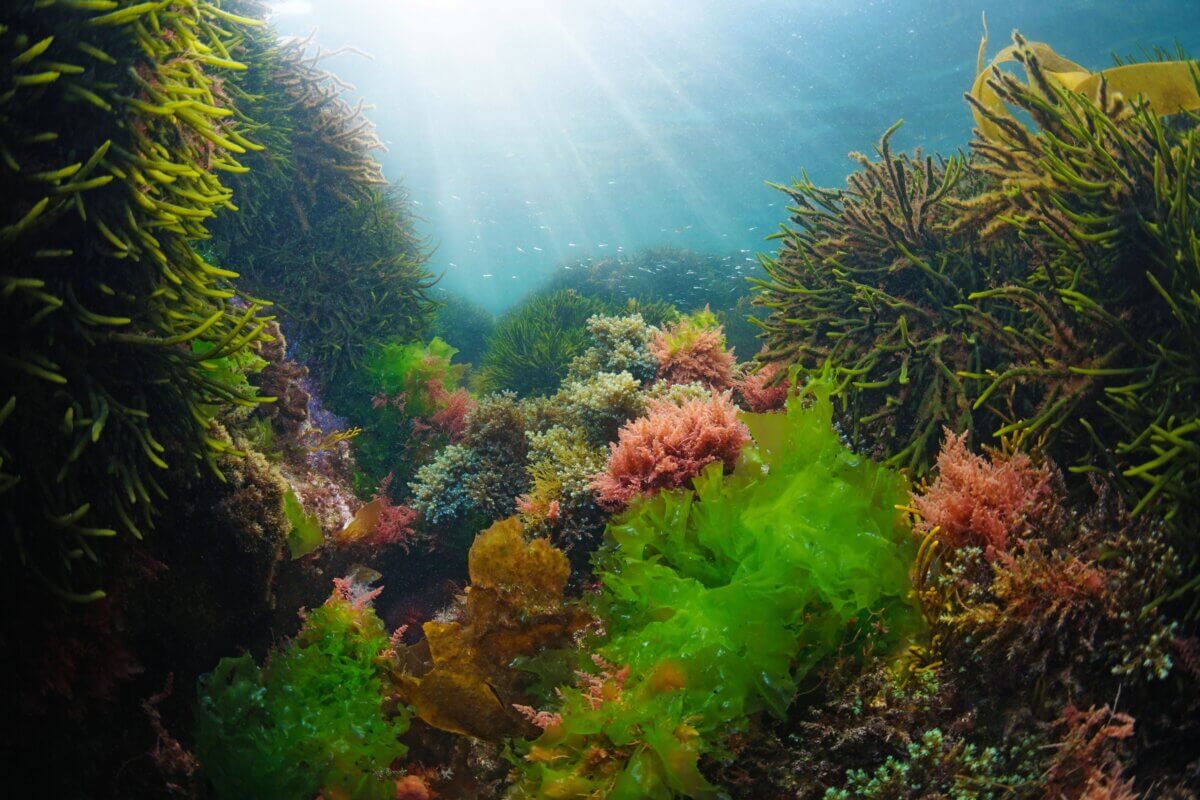
Various algae and seaweed underwater in the ocean with sunlight, Atlantic ocean, Spain, Galicia. (Photo by Damsea on Shutterstock)
OSAKA, Japan — The ocean has long been known as a source of nutritious food, but now it might also be the birthplace of a medical revolution. A new study suggests that a common seaweed could hold the power to prevent Parkinson’s disease.
The research, conducted by a team of scientists at Osaka Metropolitan University in Japan, reveals that compounds found in a brown algae called Ecklonia cava could potentially protect brain cells from the damage that leads to Parkinson’s.
Parkinson’s disease, which affects millions worldwide, is a progressive disorder that impacts movement, balance, and coordination. It occurs when the brain cells that produce dopamine, a crucial chemical messenger, begin to die off. This leads to the trademark symptoms of Parkinson’s: tremors, stiffness, and difficulty with movement. As our global population ages, the number of people facing this challenging condition is expected to skyrocket, making the search for effective treatments and preventive measures more urgent than ever.
Enter Ecklonia cava, an unassuming seaweed found in the coastal waters of Japan and Korea. This marine plant is rich in compounds called polyphenols, which are known for their powerful antioxidant properties. The researchers discovered that these seaweed-derived polyphenols, referred to as Ecklonia cava polyphenols (ECPs), might be able to shield brain cells from the kind of damage that leads to Parkinson’s.
But how exactly does seaweed protect our brains? The key lies in its ability to combat oxidative stress. Imagine our brain cells as delicate machinery constantly under attack from harmful molecules called free radicals. These free radicals are like rust, slowly corroding the cellular machinery. In Parkinson’s disease, this “rusting” process goes into overdrive, leading to the death of dopamine-producing neurons.
The ECPs act like a powerful anti-rust agent, neutralizing these harmful free radicals and activating the body’s own antioxidant defenses. They do this by triggering a protective mechanism within our cells called the Nrf2-ARE pathway. Think of Nrf2 as a cellular superhero that, when activated, rushes to turn on genes that produce antioxidant enzymes – the body’s natural defense against oxidative stress.
Delving deeper into the cellular mechanics at play, the team discovered that ECPs also work their magic by activating an enzyme called AMPK (adenosine monophosphate-activated protein kinase). AMPK acts as a cellular energy sensor and master regulator. When activated by ECPs, it sets off a chain reaction that not only boosts the cell’s defenses but also puts the brakes on the production of those harmful reactive oxygen species.
What’s particularly exciting about this research is that it shows promise both in laboratory cell cultures and in living animals. When researchers treated human brain cells with ECPs in the lab, they found that the cells were better able to withstand damage from toxins that typically cause Parkinson’s-like effects. Even more impressively, when mice with a condition similar to Parkinson’s were given ECPs orally, they showed significant improvements in their movement and coordination.
But the benefits don’t stop at movement. Parkinson’s disease often comes with a host of non-motor symptoms, including digestive issues. Intriguingly, the study found that ECP treatment also improved intestinal function in the mice and helped maintain the health of their gut lining. This finding is particularly significant given the growing evidence of a connection between gut health and brain health in Parkinson’s disease.
The implications of this research, published in the journal Nutrition are profound. If further studies confirm these results, we could be looking at a future where a simple seaweed extract could help prevent or slow the progression of Parkinson’s disease. It’s a reminder of the untapped potential of the natural world in solving some of our most pressing health challenges.
“This study suggests that Ecklonia cava antioxidants may reduce neuronal damage by AMPK activation and inhibiting intracellular reactive oxygen species production,” says Akiko Kojima-Yuasa, an associate professor with Osaka Metropolitan University’s Graduate School of Human Life and Ecology, in a statement. “It is hoped that Ecklonia cava will be an effective ingredient in the prevention of Parkinson’s disease.”
Of course, more research is needed before ECPs can be recommended as a treatment or preventive measure for Parkinson’s disease in humans. But this study opens up exciting new avenues for exploration in the field of neurodegenerative diseases. It challenges us to look beyond traditional pharmaceuticals and consider the healing power of nature – even in its most unassuming forms.
As we stand on the brink of this potential breakthrough, one thing is clear: the fight against Parkinson’s disease has found an unexpected ally in the swaying forests beneath the waves. It’s a powerful reminder that in our quest for medical breakthroughs, we should never underestimate the power of the natural world – even its most humble inhabitants.
Paper Summary
Methodology
The researchers used both laboratory cell cultures and animal models to test the effects of Ecklonia cava polyphenols (ECPs). In the cell culture experiments, they used human neuroblastoma cells (SH-SY5Y), which are often used to study Parkinson’s disease. These cells were treated with ECPs and then exposed to a toxin called rotenone, which mimics the cellular damage seen in Parkinson’s. The researchers then measured cell survival, levels of harmful reactive oxygen species, and the activity of protective antioxidant pathways.
For the animal studies, they used mice that were given rotenone to induce Parkinson’s-like symptoms. Some of these mice were also given ECPs orally. The researchers then conducted various tests to assess the mice’s motor function, including a “pole test” where mice had to turn around and descend a pole, and a “wire-hang test” to measure grip strength. They also examined the mice’s intestinal function and the health of their gut lining.
Results
The cell culture experiments showed that Ecklonia cava polyphenols protected neuroblastoma cells from rotenone-induced damage. ECPs increased the expression and activity of protective antioxidant enzymes and promoted the activation of the Nrf2 pathway, a key cellular defense mechanism.
In the animal studies, mice treated with ECPs showed significant improvements in motor function compared to those given only rotenone. The ECP-treated mice performed better on both the pole test and the wire-hang test. They also showed improvements in intestinal function and maintained healthier gut lining structure. Importantly, examination of the mice’s brains revealed that ECP treatment increased the number of dopamine-producing neurons in the substantia nigra, a brain region critically affected in Parkinson’s disease.
Limitations
While promising, this study has several limitations. First, the research was conducted on cell cultures and mice, not humans. The jump from animal studies to human applications is significant and requires extensive further research. Additionally, the study focused on prevention rather than treatment of existing Parkinson’s disease, so its applicability to those already diagnosed is unclear. The exact dosage and long-term effects of ECPs in humans would need to be carefully studied before any clinical applications could be considered.
Discussion and Takeaways
This research opens up exciting new possibilities in the field of Parkinson’s disease prevention. The ability of ECPs to activate cellular defense mechanisms and protect against oxidative stress suggests a potential avenue for developing new preventative strategies or supplements. The study also highlights the importance of looking to natural sources for potential medical breakthroughs.
The connection between gut health and neurological function observed in the study adds to the growing body of evidence linking the gut microbiome to brain health. This could lead to new approaches in managing Parkinson’s disease that consider both neurological and gastrointestinal aspects of the condition.
However, it’s important to note that while these results are promising, they are preliminary. Much more research is needed to determine if ECPs could be a safe and effective treatment or preventive measure for Parkinson’s disease in humans.
Funding and Disclosures
This work was supported by a grant from the Japan Society for the Promotion of Science (JSPS) KAKENHI. The study was conducted by researchers at Osaka Metropolitan University’s Graduate School of Human Life and Ecology. No conflicts of interest were reported by the authors.


