
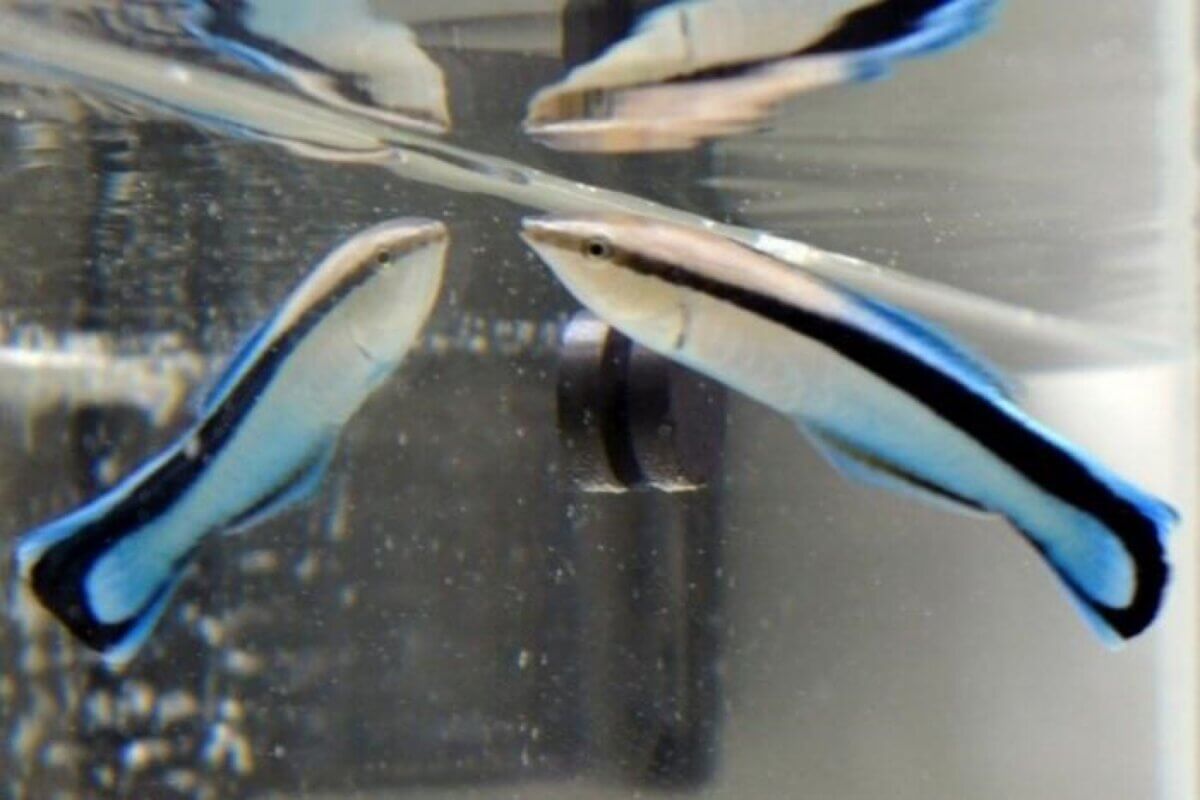
A bluestreak cleaner wrasse (Labroides dimidiatus) swims in a tank at right, with its mirror image at left. (Credit: Osaka Metropolitan University)
OSAKA, Japan — Almost every pet owner has tried showing their pet their mirror reflection. While you’ll likely get no reaction from them, it doesn’t mean all animals are unaware of their appearance. In the case of the Bluestreak cleaner wrasse (Labroides dimidiatus), Japanese researchers have shown that these fish really do recognize their reflection and that of others.
For the first time, animal researchers have shown that a non-human animal shows some type of mental capacity for self-awareness as it looks at its body size in a mirror. Private self-awareness includes the capacity for mental states, such as mental body image, standards, intentions, and goals. The details of the new research study are published in the journal Scientific Reports.
“The results that fish can use the mirror as a tool can help clarify the similarities between human and non-human animal self-awareness and provide important clues to elucidate how self-awareness has evolved,” says Taiga Kobayashi, a doctoral candidate at Osaka Metropolitan University, in a media release.
Bluestreak cleaner wrasse is a fish species originating in the Indo-Pacific region and the Red Sea. Last year, Kobayashi and his team showed evidence of cleaner wrasse identifying themselves in photographs of their faces through mirror self-recognition. Building on the previous study, the researchers sought to find how Bluestreak cleaner wrasse used this mental image information.
The researchers installed mirrors in some tanks of Bluestreak cleaner wrasse and observed their behaviors when looking at photos of other fish. In tanks with no mirrors, the Bluestreak cleaner wrasses acted aggressively to fish that were 10% larger and 10% smaller than their body size.
When the fish had mirrors available in their tank, these Bluestreak cleaner wrasses continued to act aggressively when shown pictures of smaller fish. However, the researchers found Bluestreak cleaner wrasses checking the mirror multiple times when shown photos of larger-sized fish. Aware of their body size compared to the bigger fish, the Bluestreak cleaner wrasse did not show signs of hostility among fish larger than them.
According to the researchers, the fish with mirrors developed a mental image of themselves and their size and used that knowledge to compare how they would “size up” against other nearby fish. Self-awareness of when and when not to pick a fight would help predict their best chances of winning.
Paper Summary
Methodology
In this study, researchers wanted to see if cleaner fish could recognize their own body size using mental images formed after passing the mirror self-recognition (MSR) test. First, they took photos of other fish that were either 10% larger, the same size, or 10% smaller than the focal fish. These photos were shown to 15 fish, some of which had mirrors in their tanks, while others did not.
The fish with mirrors spent a week with them, getting used to seeing their own reflection. The researchers then observed how the fish reacted to the photos both before and after exposure to mirrors. The behavior of the fish was closely monitored to see if they would behave aggressively toward larger, smaller, or same-sized fish and whether having the mirror experience changed their reactions.
Key Results
The fish that hadn’t experienced the mirror treated all photos — larger, smaller, or same-sized — as threats and acted aggressively. However, after spending time with the mirror and learning to recognize themselves, the fish became less aggressive towards larger and same-sized photos but remained aggressive toward the smaller photos.
This suggested that the fish were able to accurately assess their body size after passing the MSR test. They also swam back and forth between the mirror and the photo, likely comparing their reflection with the image of the photographed fish, showing a higher level of self-awareness.
Study Limitations
This study focuses on just one species, the cleaner fish, so the findings might not apply to other animals. Another limitation is that the study used a small sample size (only 15 fish), which might not be enough to fully confirm the results across a larger population. The behaviors observed might also have been influenced by the artificial environment of the aquarium, which differs from their natural habitat. Finally, while the results suggest private self-awareness, more tests are needed to rule out other explanations for the fish’s behavior, like simple conditioning.
Discussion & Takeaways
The study showed that cleaner fish could use mirrors to recognize their body size, which is a sign of private self-awareness. This means that these fish don’t just recognize themselves in a mirror — they can also form a mental image of their bodies, which helps them in social interactions. For example, knowing their size could help them avoid unnecessary fights with larger rivals.
This research adds to the growing evidence that certain fish have more advanced cognitive abilities than we previously thought. If similar findings are confirmed in other species, it could reshape how we think about animal intelligence and self-awareness.
Funding & Disclosures
This study was supported by various grants, including ones from JST SPRING, JSPS KAKENHI, and the Swiss Science Foundation. The researchers involved in this study declared no conflicts of interest.


