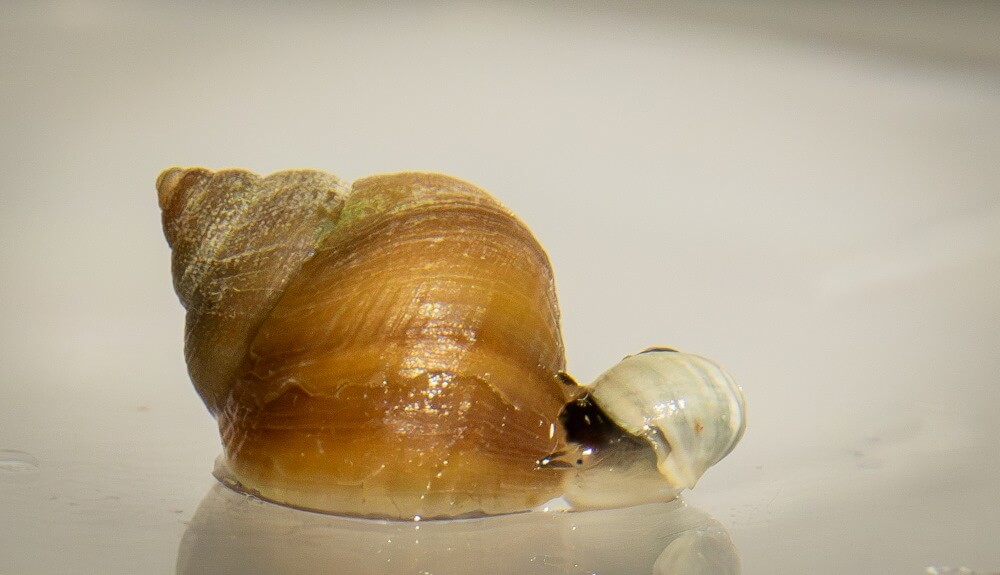
Two ecotypes of Littorina saxatilis marine snails, adapted to different environments. The Crab ecotype (left) is larger and wary of predators. The Wave ecotype (right) is smaller and has bold behavior. © David Carmelet
KLOSTERNEUBURG, Austria — Normally, scientists have believed that it takes countless centuries for evolution to produce major changes in any species. However, a new study has witnessed this amazing process unfold in a figurate blink of an eye.
A team of researchers from the Institute of Science and Technology Austria (ISTA) and Norway’s Nord University have observed marine snails evolve to closely resemble their predecessors over just 30 years – which is a tiny fraction of time in evolutionary terms.
The story begins in 1988 when a toxic algal bloom wiped out populations of marine snails from small rocky outcrops, known as skerries, in the Koster archipelago near the Swedish-Norwegian border. While this environmental disaster might have seemed insignificant to most, for marine ecologist Kerstin Johannesson from the University of Gothenburg, it presented a unique opportunity to study evolution in action.
Four years after the algal bloom, in 1992, Johannesson decided to reintroduce snails to one of these now-empty skerries. Here’s the twist: instead of bringing back the same type of snails that previously lived there, she introduced a distinctly different population of the same species, Littorina saxatilis.
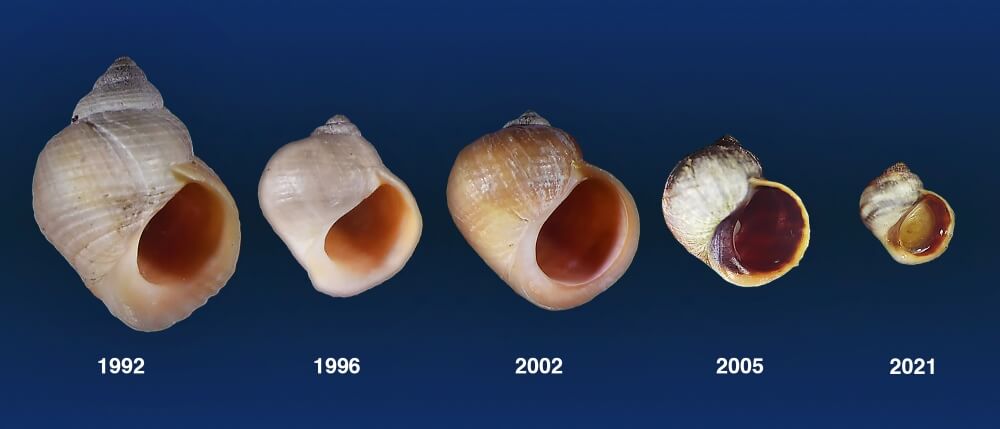
These marine snails, commonly found along North Atlantic shores, have evolved different traits to suit their specific environments. The two main types are known as “Wave snails” and “Crab snails.” Wave snails, which originally inhabited the skerries, are small with thin shells, large, rounded openings, and bold behavior – adaptations that help them survive in wave-battered environments. Crab snails, on the other hand, are larger with thicker shells, smaller elongated openings, and more cautious behavior – traits that protect them from crab predators in calmer waters.
Johannesson’s experiment involved introducing Crab snails to the skerry that had previously been home to Wave snails. The question was: How would these Crab snails adapt to their new wave-exposed environment?
The results published in the journal Science Advances were nothing short of remarkable. Within just a few generations – snails reproduce once or twice a year – scientists began to see evidence of adaptation. Over the course of 30 years, the transplanted Crab snails evolved to closely resemble the Wave snails that had inhabited the skerry before the algal bloom.
“Over the experiment’s 30 years, we were able to predict robustly what the snails will look like and which genetic regions will be implicated. The transformation was both rapid and dramatic,” says Diego Garcia Castillo, a graduate student at ISTA and one of the study’s lead authors, in a media release.
What makes this study particularly fascinating is that the snails didn’t evolve these new traits from scratch. Instead, they tapped into genetic diversity that was already present in their population, albeit at low levels. This existing genetic variation, combined with possible gene flow from neighboring Wave snail populations, allowed for rapid adaptation to the new environment.
The implications of this study extend far beyond the world of snails. In an era of rapid environmental change, understanding how species can adapt quickly is crucial.
“This work allows us to have a closer look at repeated evolution and predict how a population could develop traits that have evolved separately in the past under similar conditions,” explains Garcia Castillo.
Anja Marie Westram, a researcher at Nord University and co-corresponding author of the study, emphasizes the importance of genetic diversity in adaptation.
“Not all species have access to large gene pools and evolving new traits from scratch is tediously slow. Adaptation is very complex and our planet is also facing complex changes with episodes of weather extremes, rapidly advancing climate change, pollution, and new parasites,” says Westram. “Perhaps this research helps convince people to protect a range of natural habitats so that species do not lose their genetic variation.”
As our planet faces complex changes, including extreme weather events, climate change, pollution, and new parasites, the ability of species to adapt quickly could be the key to their survival. This study provides a glimpse into how evolution can work on relatively short timescales, offering hope for species facing rapid environmental changes.
Today, the snail population on the experimental skerry has grown to around 1,000 individuals, a testament to their remarkable ability to adapt and thrive in new conditions. As we continue to grapple with environmental challenges on a global scale, the lessons learned from these tiny marine snails could prove invaluable in understanding and potentially predicting how species might respond to our changing world.
Paper Summary
Methodology
In this study, researchers wanted to see if they could predict how a population of marine snails, Littorina saxatilis, would adapt to a new environment. To do this, they moved snails from a habitat dominated by crab predators to a location where strong waves shaped the environment. This took place on the Swedish coast, where a small, rocky islet served as the testing site. The snails were observed over 30 years to track how their physical traits (like shell size and shape) and genetic makeup changed.
The study focused on whether the changes in shell traits and genes would match what researchers had already observed in snails that had naturally adapted to different habitats in other places. They predicted changes in physical features, the frequency of specific genetic traits, and the arrangement of chromosomes over time.
Key Results
The researchers saw dramatic changes in the snails that were transplanted to the wave-dominated habitat. Over time, the snails started looking more like the local population that had naturally evolved in wave-heavy environments. For example, their shells became thinner, with different shapes and patterns compared to the thicker, more protective shells of snails from the crab habitat.
Genetically, many of the changes researchers predicted also came true. The genes associated with survival in a wave-heavy environment became more common. Overall, the snails adapted quickly, and within just a few years, they looked and acted much more like the wave-adapted snails.
Study Limitations
First, the study took place in a very specific environment, which means the results might not apply to all types of environmental changes. The waves and crabs represent only one set of natural pressures, and other factors like temperature changes or pollution could affect the snails differently.
Also, the study focused on a specific snail species and might not apply to other organisms. Finally, because the researchers had to rely on occasional sampling over 30 years, there might be gaps in the data that didn’t capture all the subtleties of how the snails were changing.
Discussion & Takeaways
The key takeaway from this study is that we can predict how populations might adapt to environmental changes based on what we know about their genetic variation and how they’ve adapted in other places. The snails in this experiment adapted quickly, showing that species with existing genetic diversity can survive rapid environmental changes.
This is an important finding in the context of climate change and other human-caused environmental shifts. However, the study also highlights that this type of predictability might not hold in all situations, especially when the environmental changes are entirely new or extreme.
Funding & Disclosures
This project received support from various sources, including the Norwegian Research Council, the Swedish Research Council, the European Research Council, the Austrian Science Fund, and the Portuguese Foundation for Science and Technology. The research involving animals was conducted in Sweden, following strict regulations for animal treatment in scientific studies. No significant conflicts of interest were declared by the researchers.


This is not true evolution which requires novel genetic information. Nor should it be surprising as this speed of adaptation from existing stocks of genetic information is common.
…and yet they are still snails. This has nothing to do with so called “evolution” and everything to do with species adaptation. Once again “scientists” try to force the data to “prove” evolution and it does nothing of the sort. Show me one species changing into another. Then we have something.
Natural Selection is the Truest form of Evolution !
A couple of observations:
1. Are they 100% certain that no outside snails washed up, traveled to, rode in on a piece of seaweed, or otherwise arrived in the inlet in 30 years? If the study area was not sealed off from outside, they have no idea that the snails they think “evolved” were the same ones they introduced 30 years ago. The “wave snails” they though “evolved” could very well have arrived there from another location.
2. Even in the best case scenarial, “adaptation” is NOT “evolution.” Maybe it’s micro-evolution–a tiny change in an organism. “Evolution” theory has snails becoming lizards, which become frogs, which become mice, which become monkeys, which become men. Squinting really hard, and wishing it’s so doesn’t make this “evolution.”
If the snails had sprouted legs, or wings, or gills, THAT would demonstrate “evolution.”
Please let us know when that happens.
Wow you mean they’re still snails.
“Normally, scientists have believed that it takes countless centuries for evolution to produce major “changes in any species.” Really? I guess the AI that generated this piece skipped high school science or BIO 101 and the evolution of the peppered moth as a consequence of air pollution during the Industrial Revolution over the span of decades first discussed as such in 1896.
Well, it’s actually good that the AI skipped high school science!
The “peppered moth” myth is a myth. It’s been debunked for well over 25 years now:
“For decades the peppered moth has been a standard classroom and textbook example of evolution. Millions of students have learned this “living proof” of natural selection. The story they have been, and are, being told is most likely false, or to put it more mildly, filled with half-truths.”
https://www.natureinstitute.org/article/craig-holdrege/science-as-process-or-dogma-the-case-of-the-peppered-moth
Replace the work evolution with adaptation in the article to make it true. As is this is just full of lies. Why does it say (Fact Checked) at the top? You just lost all credibility. The fact is that the genetics of these snails are the same they were on day one. The genetic expression ( look up epigenetics) has changed which is passed down to new generations.
exactly
StudyFinds really needs to up the standards on its “finds.” This article has nothing to do with evolution in the Darwinian sense. It’s about adaptation. Adaptation has been studied long and hard and has provided zero evidence that evolution is even the remotest possibility.
Soooo adaptation we’ve already known about, not evolution then? Hey, the clickbait headline got me here, I guess, so well played.
More delusions from those who bias their “science” to match their personal motivation of disregarding the Holy Bible -the prophesies of which Bible are now being fulfilled in live time.
So it wasnt evolution. The snail is still a snail. When it becomes a bird, let us know.
This is in no way evidence for evolution where one creature changes into an all new kind of creature or animal
I guess. If you change the definition of evolution. Now show me a snail that became fish and you’ve gotten my attention!
These people are scientists ????????????
What a joke. This doesn’t prove evolution. They would need to start growing wings.
An Intraspecies adaptation constitutes “evolution”?? HAHAHAHAHA!
I had a similar thought. Thats not the definition of evolution.
“possible gene flow”… I think that’s your “adaption” right there.
Yes. Hope this helps!
Exactly. The stretch of reality to fit the narrative never ends.
Exactly. This is proof of nothing more than a species adapting to its environment. What’s next? A dog growing a thicker fur in Alaska is proof of evolution? This is utter nonsense.
It’s merely epigenetic expression. At no time was there trans speciation.