
Italy, Milan, 2024-11-06: Denzel Dumfries (FC Inter) and Mikel Merino (Arsenal FC) head shot battle during soccer game FC Inter vs Arsenal FC. (Photo by Fabrizio Andrea Bertani on Shutterstock)
Study shows soccer players who routinely head the ball are less likely to perform well on a memory test.
In A Nutshell
- Amateur soccer players who head the ball more often show changes in the orbitofrontal brain region.
- These brain changes statistically explained weaker memory test scores.
- The orbitofrontal cortex supports planning and strategy, suggesting risks beyond memory.
- Findings raise concerns even for recreational players, not just professionals.
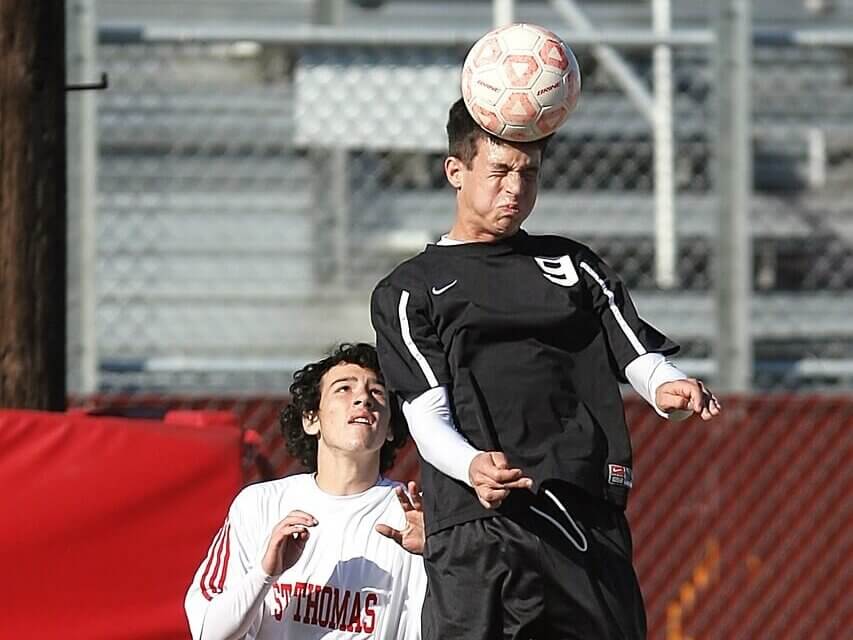
NEW YORK — For years, parents and coaches have wondered: is heading the soccer ball safe? A study by Columbia University Irving Medical Center researchers suggests the answer is more complicated than we thought.
Researchers found that amateur players who headed the ball more often showed small but measurable changes in the front of their brain. These changes were tied to weaker performance on memory tests, raising new concerns about what repeated headers might mean for players’ long-term thinking skills.
The study, published in JAMA Network Open, included 352 men and women who played soccer regularly in New York City. These weren’t professionals—they were everyday athletes who practiced and played just like millions of others around the world.
Brain Scans Show Subtle Damage Behind the Forehead
Using advanced brain scans, the research team looked at a boundary deep inside the front of the brain, just behind the forehead. This spot, called the orbitofrontal region, helps with planning, focus, and strategy, the skills every student and player needs.
Normally, the tissues in this area form a crisp, well-defined border. But in players who headed more often, that border looked blurred. Scientists see this as a warning sign of microscopic injury.

More Headers, Weaker Memory Scores
The players also took a simple memory test: they listened to a short shopping list and tried to repeat back as many items as possible. Players who reported more headers in the past year scored lower on this test.
The connection was clear: the more often players headed the ball, the more likely their scans showed subtle brain changes, and the worse they did on memory recall.
Why This Brain Area Matters
The orbitofrontal cortex isn’t mainly a “memory center.” Instead, it helps people pay attention, plan ahead, and use smart strategies for learning. If this area is injured, players may struggle with organizing information or staying focused. That could explain why memory tests were harder for frequent headers.
In daily life, this matters. These skills are the same ones students rely on in school and adults use at work. Even small changes could affect learning, focus, and decision-making.
Even Weekend Players at Risk
One of the most striking findings: these changes weren’t limited to pros or players in high-pressure leagues. They showed up in regular weekend athletes.
Some participants reported heading the ball over 20,000 times in a year. But even the “average” player, who takes about 675 headers per year, showed measurable differences. That’s just a couple of headers per practice, spread out over a season.
While the memory problems observed were mild and didn’t rise to the level of clinical impairment, the fact that recreational players showed real changes is important. It suggests heading may carry risks for anyone who plays regularly, not just professionals.
What This Means for Parents and Coaches
The study only measured one year of heading exposure, so no one yet knows the long-term effects. Still, the results raise tough questions for families and teams. Should younger players avoid heading altogether? How much is too much for adults?
Some youth leagues already ban heading for children under 12, and this research adds scientific weight to those decisions. For older players, it may come down to balancing the benefits of soccer, such as fitness, teamwork, or simple joy of the game, against the potential risks to brain health.
As one of the study authors explained, the changes were subtle but measurable. They didn’t cause obvious disability, but they did show that heading leaves its mark on the brain. Over years or decades of play, that mark could add up.
“What’s important about our study is that it shows, really for the first time, that exposure to repeated head impacts causes specific changes in the brain that, in turn, impair cognitive function,” says study leader Dr. Michael Lipton, a professor of radiology and biomedical engineering at the Columbia University Vagelos College of Physicians and Surgeons, in a statement. “The location of the abnormality we report is remarkably similar to CTE pathology, though we don’t yet know if they are linked to CTE or if any of these currently healthy athletes will develop CTE.”
Soccer is a beautiful game, but it isn’t without risks. Heading isn’t just another skill—it’s a choice that affects the brain. For parents, coaches, and players, this study is a reminder to weigh that choice carefully.
Disclaimer: This article is for general information only. It summarizes research findings and should not be taken as medical advice. Players and their families should consult qualified health professionals when making decisions about performing headers in soccer.
Paper Summary
Methodology: The study included 352 amateur players ages 18–55 from New York City, each with at least five years of soccer experience. Participants completed the validated HeadCount survey of heading exposure over the past year and underwent diffusion MRI. Researchers measured the slope sharpness of gray-white transitions in six brain regions and tested memory with the International Shopping List task.
Results: Greater heading exposure was linked to a less steep slope specifically in the orbitofrontal region. This imaging change mediated the relationship between heading and weaker recall scores. Other regions and other diffusion metrics showed no association.
Limitations: The study relied on self-reported heading counts, covered only one year of exposure, and was cross-sectional, meaning it cannot establish long-term causation. Participants with psychiatric disorders or prior brain injuries were excluded. Memory testing focused on recall rather than executive functions, which may be more directly affected by orbitofrontal injury.
Funding and Disclosures: Dr. Michael Lipton and co-authors reported funding from various sources and financial ties to unrelated medical companies. The work was approved by institutional review boards at Albert Einstein College of Medicine and Columbia University.
Publication: Song JY, Fleysher R, Ye K, et al. “Orbitofrontal Gray-White Interface Injury and the Association of Soccer Heading With Verbal Learning.” JAMA Network Open. 2025;8(9):e2532461.


