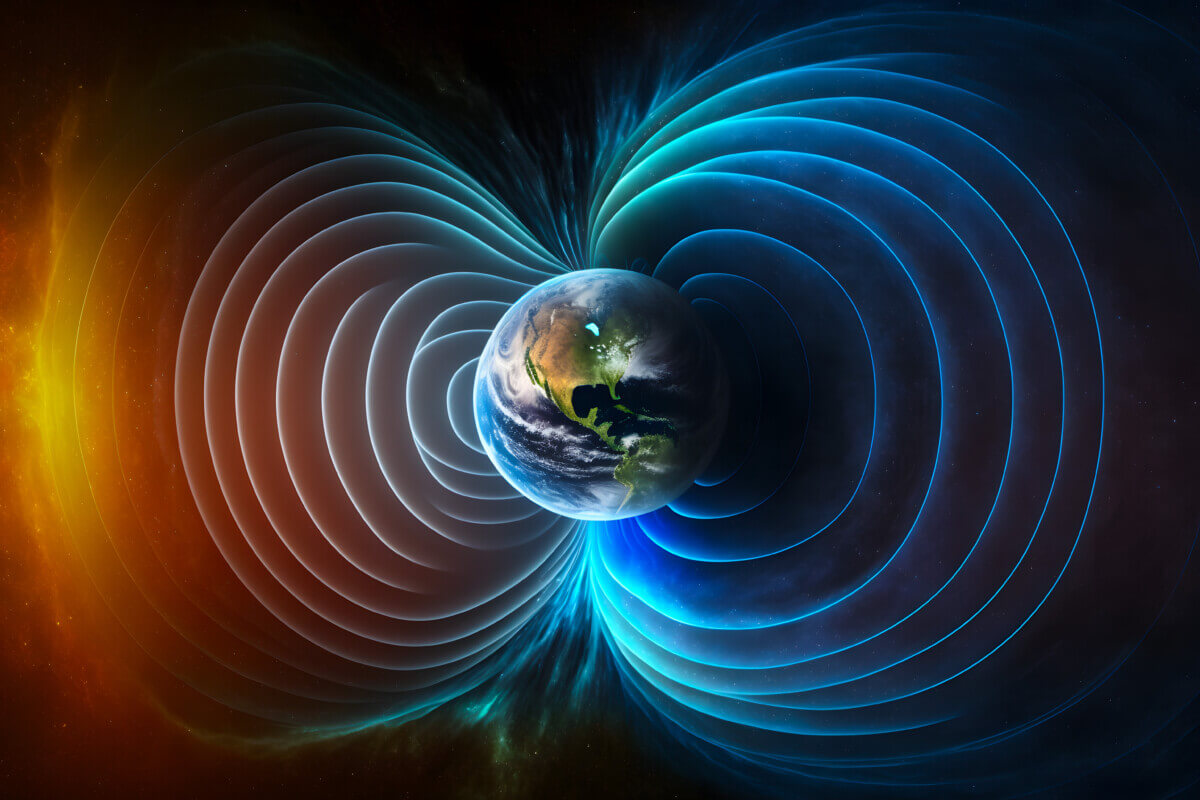
Earth's magnetic field, the Magnetosphere (© aapsky - stock.adobe.com)
KONGENS LYNGBY, Denmark — Imagine standing in the heart of Copenhagen, surrounded by an orchestra of 30 speakers buried in the ground. However, instead of Mozart or Beethoven, you’re about to hear something far more primordial — the haunting sound of Earth’s magnetic field as it flipped 41,000 years ago. Welcome to the cutting edge of geomagnetic research, where science meets art in the most unexpected way.
In a groundbreaking project, scientists from the Technical University of Denmark and the German Research Centre for Geosciences have transformed data from the European Space Agency’s Swarm satellite mission into an auditory experience that’s both fascinating and slightly unnerving.
The star of this cosmic concert? The Laschamp event, a brief but dramatic period when Earth’s magnetic field did the unthinkable – it completely reversed direction. During this geomagnetic rollercoaster, our planet’s magnetic shield weakened to a mere 5% of its current strength, leaving Earth more vulnerable to cosmic rays than ever before.
“The team used data from ESA’s Swarm satellites, as well as other sources, and used these magnetic signals to manipulate and control a sonic representation of the core field. The project has certainly been a rewarding exercise in bringing art and science together,” explains Klaus Nielsen, a musician and project supporter from the Technical University of Denmark, in a 2022 media release after researchers first converted the magnetic field into sound.
The result is a soundscape that blends familiar natural noises like creaking wood and falling rocks with otherworldly tones, creating an audio journey that’s both familiar and alien. It’s a symphony of science, with each of the 30 speakers in Copenhagen’s Solbjerg Square representing a different location on Earth and demonstrating how our magnetic field has fluctuated over the last 100,000 years.
So, why go to all this trouble to turn invisible magnetic fields into sound? “The intention, of course, is not to frighten people – it is a quirky way of reminding us that the magnetic field exists and although its rumble is a little unnerving, the existence of life on Earth is dependent on it,” Nielsen says, shedding light on the project’s purpose.
Indeed, Earth’s magnetic field is our invisible protector, a complex and dynamic bubble that shields us from cosmic radiation and the relentless solar wind. Generated by the swirling liquid iron in Earth’s outer core, this magnetic dynamo is essential for life as we know it.
The Swarm satellite mission, launched by ESA in 2013, aims to unravel the mysteries of this magnetic shield. By measuring magnetic signals from Earth’s core, mantle, crust, oceans, and even the ionosphere and magnetosphere, Swarm is helping scientists understand how our magnetic field is generated and how it changes over time.
As visitors to Solbjerg Square in Copenhagen experience this unique audio installation, they’re not just listening to strange noises – they’re hearing the voice of our planet’s invisible guardian, a force that has shaped Earth’s destiny for billions of years. It’s a reminder that in the grand cosmic symphony, Earth’s magnetic field plays a crucial, life-sustaining role – even if its solo sounds a bit scary.


So it sounds like a used Jeep Wrangler?
Just noise. Boring.
There’s a whispered voice saying I hate you numerous times in this recording.