(Photo of an eye Vanessa Bumbeers on Unsplash.com)
OSAKA, Japan — In a remarkable medical breakthrough, doctors have successfully used stem cells to treat a debilitating eye condition that can lead to vision loss. The world-first procedure, which involves transplanting lab-grown corneal cells derived from human stem cells, has the potential to restore sight for those suffering from a condition called limbal stem cell deficiency.
LSCD is a devastating disorder that occurs when the stem cells responsible for maintaining the cornea’s outer layer are damaged or depleted. This can lead to the growth of fibrous tissue over the cornea, clouding vision and causing pain, inflammation, and even blindness. Until now, treatments have been limited, often involving complex surgeries or risky immunosuppressant drugs.
However, the new research published in the medical journal The Lancet shows remarkable success with a novel approach using induced pluripotent stem cells (iPSCs) — adult cells that have been reprogrammed to behave like embryonic stem cells. Researchers in Japan were able to generate corneal epithelial cell sheets from iPSCs and successfully transplant them into the eyes of four patients with LSCD.
These patients — three men and one woman — ranged in age from 39 to 72. All had been diagnosed with LSCD stemming from various causes, including chemical burns, immune disorders, and a rare skin condition. After undergoing a procedure to remove the clouded corneal tissue, the research team carefully transplanted the lab-grown stem cell-derived corneal cell sheets onto the patients’ eyes.
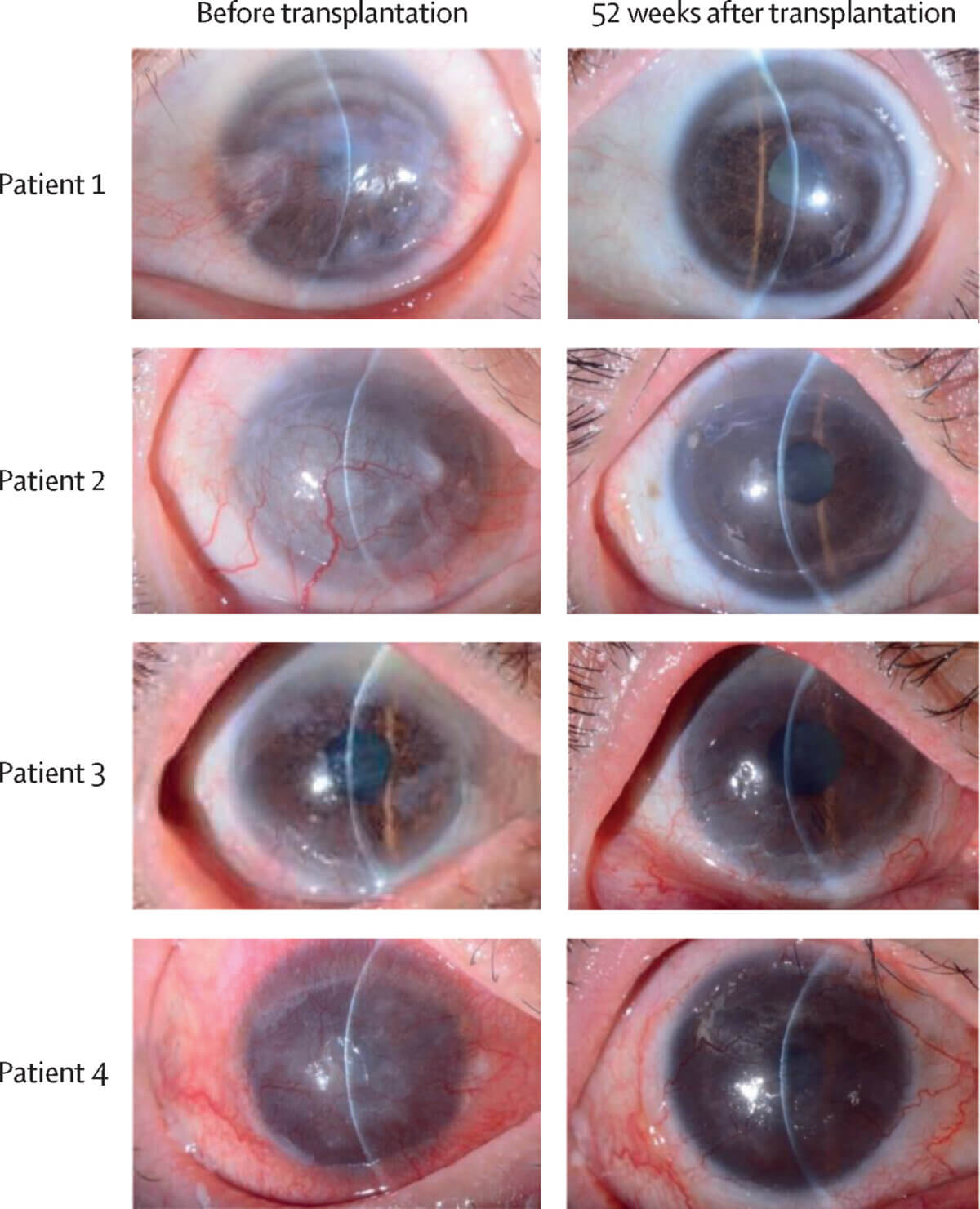
Remarkably, the transplanted cells were able to successfully integrate and restore the corneal surface in all four patients, with no serious side-effects reported over a two-year follow-up period. Three of the patients experienced significant improvements in visual acuity, corneal clarity, and overall eye health. Even the fourth patient, who had the most severe condition, showed some improvement initially, though this was not sustained long-term.
The researchers hypothesize that the transplanted cells either directly regenerate the corneal epithelium or prompt the patient’s own conjunctival cells to take on a corneal-like function, a process called “conjunctival transdifferentiation.” Further research will still be necessary to fully understand the underlying mechanisms of this vision-saving process.
Despite the small sample size, the study’s authors are optimistic that this innovative approach could revolutionize the treatment of LSCD and potentially other corneal disorders. They are already planning a larger multi-center clinical trial to further evaluate the safety and efficacy of the procedure.
“To our knowledge, this study provides the first description of iPSC-derived cell constructs being transplanted into or onto patients’ corneas, and it represents a promising future treatment option for individuals with an LSCD,” the study authors write in their report.
Paper Summary
Methodology
The researchers conducted a non-randomized, single-arm clinical study involving four patients with LSCD at a hospital in Japan. They generated corneal epithelial cell sheets from human induced pluripotent stem cells (iPSCs) and transplanted these onto the patients’ affected eyes after removing the damaged corneal tissue. The patients were then monitored for 52 weeks, with an additional year of safety monitoring, to assess the safety and efficacy of the procedure.
Key Results
The transplanted stem cell-derived corneal cell sheets were well-tolerated, with no serious adverse events or signs of tumor formation reported over the two-year observation period. Three of the four patients experienced significant improvements in their LSCD condition, including better visual acuity, reduced corneal opacity, and overall eye health. The fourth patient, who had the most severe initial condition, showed some initial improvement, but this was not sustained long-term.
Study Limitations
The primary limitation of this study is the small sample size of just four patients. While the results are promising, a larger clinical trial will be needed to fully evaluate the safety and efficacy of this stem cell-based approach for treating LSCD. Additionally, the underlying mechanisms by which the transplanted cells restore the corneal surface are not yet fully understood and require further investigation.
Discussion & Takeaways
This study represents a groundbreaking advancement in the use of stem cell technology to treat debilitating eye disorders. The ability to generate corneal epithelial cells from induced pluripotent stem cells and successfully transplant them into patients with LSCD without the need for immunosuppressant drugs is a remarkable achievement.
The results suggest that this stem cell-based approach has the potential to significantly improve vision and quality of life for those suffering from LSCD. While further research is needed, this study lays the foundation for a new treatment paradigm that could revolutionize the way we manage corneal diseases and vision loss.
Funding & Disclosures
This study was funded by grants from the Japan Agency for Medical Research and Development, the Ministry of Education, Culture, Sports, Science, and Technology—Japan, and the UK Biotechnology and Biological Sciences Research Council. One of the authors reports receiving research funds from a company in which he is a stockholder but was not directly involved in the evaluation of efficacy and safety, data management, monitoring, or statistical analysis. All other authors declare no competing interests.


