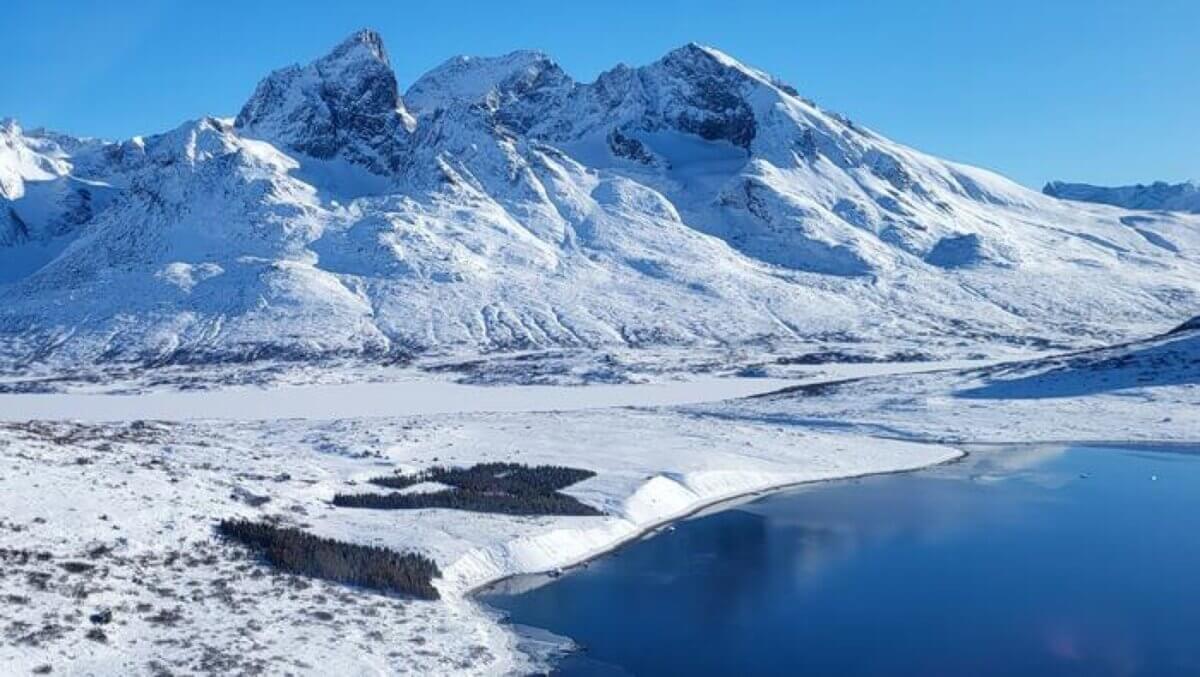
Snow reflects the sunlight back into space without converting it into heat (the albedo effect). The trees in this plantation in South Greenland reduce the albedo effect. (Credit: Mathilde le Moullec, Greenland Institute of Natural Resources)
AARHUS, Denmark — In a surprising twist that challenges popular climate solutions, scientists have discovered that planting trees in the Arctic and northern boreal regions could actually accelerate global warming rather than help combat it. In other words, researchers have a simple message: stop messing with the landscape of the Arctic, it’s making things worse.
The findings, published in Nature Geoscience, reveal that the dark surface of trees absorbs more heat than the reflective snow-covered ground they replace, potentially undermining well-intentioned climate mitigation efforts.
While tree-planting initiatives have gained momentum worldwide as a solution to climate change, this research suggests that location matters enormously. The study comes at a critical time, as various regions, including Alaska, Greenland, and Iceland, have begun implementing or considering large-scale tree-planting projects in their northern territories.
The problem lies in a phenomenon known as the albedo effect – the ability of surfaces to reflect sunlight back into space. The snow-covered ground in the Arctic reflects about 75% of incoming sunlight, while dark evergreen trees reflect only about 10%. This difference means that replacing open tundra with forests actually traps more heat in the Earth’s system, despite the trees’ ability to capture carbon dioxide from the atmosphere.
However, the issues don’t stop there. When trees are planted in Arctic regions, they disturb the soil, which in these areas serves as one of Earth’s largest carbon banks. The Arctic’s permanently frozen soils, or permafrost, contain more carbon than all the world’s plant life combined. When this soil is disturbed by tree planting and root growth, it releases stored carbon into the atmosphere, further contributing to global warming.
“Soils in the Arctic store more carbon than all vegetation on Earth,” explains lead author Jeppe Kristensen, an assistant professor from Aarhus University, in a media release. “These soils are vulnerable to disturbances, such as cultivation for forestry or agriculture, but also the penetration of tree roots. The semi-continuous daylight during the spring and early summer, when snow is still on the ground, also makes the energy balance in this region extremely sensitive to surface darkening, since green and brown trees will soak up more heat from the sun than white snow.”
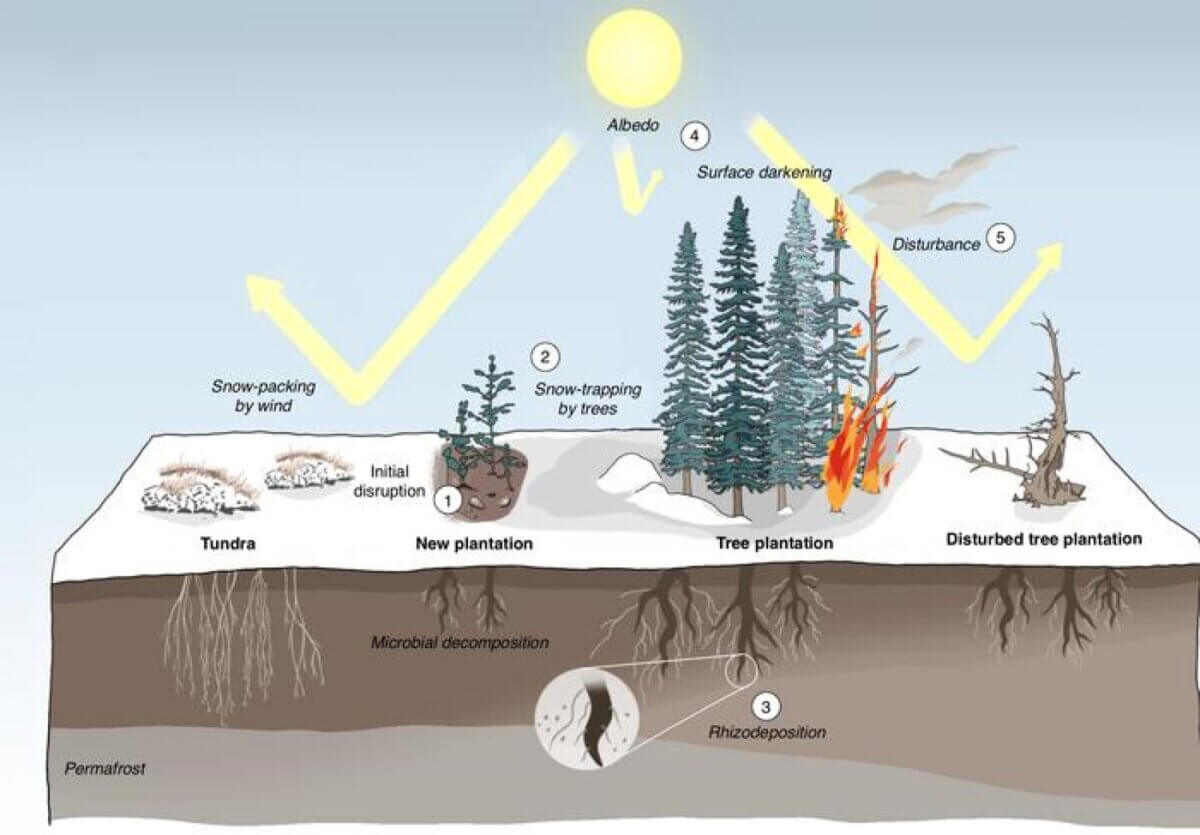
The research team also found that trees in these regions face significant survival challenges. As climate change intensifies, these areas are experiencing more frequent wildfires, droughts, and pest outbreaks. When trees succumb to these disturbances, any carbon they’ve stored is released back into the atmosphere, negating their potential benefits as a carbon capture solution.
“This is a risky place to be a tree, particularly as part of a homogeneous plantation that is more vulnerable to such disturbances,” Kristensen continues. “The carbon stored in these trees risks fueling disturbances and getting released back to the atmosphere within a few decades.”
The study’s findings are particularly relevant as companies and governments increasingly turn to tree planting as a way to offset their carbon emissions. The researchers warn that this “carbon tunnel vision” – focusing solely on trees’ ability to capture carbon while ignoring other environmental impacts – could lead to misguided climate solutions.
Instead of tree planting, the researchers suggest that preserving and restoring existing Arctic ecosystems, including maintaining sustainable populations of large herbivores, might be a more effective climate strategy. This approach would also better protect biodiversity and support local communities that rely on open landscapes for traditional activities like hunting, herding, and gathering.
Paper Summary
Methodology
The research team analyzed multiple aspects of Arctic tree planting, including its effects on surface reflectivity (albedo), soil carbon storage, and ecosystem stability. They examined existing scientific literature and data on Arctic ecosystems, combining information about soil carbon content, tree growth patterns, surface reflectivity measurements, and climate disturbance patterns to create a comprehensive picture of how tree planting affects northern environments.
Key Results
The study found that the warming caused by reduced surface reflectivity outweighs any cooling benefit from carbon capture by the trees. Additionally, soil disturbance from planting and root growth releases stored carbon, while increased snow retention by trees leads to warmer winter soil temperatures, further destabilizing permafrost. The research also showed that planted trees face high risks from intensifying wildfires, droughts, and pest outbreaks in these regions.
Study Limitations
The study primarily relied on existing research and data rather than new field experiments. While this allowed for a broad analysis, it means some specific local variations might not be fully captured. The long-term effects of tree planting in these regions would need decades of observation to fully verify the projected outcomes.
Discussion & Takeaways
The research emphasizes that climate solutions need to consider multiple environmental factors, not just carbon capture. The findings suggest that protecting existing Arctic ecosystems might be more effective than trying to transform them through tree planting. The study also highlights the importance of considering local conditions and communities when developing climate strategies.
Funding & Disclosures
The research was supported by several organizations, including the NERC Arctic Office UK-Greenland Arctic Bursary, the Carlsberg Foundation, and the European Union’s HORIZON Research and Innovation program. The study was conceived during a workshop in Greenland hosted by Kangerlussuaq International Science Support. The authors declared no competing interests that might influence the study’s findings.


They needed a study to understand this? This was clear decades ago for anyone who understands physics.
Human arrogance keeps scientists, and those who fund them, from realizing that they know nothing about how nature really works. We are monkeys playing god. Geoengineering and other climate change methods will never result in the expected outcome, given our extremely limited understanding. Experiments are good for discovering things. But don’t experiment in the same test tube you live in. When the experiment goes awry, there is nowhere else to go.
Yup. AGREED.
Plus, trees WILL NOT GROW in arctic regions. This article is a lie at best.