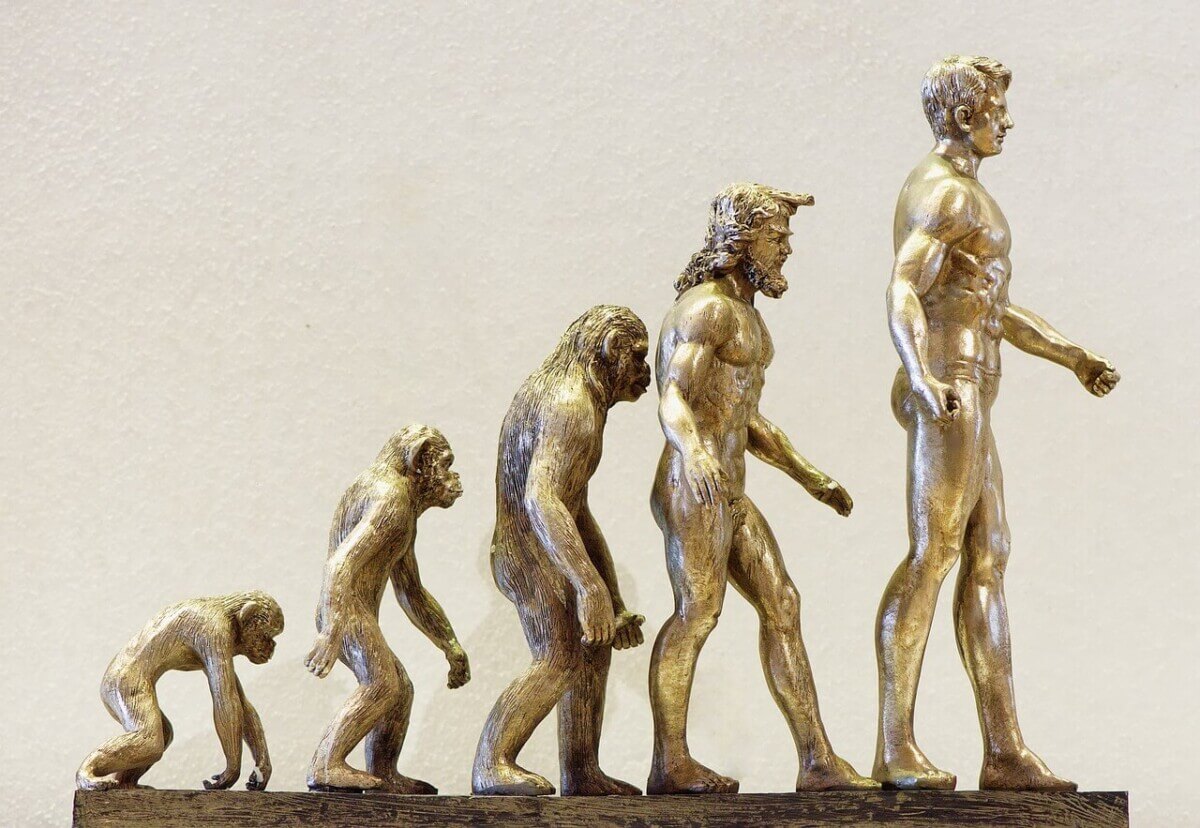
(Image by Alexa from Pixabay)
In A Nutshell
- Research suggests sexual selection may have played a role in shaping human penis size over time.
- Humans have much larger penises than other primates, even after accounting for body size.
- A new experiment shows penis size affects both female attraction and how men judge rivals.
- Women preferred larger penises up to a point, while men saw larger penises as slightly more threatening.
Among primates, the human penis is an evolutionary outlier. Controlling for body size, humans have greater girth and generally longer penises than chimpanzees, gorillas, or orangutans. Unlike our closest relatives, the human penis also lacks a baculum (penis bone) and relies entirely on blood flow to achieve rigidity.
Scientists have puzzled over this difference for decades, but a new experimental study offers compelling evidence for one possible answer: sexual selection. Both female mate choice and male-male competition appear to have favored larger penis size, along with greater height and more V-shaped bodies.
Over 800 participants viewed computer-generated male figures that systematically varied in three traits: penis size, height, and body shape. Women rated the figures for sexual attractiveness, while men assessed how threatening rivals would be in a fight and how attractive they’d be to women. The findings reveal that penis size matters for both attractiveness and perceived fighting ability, offering the first experimental evidence that sexual selection before mating could have nudged penis size upward over evolutionary time.
“To our knowledge, this is the first experimental evidence that males assess rivals’ fighting ability and attractiveness to females based partly on a rival’s penis size,” the researchers write in PLOS Biology “Our findings suggest that female choice and male-male competition have jointly favored larger penis size, greater height, and more V-shaped bodies in men.”
Sexual Selection as the Evolutionary Driver
For decades, scientists have wondered why. Most research focused on what happens after sex, such as sperm competition. But this new study looked at what happens before mating: whether women simply find larger penises more attractive and whether men see them as a sign of a tougher opponent.
Prior to clothing, the human penis was a visually prominent feature, comparable in visibility to women’s enlarged breasts. Such exaggerated sex-specific traits always raise questions about how and why they evolved. Yet far more scientific research has asked why humans have enlarged breasts than has asked about penis size.

In this study, researchers created 343 computer-generated male figures, each with different combinations of penis size, height, and body shape. Penis size ranged from about 2 to 5 inches (flaccid), height from about 5’4″ to 6’2″, and body shape from pear-shaped to the classic V-shaped build.
Each figure appeared as a rotating video. Women rated them for sexual attractiveness. Men rated them for either how jealous they’d feel if the guy talked to their partner, or how threatened they’d feel if he wanted to fight.
What Women Actually Want
Women preferred larger penises, but only up to a point. Beyond a certain size, the benefits leveled off. The same pattern held for height and V-shaped bodies—bigger was better, but there were diminishing returns.
Body shape mattered most in the attractiveness ratings. Penis size and height had similar effects, with penis size sometimes mattering even more than height. These traits also worked together: penis size mattered more for taller men and men with broader shoulders.
Interestingly, heavier women showed stronger preferences for larger penises, while taller women cared more about male height. These takeaways are consistent with the tendency for people to choose partners similar to themselves.

Men Overestimate What Women Want
Men could generally identify which traits women prefer, but they weren’t as accurate as the women themselves. When men rated how attractive a rival would be to women, they kept seeing benefits from bigger and bigger traits. Researchers found they didn’t recognize that women’s preferences level off.
This reveals something about male psychology: men tend to overestimate how much these traits matter to women. They may mix up two different things: what makes a man attractive to women versus what makes him a tough opponent. It makes sense from an evolutionary standpoint: better to overestimate a rival than to underestimate one and end up in a fight you can’t win.
Connecting Fighting Ability To Penis Size
When men rated how threatened they’d feel by another man in a fight, height and body shape mattered most. Penis size had a much smaller effect, but it was real.
“Males were more likely to feel threatened if they had to imagine being challenged by a rival with a large penis,” the researchers explain. In other words, men with larger penises may be less likely to get challenged to fights in the first place. This held true even when the guys were the same height and build. The researchers say this is the first experimental evidence that men factor penis size into snap judgments about a rival’s fighting ability.
Of course, these were snap judgments based on computer images, not real-world fights or actual dating decisions. But the pattern reveals something about the psychology that may have shaped human evolution.
Penis size functions more as a turn-on for women than as a badge of toughness for men. Other male traits, like beards and deep voices, are much stronger signals of fighting ability. Penis size affects female attraction more than male intimidation.
Why Penis Size Might Signal Strength
One possible reason involves testosterone. This hormone drives penis development during puberty and is also linked to muscle mass, aggression, and competitive ability. A larger penis might therefore signal higher testosterone, a marker of overall masculinization. This study didn’t test that idea directly, but it’s a plausible explanation.
Another idea involves stress. When men feel anxious or threatened, adrenaline redirects blood away from the genitals. This is part of the “fight or flight” response. A larger flaccid penis might signal confidence and low stress, suggesting a man who isn’t experiencing the fear response typical of someone in danger.
Size Matters in Human Evolution
The study included participants from diverse ethnic backgrounds, and the patterns held across groups. Cultural factors do influence what people find attractive, but the strong female preference for larger penis size suggests these preferences may have been present in our ancestors.
There’s an important catch: we don’t know how much mate choice women actually had in ancestral populations. In many societies, families arranged marriages. But even under constraint, women found ways to exercise choice through extra-pair relationships or re-partnering after splits.
Some researchers have also suggested that penis size may have been selected because it affects sexual pleasure. Previous studies have linked larger penises to increased likelihood of female orgasm, which may improve sperm retention and encourage repeat encounters. That’s separate from this experiment, but it’s part of the bigger evolutionary debate about why human penises are so large.
The bottom line: the existence of strong female preferences and male rival assessment based on penis size suggests these preferences may have been around in our ancestors, even if we can’t know exactly how much they shaped evolution. Female choice and male competition appear to have worked together, favoring larger penis size, greater height, and more V-shaped bodies in men.
Paper Summary
Limitations
The study acknowledged several constraints on interpretation. Computer-generated figures, while allowing precise experimental control, may not fully capture the complexity of real human bodies or social contexts. All figures were shown nude and without facial features, removing cues that typically influence attractiveness judgments in real-world settings. The study used only heterosexual participants’ assessments and didn’t examine how sexual orientation might affect these patterns. Cultural variation in mate preferences means results from primarily Western participants may not generalize to all human populations. The researchers also noted that the opportunity for female mate choice in ancestral human populations remains unclear, making it difficult to determine how strongly these preferences actually drove evolution. Finally, the study measured perceptions of fighting ability rather than actual combat outcomes, and the link between penis size and genuine fighting success has not been established.
Funding and Disclosures
Upama Aich received funding from the Monash University Research Reactivation Grant and the Forrest Research Foundation Fellowship. Brian S. Mautz was supported by the National Cancer Institute (grant T32 CA160056). Bob B. M. Wong received funding from the Australian Research Council (grants DP220100245 and DP250100501). Michael D. Jennions received funding from the Australian Research Council (grant DP2019100279). The funders had no role in study design, data collection and analysis, decision to publish, or preparation of the manuscript. The authors declared no competing interests.
Publication Information
Authors and Affiliations: Upama Aich (Centre for Evolutionary Biology, School of Biological Sciences, University of Western Australia; School of Biological Sciences, Monash University; Division of Ecology and Evolution, Research School of Biology, The Australian National University), Chloe Tan (Division of Ecology and Evolution, Research School of Biology, The Australian National University), Rebecca Bathgate (Division of Ecology and Evolution, Research School of Biology, The Australian National University), Khandis R. Blake (Melbourne School of Psychological Sciences, The University of Melbourne), Robert C. S. Capp (Melbourne School of Psychological Sciences, The University of Melbourne), Jacob C. Kuek (Melbourne School of Psychological Sciences, The University of Melbourne), Bob B. M. Wong (School of Biological Sciences, Monash University), Brian S. Mautz (Division of Ecology and Evolution, Research School of Biology, The Australian National University), Michael D. Jennions (Division of Ecology and Evolution, Research School of Biology, The Australian National University; Stellenbosch Institute for Advanced Study, Wallenberg Research Centre at Stellenbosch University, South Africa).
Journal Citation: Aich U, Tan C, Bathgate R, Blake KR, Capp RCS, Kuek JC, et al. (2026) “Experimental evidence that penis size, height, and body shape influence assessment of male sexual attractiveness and fighting ability in humans.” PLoS Biology 24(1): e3003595.
DOI: 10.1371/journal.pbio.3003595 | Published: January 22, 2026 | Received: August 28, 2025 | Accepted: December 19, 2025


