
(Photo by Boukaih on Unsplash)
These video games’ nonsensical optimism help young adults ‘mentally reset’
In A Nutshell
- Imperial College London researchers found that playing Super Mario Bros. and Yoshi games helped university students rediscover “childlike wonder”—the ability to find delight in ordinary moments like clouds, coins, and playful sounds.
- Students who experienced more childlike wonder from gameplay reported significantly higher overall happiness, which in turn lowered their burnout risk through a measurable statistical pathway.
- The games’ bright colors, cheerful music, low-pressure gameplay, and delightful “nonsense logic” created what researchers called a mental reset that carried over into daily life—participants noticed moons, stars, and small joys they’d stopped appreciating.
- Benefits depend on moderate, voluntary play for enjoyment. The games can’t fix systemic burnout causes or replace professional support, but they may offer accessible emotional restoration for stressed young adults.
When was the last time you marveled at clouds drifting across the sky or felt genuine delight picking up a coin? For burned-out young adults, that sense of childlike wonder might seem like a distant memory. A study from Imperial College London suggests an unexpected path back: playing Super Mario Bros. and Yoshi video games.
Researchers found that these Nintendo games don’t just provide distraction from stress. They actually help players rediscover the curiosity, playfulness, and joy they felt as children—and that rekindled sense of wonder may help lower burnout risk.
“Playing Yoshi transports me back in time. It’s a bit like time travel. I see myself as this kid again, wondering about the possibilities and beauty of this world. It’s a bit like a fresh new start,” one 22-year-old participant told researchers.
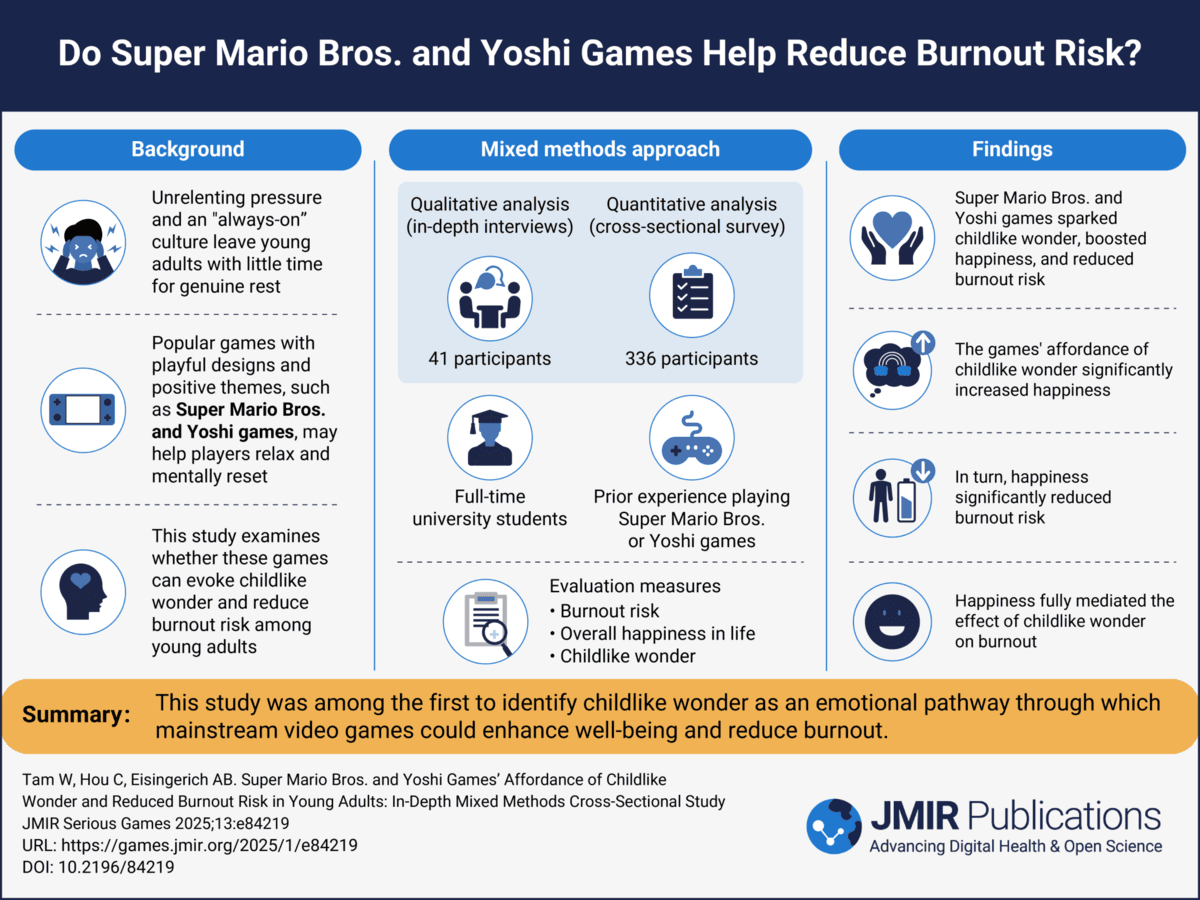
The study, published in JMIR Serious Games, used a mixed-methods approach combining interviews with a large student survey. Researchers examined 41 in-depth interviews and surveyed 336 university students who played Super Mario Bros. and Yoshi games. Lead researcher Andreas Eisingerich and his team wanted to understand whether popular video games could do more than temporarily distract from life’s pressures.
What Burnout Takes Away and Why Wonder Matters
Young adults today face a perfect storm of stressors: soaring housing costs, crushing student debt, hypercompetitive job markets, and an “always-on” digital culture that makes genuine rest nearly impossible. Many report feeling exhausted and cynical before they’ve even established their careers.
Burnout involves three core elements: emotional exhaustion, detachment or negativity, and reduced sense of accomplishment. The researchers discovered that Super Mario and Yoshi games addressed each component by first restoring something fundamental that burnout steals—the ability to find magic in ordinary moments.
Gameplay awakened a forgotten perspective in participants. After sessions, several noticed details they’d stopped appreciating in their surroundings. A few examples include the way sunlight hit a window, clouds forming shapes, and flowers growing through pavement cracks.
“Super Mario Bros. Wonder is crazy. I love how the clouds are all animated and full of life. I hardly see the sky these days,” one participant explained. “Living in a big city it’s hard to get a sense of nature. We did not evolve over thousands of years to run around like rats underground, squashed in hot and cramped, tight spaces like the subway and compete for the tiniest of spaces. Super Mario Bros. Wonder is like a breath of fresh air with trees, clouds, water and fun everywhere. It makes me feel I am part of nature and nature is part of me. I miss that feeling. When I play Super Mario Wonder it is as if I’m a kid again.”
Inside the Study: What Researchers Found
The research team conducted interviews lasting 25 to 40 minutes with students during summer 2025, then surveyed a larger group to measure relationships between childlike wonder, happiness, and burnout risk.
The survey data confirmed what participants described in interviews. Games fostering childlike wonder significantly increased overall happiness in life. That happiness, in turn, substantially reduced burnout risk. The data showed that happiness fully explained the statistical link between wonder and burnout risk—the games appeared to reduce burnout risk indirectly, by first boosting happiness.
What makes these games particularly effective at restoring wonder? The researchers identified specific design elements. Super Mario and Yoshi games feature impossibly bright colors, cheerful soundtracks, and worlds operating on delightful nonsense logic. Mushrooms make you big, flowers shoot fire, turtles are cute enemies, clouds have eyes.
Unlike high-stress competitive games or survival horror titles, these platformers involve bursts of focused action followed by brief moments of lower tension. The games reward curiosity over perfection. Hidden blocks contain surprises. Secret paths lead to discoveries. Failure isn’t harshly punished—you simply try again, learning as you go.
“I kept jumping and falling. Jumping and falling all the time. Finally I made the jump and I was over the moon. What a feeling of happiness,” one participant recalled.
How Mario and Yoshi Games Spark Childlike Joy
Yoshi games proved particularly effective at creating a sense of safety and warmth. Games like Yoshi’s Crafted World use a handmade aesthetic where everything appears made from yarn, cardboard, and craft supplies. This evokes nostalgia for childhood arts and crafts while creating a nonthreatening, playful atmosphere.
One participant explained: “Yoshi games help me see the world and my life with softness, playfulness and wonder. The fact that it allows me to appreciate the magic in something as simple and joyful as Super Mario is what brings me joy. Never underestimate the power of play.”
Super Mario games offered similar benefits through their iconic design. The satisfying sounds—the “boing” of a jump, the “ching” of a coin—triggered simple pleasure. The upbeat music created an optimistic baseline that made cynicism difficult to maintain.
“Haha, the moment I switch on and the game starts with the iconic Super Mario tune in my head I sense a moment of relief and I am playing the game as I used to when I was a child. Probably that was the happiest time of my life when I was a child. Super Mario gives me a chance to appreciate the world and everything again with the eyes of a child that is not jaded, not tired but full of energy, full of enthusiasm, interest, and marveling at what surrounds us and what each new day may bring,” another participant said.
Why the Effects Extend Beyond the Screen
Participants reported that this shift in perspective often carried over into daily life. The wonder didn’t stay contained within gameplay sessions.
“A while ago I did have the strangest of feelings. I was sitting on my sofa and played Super Mario when I looked outside the window and spotted the moon shining. I haven’t seen the moon for ages. I mean ages. And there it was shining and smiling at me. At least I felt it was smiling at me. I even discovered a few stars,” one student said. “Super Mario is a magical treat for the soul.”
Another participant described how the games changed their approach: “Keep collecting those coins of joy. Power-up with little moments of happiness and never stop looking for hidden blocks. That’s what Super Mario taught me more than anything.”
The researchers emphasized that benefits depend on moderate, voluntary play primarily for enjoyment. Compulsive gameplay or using games solely to avoid addressing real problems could prove counterproductive.

What This Research Can and Can’t Tell Us
The study offers a fresh perspective on how popular entertainment might support mental wellness. Previous research has shown video games can provide relaxation and stress relief, but this work identifies a specific pathway: restoring childlike wonder as protection against burnout risk.
Burnout doesn’t just cause exhaustion—it fundamentally changes how people see the world, replacing curiosity with cynicism and wonder with weariness. The research suggests carefully designed games can help reverse that shift.
The researchers noted important limitations. The study examined self-reported burnout risk rather than diagnosed burnout, and all participants were university students. Future research needs to explore whether similar benefits extend to other age groups. The team also didn’t compare these specific games to other types, so whether Mario and Yoshi are uniquely effective remains unclear.
Games also can’t replace solutions to burnout’s root causes, like excessive workloads or organizational dysfunction. They complement rather than substitute for professional mental health support or workplace changes.
“Burnout may be the shadow of deep care. If you feel its weight. Breathe. Remember you don’t need to carry the wonder. You are the wonder. Mario is our fellow traveler in this journey,” one participant reflected. “Super Mario games allow me to see the magic in small things. It’s a true gift to feel life has still something in store and not being tired of it all.”
For young adults drowning in pressures that feel relentless, a 30-minute session jumping through whimsical worlds might offers permission to see life through wonder-filled eyes again. Those moments, the research suggests, can accumulate into genuine protection against burnout risk.
Paper Notes
Limitations
The study examined self-reported burnout risk rather than clinically diagnosed burnout among participants. All participants were full-time university students, which limits generalizability to other age groups and life circumstances. The research used a cross-sectional design, so causation cannot be definitively established. The team did not compare Super Mario and Yoshi games to other video game types to determine whether these specific games are uniquely effective. Additionally, qualitative saturation may not have been fully achieved in interviews, as new insights continued to emerge.
Funding and Disclosures
No external financial support or grants were received from any public, commercial, or nonprofit entities for this research. The authors declared no conflicts of interest.
Publication Details
Tam W, Hou C, Eisingerich AB. Super Mario Bros. and Yoshi Games’ Affordance of Childlike Wonder and Reduced Burnout Risk in Young Adults: In-Depth Mixed Methods Cross-Sectional Study. JMIR Serious Games. 2025;13:e84219. DOI: 10.2196/84219. Authors are affiliated with Imperial College Business School, Imperial College London (Tam, Eisingerich) and Faculty of Commerce, Kyushu Sangyo University, Japan (Hou).


