
(Photo by Unsplash+ in collaboration with Sandra Seitamaa)
SAN DIEGO — If you’ve ever wished your dog could tell you exactly what they want instead of barking at the door, science has good news. A study analyzing how dogs use the app “FluentPet” reveals that dogs can learn to “talk” using soundboards — and they’re doing it with remarkable intentionality.
The research represents the first scientific study to analyze how dogs use communication soundboards. Conducted by scientists from the University of California San Diego’s Comparative Cognition Lab and Johns Hopkins University, the team analyzed data from 152 pet dogs who used the communication devices in their homes.
These soundboards, which have gained significant popularity on social media, consist of buttons that play pre-recorded human words or phrases when pressed. The scope of the study was impressive: researchers examined over 260,000 button presses over 21 months, with 195,000 of those presses made by the dogs themselves.
“This is the first scientific study to analyze how dogs actually use soundboards,” explains Federico Rossano, associate professor of cognitive science at UC San Diego and director of the Comparative Cognition Lab, in a statement. “The findings reveal that dogs are pressing buttons purposefully to express their desires and needs, not just imitating their owners. When dogs combine two buttons, these sequences are not random but instead seem to reflect specific requests.”
To understand how these soundboards work in practice, consider a dog who needs to go outside to relieve itself. Rather than simply barking or scratching at the door – traditional ways dogs communicate their needs – dogs using soundboards can press specific buttons to convey their precise intentions. The study found that combinations like “outside” + “potty” or “food” + “water” occurred more frequently than random chance would predict, suggesting purposeful communication.
The research team collected this data through the FluentPet mobile app, where owners logged their dogs’ button presses in real time. To ensure quality data, they focused on dogs who had made at least 200 recorded interactions. Using advanced statistical methods and computer simulations, the researchers could determine whether button combinations were random, imitative, or truly intentional.
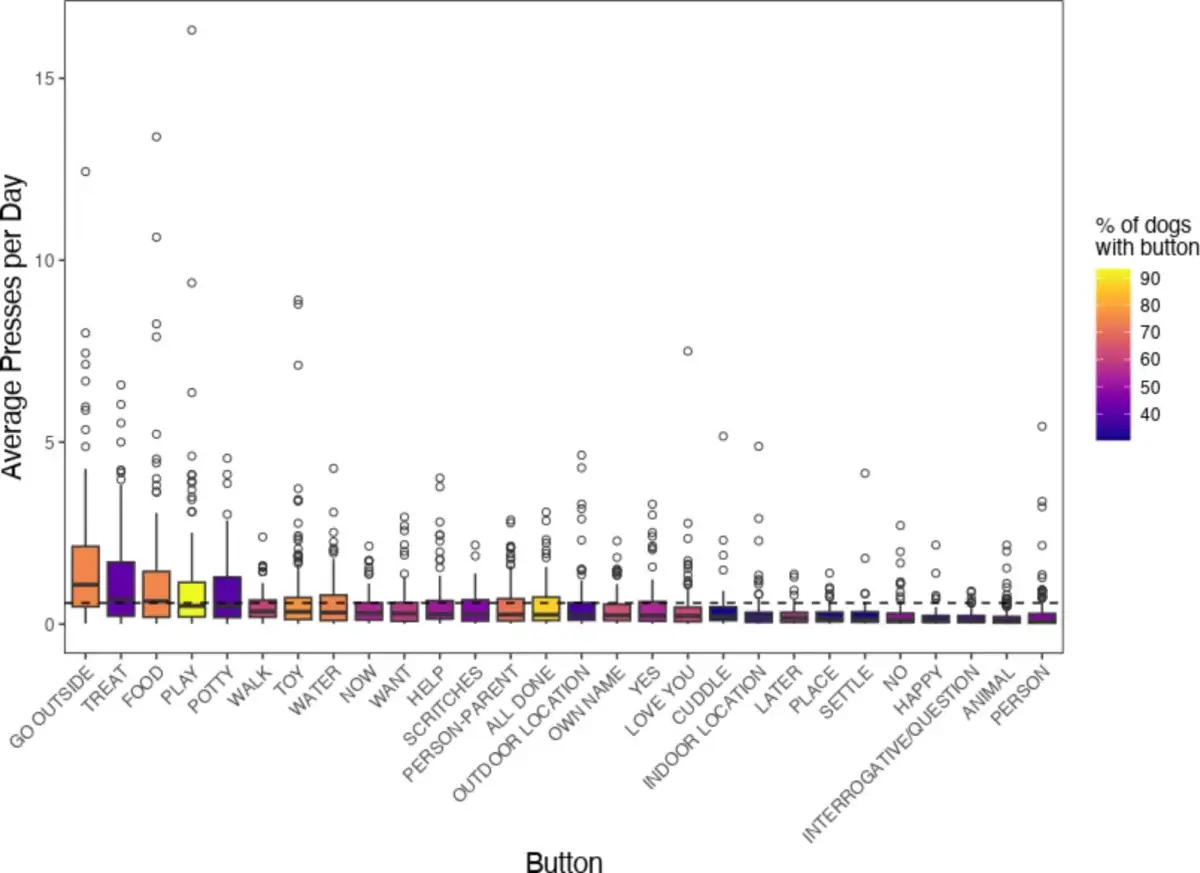
One particularly fascinating finding emerged when researchers compared dogs’ button choices to those of their owners. The analysis revealed that dogs weren’t simply copying their humans’ patterns. For instance, while humans frequently pressed the “I love you” button, dogs used it far less often, suggesting they were making their own distinct choices about which buttons to press.
The most commonly used buttons related to essential needs and desires, with words such as “outside,” “treat,” “play,” and “potty” topping the list. Of the nearly 195,000 recorded dog button presses, about 29% were combinations of multiple buttons, indicating that dogs weren’t just making simple, one-word requests but potentially attempting more complex communications.
What makes this study particularly compelling is that these patterns emerged despite each dog’s soundboard being unique in terms of button placement and available words. This suggests that dogs were truly learning to associate specific buttons with their desired outcomes, rather than just pressing whatever was convenient.
The research, published in Scientific Reports, revealed considerable variation between individual dogs, much like how humans display different levels of verbal expressiveness. Some showed more random patterns in their button pressing, while others displayed highly consistent combinations that suggested a deeper understanding of the communication system.
Looking ahead, the research team has even more ambitious goals. “We want to know if dogs can use these soundboards to express ideas beyond their immediate needs, like absent objects, past experiences, or future events,” Rossano explains. “If they can, it would drastically change how we think about animal intelligence and communication.”
From basic commands to button combinations, dogs continue to push the boundaries of interspecies communication. The question is no longer whether dogs can learn to “talk” to us, but rather: what will they tell us when we give them the right tools to speak?
Paper Summary
Methodology Explained
The researchers collected data through a mobile application where dog owners reported button presses made by both their dogs and themselves. Owners were asked to report all presses, whether watching live or reviewing recorded videos. The data was organized into broad concept categories (for example, “kibble,” “dinner,” and “food” were all grouped under “FOOD”). The team then used sophisticated statistical models to analyze the patterns of button presses, looking at both individual buttons and two-button combinations.
Results Breakdown
The study found three key results: First, dogs’ button presses weren’t random – they showed consistent patterns that differed from what you’d expect by chance. Second, certain two-button combinations appeared more frequently than others across different households. Third, there was only a minimal correlation between which buttons dogs pressed and which ones their owners used, suggesting dogs weren’t simply copying their humans.
Limitations
The study relied on owner-reported data, which could introduce bias – owners might be more likely to report “interesting” button presses than mundane ones. Additionally, the study only included dogs with significant soundboard experience (200+ interactions), so the results might not represent all dogs’ potential ability to use these devices. The research also couldn’t definitively determine whether dogs understood the meanings of the words they were triggering.
Discussion and Takeaways
The research suggests that dogs can use soundboards deliberately and shows that their button pressing isn’t just random or imitative. This opens up new questions about canine cognitive abilities and the potential for human-animal communication. Future research will need to investigate whether dogs truly understand the meanings of the buttons they press and whether they’re using them with communicative intent.
Funding and Disclosures
The research was supported by the Johns Hopkins Provost’s Postdoctoral Fellowship Program. Two of the authors previously consulted for CleverPet, Inc., a company that produces these communication devices for pets, and one author currently works there. The data was obtained through a data sharing agreement between CleverPet, UCSD, and the researchers.
This article contains affiliate marketing links in which StudyFinds earns a commission if a purchase is made.


Youre way behind the curve on this one. Youtube has many videos of cats using sound buttons to communicate, especially Chronicles of Todd. Todd’s owner has been very active in teaching Todd to talk…and is up the 5 word sentences.