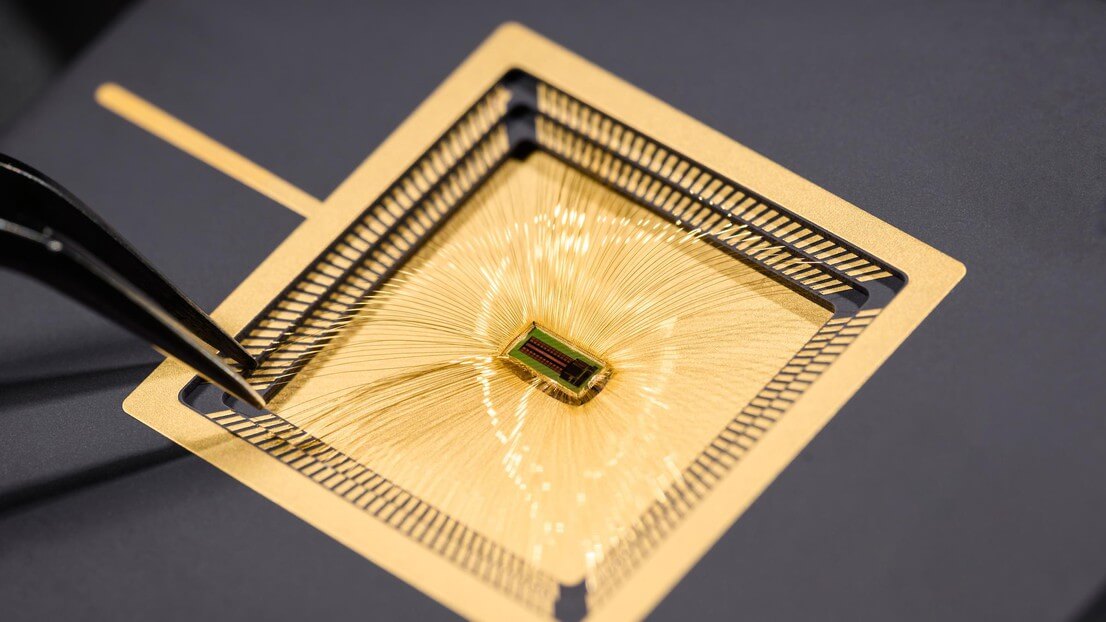
Researchers from EPFL have developed a next-generation miniaturized brain-machine interface - 2024 EPFL / Lundi13 - CC-BY-SA 4.0
LAUSANNE, Switzerland — Researchers have created a miniature brain-computer interface that can transform thoughts into text with astonishing accuracy. This tiny marvel, no larger than a postage stamp, could revolutionize communication for people with severe paralysis, offering them a way to express themselves at speeds approaching normal conversation.
The device, dubbed MiBMI (Miniaturized Brain-Machine Interface), was developed by an international team of scientists led by researchers at the École Polytechnique Fédérale de Lausanne (EPFL) in Switzerland. Their work, recently presented at the 2024 IEEE International Solid-State Circuits Conference, represents a significant leap forward in the field of brain-computer interfaces. The paper is also published in the IEEE Journal of Solid-State Circuits.
At its core, the MiBMI is a sophisticated electronic chip that can interpret brain signals associated with imagined handwriting. When a person thinks about writing a letter, their brain generates specific patterns of neural activity. The MiBMI captures these signals, processes them, and translates them into text on a screen – all in real-time.
What sets this device apart from previous brain-computer interfaces is its remarkable combination of size, power efficiency, and accuracy. Despite being small enough to fit on your fingertip, the MiBMI can process signals from up to 512 channels of neural data simultaneously. This high channel count allows it to capture a rich, detailed picture of brain activity, leading to more accurate decoding of intended movements.
“MiBMI allows us to convert intricate neural activity into readable text with high accuracy and low power consumption. This advancement brings us closer to practical, implantable solutions that can significantly enhance communication abilities for individuals with severe motor impairments,” says Mahsa Shoaran, who leads the Integrated Neurotechnologies Laboratory at EPFL, in a statement.
The chip’s prowess was demonstrated in a series of tests using data from a person with tetraplegia – complete paralysis of all four limbs. The participant imagined writing letters of the alphabet, and the MiBMI interpreted these thoughts with an average accuracy of 90.8%. That means for every 10 letters the person thought about writing, the device correctly identified nine of them.
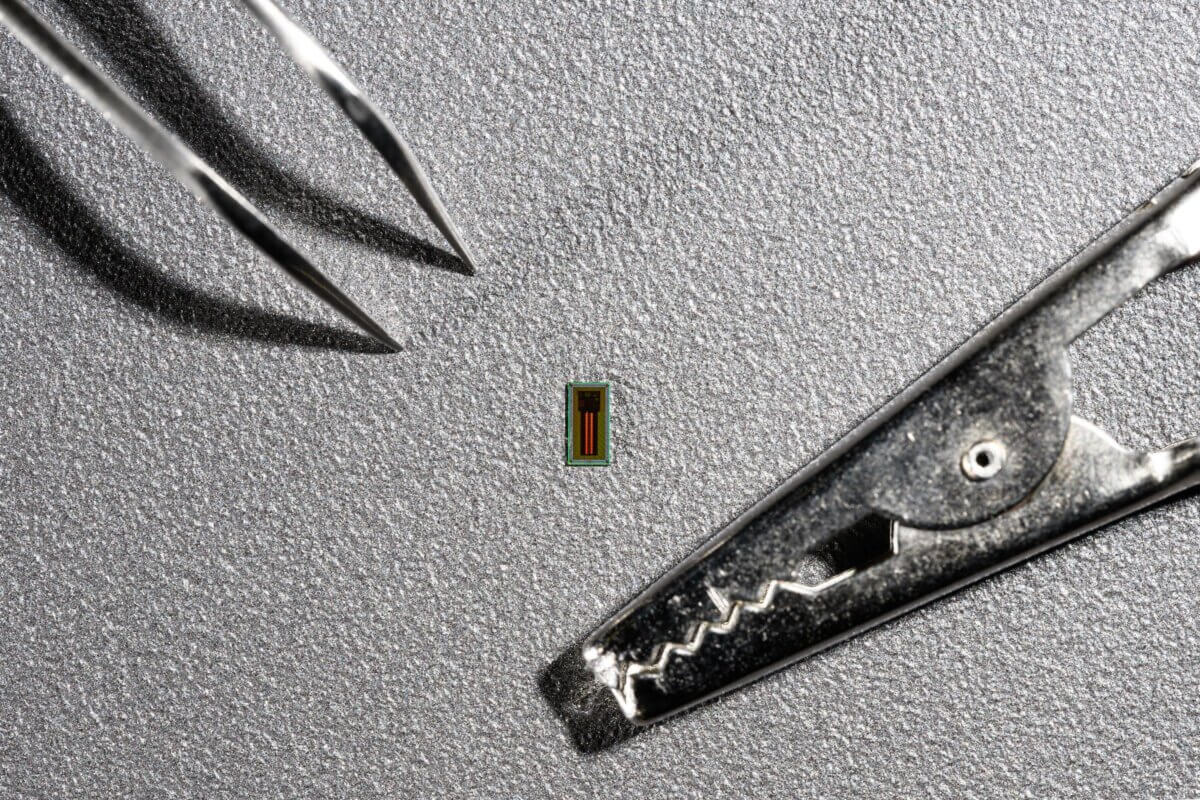
The MiBMI’s capabilities don’t stop at the alphabet. The chip can distinguish between 31 different classes of symbols, including all 26 letters, punctuation marks, and commands like “space” and “backspace.” This wide range of options allows for more natural and fluid communication.
“We are confident that we can decode up to 100 characters, but a handwriting dataset with more characters is not yet available,” says lead author Mohammed Ali Shaeri.
One of the most impressive aspects of the MiBMI is its efficiency. Traditional brain-computer interfaces often rely on complex algorithms that require significant computing power, making them bulky and energy-hungry. In contrast, the MiBMI uses a novel approach called “distinctive neural codes” (DNCs) to interpret brain signals. This method allows the chip to achieve high accuracy while consuming minimal power – about 223 microwatts on average, less than a typical LED.
The secret sauce behind the MiBMI’s efficiency is its ability to focus on the most relevant neural signals. Rather than processing all incoming data constantly, the chip has an “activity-driven” design. It springs into action when it detects a surge in neural activity associated with an attempted movement and goes into a low-power mode during periods of inactivity. This adaptive approach not only saves energy but also helps filter out background noise in the brain signals, leading to cleaner, more accurate decoding.
To put the MiBMI’s capabilities in perspective, consider this: with its current performance, a person using this device could potentially “type” their thoughts at a rate of about 90 characters per minute. While this isn’t quite as fast as average spoken communication, it’s a dramatic improvement over existing assistive communication devices for people with severe paralysis, which often allow only a few words per minute.
The implications of this technology are profound. For individuals who have lost the ability to speak or move due to conditions like amyotrophic lateral sclerosis (ALS), stroke, or spinal cord injury, the MiBMI could offer a new lease on expressive life. Imagine being able to compose emails, participate in text conversations, or even write books, all through the power of thought alone.
Moreover, the compact size and low power consumption of the MiBMI bring us closer to the goal of fully implantable brain-computer interfaces. Current systems often require bulky external equipment, limiting their practicality for everyday use. A device like the MiBMI could potentially be implanted entirely within the skull, powered by a small battery, and wirelessly transmit its output to external devices.
While the current version of the MiBMI is focused on decoding imagined handwriting, the researchers believe their approach could be adapted to other types of intended movements or even speech. This versatility suggests a future where brain-computer interfaces might restore various forms of communication and motor control to those who have lost them.
Of course, as with any emerging technology, there are still hurdles to overcome before the MiBMI can move from the lab to clinical use. The chip needs to be tested in live, long-term implantation scenarios to ensure its stability and safety. Researchers also need to refine the system to handle the variability in brain signals that occur over time and across different individuals.
Despite these challenges, the MiBMI represents a significant step forward in the field of neural interfaces. It demonstrates that it’s possible to create a brain-computer interface that is both highly capable and practically sized for real-world use.
“We are collaborating with other research groups to test the system in different contexts, such as speech decoding and movement control. Our goal is to develop a versatile BMI that can be tailored to various neurological disorders, providing a broader range of solutions for patients,” says Shoaran.
Paper Summary
Methodology
The researchers developed a two-chip system: one for recording brain activity (the analog front-end or AFE) and another for decoding this activity into text (the neural decoder). The AFE chip can record from up to 192 electrodes implanted in the brain, capturing both high-frequency “spikes” from individual neurons and lower-frequency “local field potentials” that represent the activity of larger groups of neurons. The decoder chip receives this data and processes it using a novel algorithm based on “distinctive neural codes” (DNCs).
These DNCs are specific patterns of neural activity that are highly informative for distinguishing between different intended movements. The chip identifies these patterns and uses them to classify the intended letter or symbol using a method called linear discriminant analysis (LDA). The system was tested using a dataset from a previous study, which included 10.7 hours of neural recordings from a person with tetraplegia attempting to write letters by imagining the hand movements.
Key Results
The MiBMI achieved an average decoding accuracy of 90.8% when tested on 620 seconds of data (310 trials) from the handwriting task. Over the full 10.7-hour dataset, the average accuracy was 91.3%, which is comparable to the 94.1% accuracy achieved by more complex software-based methods. The chip consumed only 223 microwatts of power on average, making it highly energy-efficient.
The researchers also tested the system on data from a rat experiment involving acoustic stimuli, where it achieved 87% accuracy in identifying 6 different frequency bands. The analog front-end chip demonstrated low noise levels, making it suitable for high-quality neural recordings.
Study Limitations
The chip was tested on pre-recorded data, not in a live, implanted scenario. The long-term stability and biocompatibility of such an implant still need to be evaluated. The current system is optimized for decoding imagined handwriting, and its performance on other types of intended movements or across different individuals is unknown.
The accuracy, while high, is not perfect, which could lead to frustration or errors in real-world use. Finally, the ethical implications of direct brain-computer interfaces need careful consideration as this technology advances.
Discussion & Takeaways
The MiBMI represents a significant advance in brain-computer interface technology, demonstrating that high-performance neural decoding can be achieved with a small, low-power chip. This brings us closer to the goal of clinically viable, fully implantable brain-computer interfaces for restoring communication in paralyzed individuals.
The use of DNCs and activity-driven processing offers a novel approach to efficient neural decoding, which could be applied to other types of brain-computer interfaces. The high channel count and broadband recording capabilities of the AFE chip also make it a valuable tool for neuroscience research. As this technology develops, it could potentially expand beyond communication to restore other functions lost due to paralysis or neurological disorders.
Funding & Disclosures
The paper does not explicitly state the funding sources for this specific project. However, it mentions that the research was conducted at EPFL, the Neuro-X Institute in Geneva, Cornell University, and the University of Fribourg. No conflicts of interest were disclosed in the paper.


