(© sheilaf2002 - stock.adobe.com)
In A Nutshell
- Nearly 90,000 nurses tracked for 18 years showed neighborhoods with more visible trees had 4% lower cardiovascular disease rates, while areas with more grass had 6% higher rates
- Street-view AI analysis of 350 million photos revealed what satellites miss: not all green space affects heart health the same way
- Trees may cool neighborhoods, filter pollution, and encourage walking, while grass-dominated areas often signal car-dependent sprawl
- The takeaway for cities: prioritizing tree canopy over turfgrass could deliver meaningful public health benefits
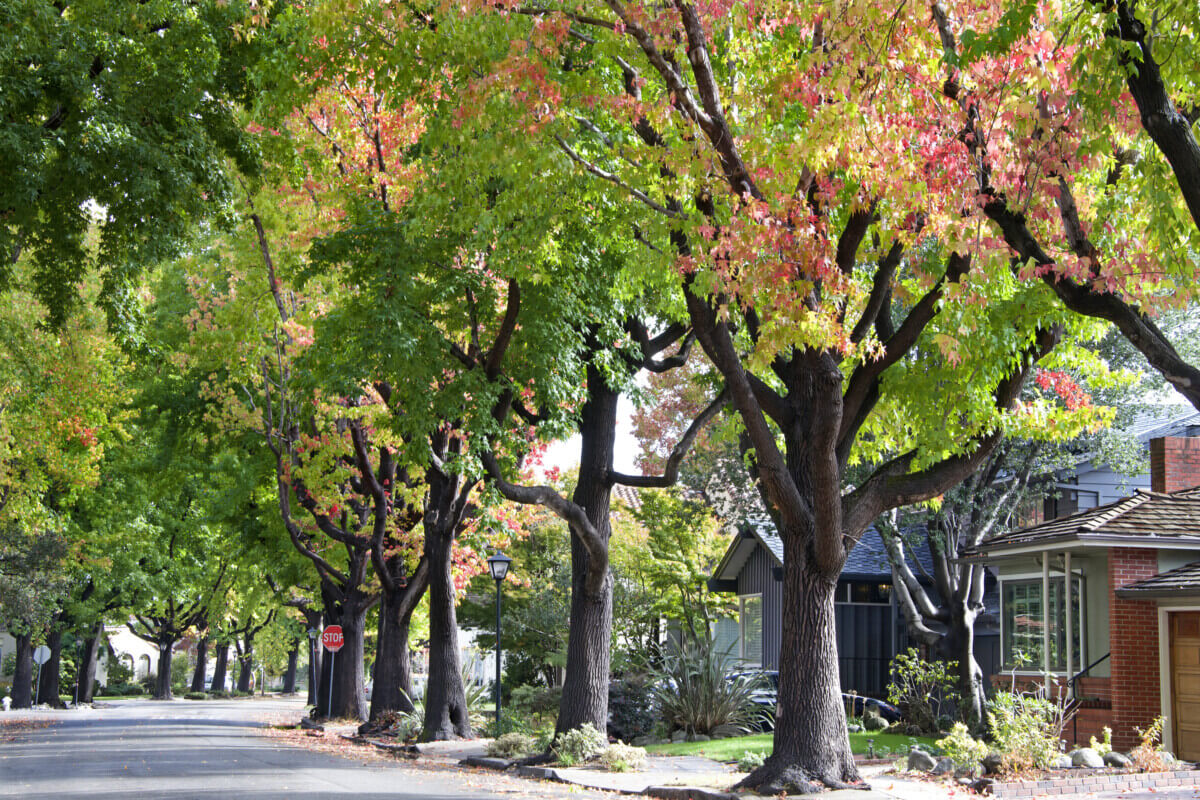
Is the street you live on lined with leafy trees, or mostly grass and pavement? That simple difference might be affecting your heart in ways scientists are just beginning to understand.
A study tracking nearly 90,000 nurses across America for 18 years found neighborhoods with more visible trees showed about 4% lower rates of heart attack and stroke, while areas with more grass showed about 6% higher rates. These are relative differences comparing neighborhoods with varying amounts of visible vegetation, not guaranteed changes for any one person. After analyzing 350 million street-view photographs using artificial intelligence, researchers discovered that not all green space appears equal for cardiovascular health.
For decades, public health experts have urged people to get outside and enjoy nature. Parks, gardens, open spaces: it all seemed equally beneficial. But this research reveals something more complicated. From high above, a satellite can’t tell the difference between a tree-shaded avenue and a grass-covered suburb. Both look green. Yet for your cardiovascular system, the distinction matters.
How Scientists Measured Trees and Cardiovascular Disease Risk
Researchers used Google Street View images from across the country, training computers to identify exactly what appeared in each photo: trees, grass, shrubs, and other plants. They created detailed maps showing what someone would actually see walking through urban and suburban areas nationwide.
Then they matched those maps to health records from the Nurses’ Health Study, which has been following female nurses since 1976. The 88,788 women in this analysis lived everywhere from dense cities to rural towns. Every two years, they reported any heart attacks or strokes, which researchers verified through medical records. Over 18 years, doctors confirmed 6,065 cardiovascular events.
Even after accounting for smoking, diet, exercise, income, education, and air pollution levels, the pattern held. Trees seemed to protect hearts. Grass didn’t.

Why the Association Might Exist
Researchers suggest several reasons why trees and grass might show different associations with heart health, though the study didn’t directly prove these pathways.
Trees may offer protective mechanisms that grass cannot. Their leaves trap pollution particles that would otherwise enter lungs. A mature tree canopy cools a neighborhood far more effectively than a lawn. That’s critical during heat waves that stress the cardiovascular system. Thick branches muffle traffic noise, and prior research has linked chronic noise exposure to higher blood pressure and heart disease risk. Tree-lined streets also tend to encourage more walking and social interaction, and shaded sidewalks feel more inviting than exposed concrete.
Grass offers few of these potential benefits. Regular mowing creates noise and air pollution. Grass provides minimal cooling on hot days and does little to filter pollutants from the air. Open, sun-baked stretches of grass don’t exactly invite leisurely strolls.
Importantly, the study’s authors note that grass might also signal something else about a neighborhood rather than directly causing harm. Areas dominated by lawns but lacking trees often have sprawling, car-dependent layouts where people drive everywhere instead of walking. The analysis couldn’t fully separate grass itself from these neighborhood design patterns, meaning the observed associations could reflect these broader environmental differences.
The findings held across wildly different settings: crowded cities and quiet suburbs, polluted areas and clean ones, wealthy neighborhoods and modest ones, North and South, East and West. Whatever’s going on, it’s not limited to one type of community.
The Distance That Matters
The protective effect showed up most clearly within the 500-meter neighborhood buffer researchers used as their main measure, about one-third of a mile from someone’s home. Right outside your front door matters less than you might think. When researchers looked only at the immediate 100 meters, the associations mostly disappeared. But expand to the neighborhood level, and the pattern emerged strongly.
That’s actually good news for urban planning. You don’t need every single yard packed with trees. What matters is creating tree-covered neighborhoods where canopy extends over streets and sidewalks, cooling and cleaning the air across a wider area. One homeowner planting a tree helps a little. A community planting hundreds helps a lot.
What This Means for Your Neighborhood
Cities nationwide face tough choices about trees right now. Climate change brings more droughts, diseases, and storms that kill urban forests. New construction often means cutting down mature trees. Tight budgets force parks departments to choose between planting trees or maintaining grass.
This research offers clear guidance: prioritize trees. The findings suggest tree planting may deliver more cardiovascular benefit than investments focused mainly on turfgrass. Protecting existing mature trees during development could be as important as adding new parks.
Dr. Peter James, who led the study at the University of California, Davis, pointed out that scientists have been measuring green space wrong for years. “Aggregating green space into a single exposure category limits epidemiological research and potential interventions to increase health-promoting green space,” his team wrote.
Street-view imagery changes that. Computers can now analyze what people actually see at ground level, distinguishing between a tree canopy overhead and a stretch of grass beside the road. That specificity makes the research far more useful for anyone trying to improve public health through urban design.
What We Still Don’t Know
The study, published in Environmental Epidemiology, followed only female nurses, 93% of them white, which raises questions about whether the same patterns apply to men or more diverse populations. The researchers could track where participants lived but not where they spent their days or whether they actually went outside. Someone living on a tree-lined street who never walks there might not get the same benefits.
The harmful associations with grass might not be directly caused by the grass itself but rather by the kinds of neighborhoods that tend to have lots of grass and few trees. The analysis couldn’t fully separate those overlapping factors.
Interestingly, when researchers included traditional satellite-based greenness measures in their analysis, those showed no association with heart disease once street-level tree and grass measurements were accounted for. This reinforces that what matters isn’t just whether an area looks green from space, but what specific plants people actually see and experience at ground level.
Still, the sheer size and duration of the study makes the findings hard to dismiss. Trees consistently showed a link to healthier hearts. Grass consistently didn’t.
As summers get hotter and cities struggle to stay livable, understanding exactly which plants protect human health becomes critical. This study offers evidence that the tree outside your window might be doing more for your cardiovascular system than anyone realized. And the lawn? Maybe not so much.
Disclaimer: This article describes an observational study that identified associations between street-level green space and cardiovascular disease risk. While the research controls for many factors, observational studies cannot prove causation. The mechanisms discussed represent plausible explanations based on prior research, not conclusions demonstrated by this particular study.
Paper Notes
Study Limitations
The research followed only female nurses, 93% white, limiting how well findings apply to other groups. Street-view images show only what’s visible from roads, missing private yards and gardens. The analysis tracked where participants lived but not where they spent time during the day or how often they went outside. Google Street View became available only in 2007, so researchers applied 2007 data to earlier years. About 11% of images were taken in winter when trees lack leaves. The observed harmful effects of grass might reflect unmeasured neighborhood factors like sprawling development patterns rather than grass itself directly causing harm.
Funding and Disclosures
This research was supported by NIH grants R01 HL150119, R21 ES029722, R00 AG066949, UM1 CA186107, R01 HL034594, R01 HL088521, and P30 ES000002. The authors declared no conflicts of interest. The study protocol received approval from the Institutional Review Boards of Harvard Pilgrim Health Care Institute and Brigham and Women’s Hospital.
Publication Details
Authors: Peter James (University of California, Davis; Harvard T.H. Chan School of Public Health), Esra Suel (University College London; University of Zurich), Pi-I Debby Lin (Harvard Medical School; Harvard Pilgrim Health Care Institute), Jaime E. Hart (Harvard T.H. Chan School of Public Health; Brigham and Women’s Hospital), Eric B. Rimm (Harvard T.H. Chan School of Public Health; Brigham and Women’s Hospital), Francine Laden (Harvard T.H. Chan School of Public Health; Brigham and Women’s Hospital), Perry Hystad (Oregon State University), Steve Hankey (Virginia Polytechnic Institute and State University), Andrew Larkin (Oregon State University), Wenwen Zhang (Rutgers University), Jochem Klompmaker (National Institute for Public Health and the Environment, The Netherlands; Utrecht University), Brent Coull (Harvard T.H. Chan School of Public Health), Li Yi (Harvard Medical School; Harvard Pilgrim Health Care Institute), Marcia Pescador Jimenez (Boston University School of Public Health) | Journal: Environmental Epidemiology | Publication Date: January 20, 2026 | Volume/Issue: Volume 10, Article e442 | DOI: 10.1097/EE9.0000000000000442


