
(Credit: zimmytws/Shutterstock)
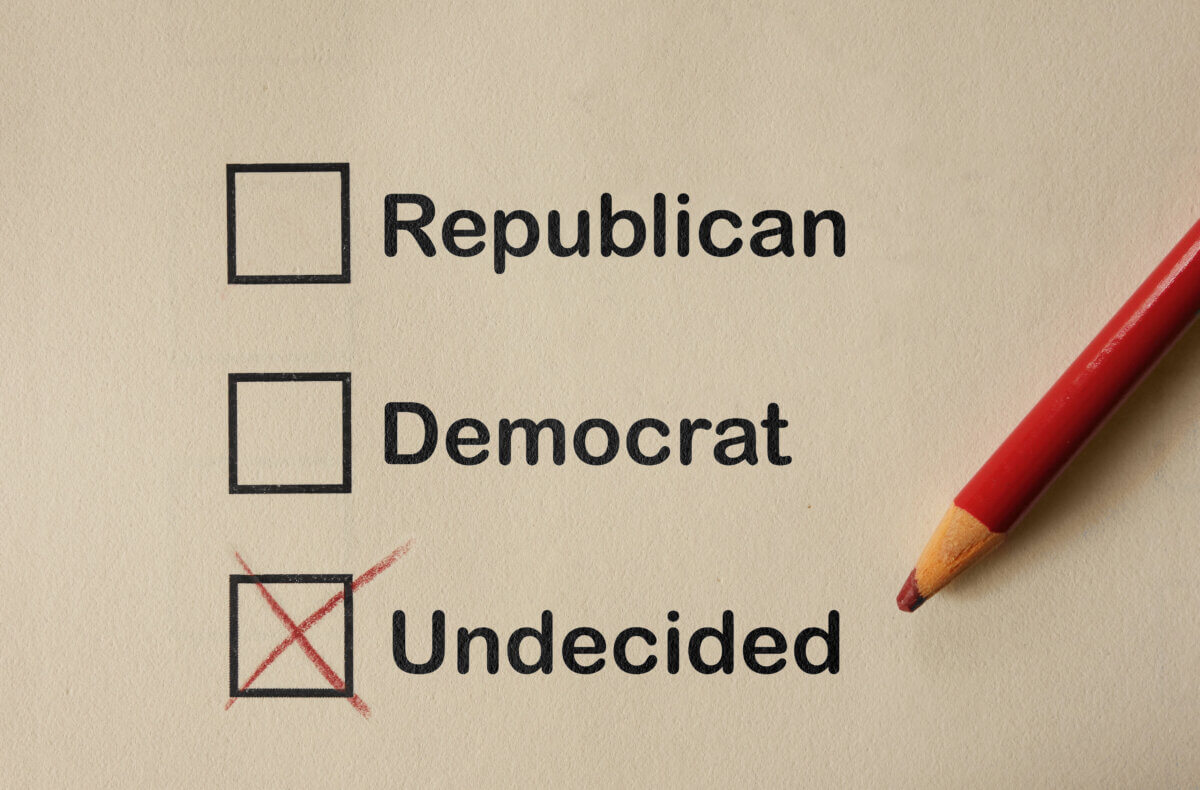
EXETER, United Kingdom — When it comes to political elections, polls are always interested in which way the undecided voters will break. Well, a new study finds that the impact of undecided voters may be seriously overblown. Researchers in the United Kingdom have found that many undecided voters never make up their minds and just sit out the election altogether!
The findings, published in the journal Electoral Studies, reveal that voters who are torn between candidates are significantly less likely to turn out on election day compared to those with a clear preference. The research suggests that as party loyalties weaken and more options emerge, the very competitiveness meant to energize democracy may instead discourage participation. Simply put, the more political candidates people have to choose from, the more likely they are not to vote.
Using data from over 500,000 survey responses, University of Exeter researcher Hannah Bunting found that roughly 40% of British voters are “in competition” – meaning they rate two or more parties similarly in terms of how likely they are to vote for them. These undecided voters were 10 percentage points less likely to say they intended to vote compared to those with a clear party preference.
“Voters are now more indecisive, more likely to switch parties, and generally more volatile and unpredictable in their behavior. My research shows low levels of voting may be related to the more complex choices people have to make, and people becoming more indecisive,” Dr. Bunting says in a media release.
Bunting argues that when faced with multiple appealing options and uncertainty about their preferences, some voters may choose to abstain rather than make a difficult choice. All of this drives down voter turnout, making it a battle between supporters of the major parties.
The findings challenge the conventional wisdom that electoral competitiveness increases turnout. While close races between parties may motivate some voters, individual-level competition between multiple options seems to have the opposite effect.
Interestingly, the study found that how competitive a voter’s local district was had no significant impact on their likelihood of voting. What mattered was their personal indecision, not how close the race was expected to be.
Some factors did make voters less likely to be “in competition.” Those with a strong party identity and those who paid more attention to politics were more likely to have a clear preference.
“This is a positive sign for democracy. Citizens do seem to spend time deliberating between different parties during competitive elections. The expansion and complexity of choice can promote democracy if parties can convince voters to back them before election day,” Dr. Bunting says.
The study also found that older voters and men were also somewhat less likely to be undecided between parties.
The research’s implications are mixed. On one hand, lower turnout among undecided voters could skew election results toward the preferences of more partisan citizens. On the other hand, the fact that so many voters are carefully weighing multiple options suggests a healthy, competitive democracy where citizens thoughtfully consider the platforms on offer.
Bunting suggests that efforts to boost turnout should focus on helping voters develop stronger party identities and encouraging greater attention to politics. By giving citizens the tools to make more confident choices, campaigns may be able to convert more undecided voters into active participants.
“All of this means people are more likely to abstain from voting. It creates a greater cognitive burden for citizens and this complexity feeds indecision which increases the likelihood of making no choice at all. A high number of undecided citizens may thus result in low turnout rates,” the study author concludes.
Paper Summary
Methodology
The study used data from the British Election Study Internet Panel, which surveyed UK voters between 2014 and 2023. Bunting created a measure of individual electoral competitiveness based on how similarly respondents rated different parties on a 0-10 scale of likelihood to vote for them. Those rating multiple parties within 2 points of each other were considered “in competition.” This measure was then used in statistical models to predict voting intention and party switching while controlling for factors like age, education, and local district competitiveness.
Key Results
The analysis found that about 40% of respondents were “in competition” between parties. These undecided voters had a 79.2% predicted probability of voting, compared to 89.1% for those with a clear preference – a 10 percentage point difference. Having a party identity and paying more attention to politics both made voters less likely to be in competition and more likely to vote. Constituency-level competitiveness had no significant effect on individual turnout intention.
Study Limitations
The study relied on self-reported voting intention rather than validated turnout data, which can sometimes be overstated in surveys. It also focused on the UK context, so the findings may not generalize to all democratic systems. Additionally, the measure of being “in competition” required somewhat arbitrary cutoffs for what counted as similar party ratings.
Discussion & Takeaways
The research highlights how individual-level indecision, rather than just aggregate electoral competitiveness, can impact turnout. It suggests that as party systems become more fragmented and voters less attached to single parties, participation may suffer. However, the prevalence of undecided voters also indicates citizens are seriously considering multiple options. Efforts to boost turnout may need to focus on helping voters develop clearer preferences rather than just emphasizing close races.
Funding & Disclosures
The author notes that earlier versions of the work were developed during doctoral research supported by the Economic and Social Research Council. No conflicts of interest were declared.


